Showing posts with label Fukushima. Show all posts

2016/03/13

View From The Couch - 13/Mar/2016

Robotics' Horizon of Death

Back in the 1960s and 1970s, there was a kind of fiction to do with robots which pre-dated the fiction to do with androids. It was the kind of fiction that predated notions of 'the uncanny valley' and went straight to positioning robots as heroic. If you think 'Astroboy', then you're certainly there. Instead of an anxiety about a technological Frankenstein, the fiction to do with robots had us thinking of them going into situations where robots would tread where humans fear. The hope was robots could accomplish things human couldn't.

In that light, I bring depressing news with the fifth anniversary of the Fukushima nuclear plant disaster. The radiation leak in Fukushima is so bad it's killing robots sent in to repair it.
Five years after Fukushima, the exclusion zone is in better shape, but still a mess. The area around its once functional nuclear reactors are by far the most inhospitable. So much so that the radiation even managed to kill robots that had been sent in to help clean up.

Five robots that have gone into the reactor in order to help remove spent fuel rods have failed to return, reports Reuters. The issue? The radiation levels are so high that the robot's internals just melt. We've seen this happen before.

Naohiro Masuda, Tepco's head of decommissioning, explained the difficulties the company faces in an interview. Not only do the robots tend to fail do to the failure of their wiring, but it's also not easy to get replacements. These aren't just off-the-shelf bots; they have to be designed specifically for the challenges of the particular building they enter, and that takes about two years of design.
If you go to the link on "we've seen this happen before", you'll see another article showing what one of the earlier robots saw before it went down.


It's a terrible thing that the Fukushima plants still in the state that it is, but moreover it is terrible that the limits of robotics got shown in the high radiation environment.

When You're This Bad At Remembering Things

The Hillary Clinton campaign is slightly gaffe prone. Earlier in the week she praised Nancy Reagan for raising AIDS awareness - which was not the way I remember the 1980s and the AIDS crisis. By 1983, everybody on the planet was freaking about AIDS except the White House.
“It may be hard for your viewers to remember how difficult it was for people to talk about HIV/AIDS back in the 1980s,” Mrs. Clinton, who was attending Mrs. Reagan’s funeral in Simi Valley, California, told MSNBC.

“And because of both President and Mrs. Reagan — in particular, Mrs. Reagan — we started a national conversation, when before nobody would talk about it. Nobody wanted anything to do with it,” she said. 
The former Secretary of State said she appreciated Mrs. Reagan’s “low-key advocacy” on HIV/AIDS, saying “it penetrated the public conscience, and people began to say, ‘Hey, we have to do something about this.’ “ 
Her comments prompted major backlash online, where gay men and LGBT groups were quick to point out that the Reagans kept quiet on the AIDS crisis for most of their administration, despite desperate pleas for help and thousands of deaths.
The Centers for Disease Control and Prevention first identified the disease in 1981, but former President Ronald Reagan did not publicly acknowledge the disease until 1985 and he didn’t give a speech about the crisis until 1987.
Just about anybody with a memory could remember this turn of events. So of course this ended up with Hillary Clinton offering an apology.
“While the Reagans were strong advocates for stem cell research and finding a cure for Alzheimer’s disease, I misspoke about their record on HIV and AIDS,” she said in a statement about two hours after her interview had been shown on MSNBC. “For that, I’m sorry.”
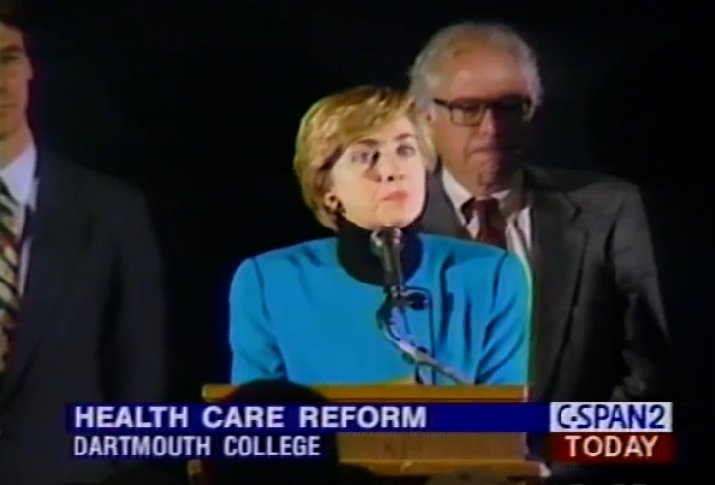
The worse gaffe this week was her claim that she didn't know where Bernie Sanders was back in '93 and '94 when she tried to put a Health Care plan through.


A picture speaks a thousand words. Surely she would have remembered the Senator helping her with her bill. Which leads me to wonder just what in the world is going on inside the Clinton campaign office.


2016/02/02

Junichiro Koizumi Goes For Zero Nuclear

The Interview Is Out On Bungei Shunjuu

The most riveting read for me in the last 24hours was the interview with former Prime Minister Junichiro Koizumi and his current anti-nuclear power station stance. I was vaguely aware that he had started talking aloud against nuclear power after his time in political office. The most significant Japanese Prime Minister this century was in office for five and a half years and did nothing about nuclear power. All of a sudden he's become a vocal critic of the entire nuclear industry in Japan, so much so it has become his single issue.

Amazingly, he is retracting everything he ever said in favour of the nuclear industry in plain language. He says all the claims made by the nuclear industry in favour of nuclear power are lies. It is not cheap, it is not safe, and it is not sustainable. He goes through it in great detail as to why all those claims are lies, and forcefully makes the point that the electrical companies, the nuclear industry and the unions for the electrical companies, and therefore the politicians who receive political donations are too close to see it.

Mr. Koizumi says it is possible for Japan to completely abandon nuclear power. It can be done, it should be done, and all it would take would be for a Prime Minister to decide it is his cause. After Fukushima, Japan in fact did it without any nuclear power for four and a half years before they started up one of the plants. Germany by contrast has declared it is down to zero, but is still using eight nuclear plants as they wind them down.

When asked about his historic involvement with nuclear power back to the 1970s, he says he deeply regrets believing what the industry representatives presented to government. He was given genuine assurances from all the presenters dating back to the 1970s that it would be "cheap, safe and clean" - a claim he says is so deceitfully wrong, he simply has to speak up now. It's frustrating to read that because I remember those discussions in the 1970s when I was still a kid, and thinking how in the name of all that is good can these politicians believe nuclear power is safe after Three Mile Island?  Reading the change in position by Mr. Koizumi today is devastating because it was known back in the late 1970s that nuclear power was not cheap, safe or clean. Really, I was a kid and I knew it.

I guess it's a case of better late than never. It's truly frustrating.
There is a generation of people in Japan that became apolitical and stayed apolitical in the late 70s through to the moment of Fukushima. As if a great political and scientific amnesia covered Japan, and they simply forgot the risks until it all went pear-shaped. The stupid thing is that had they thought about it before, they would have known the risks that emerge out of catastrophic failure are catastrophe itself. Even Mr. Koizumi and his LDP cohorts must have known on some level back in the 1970s.

In his rationalisation, Mr. Koizumi offers the context of the oil shock of the 1970s as giving great impetus to move nuclear energy as quickly as possible. While it is true that nuclear power freed Japan from dependence on oil, it put it right on course for Fukushima. Even so, you sort of wonder why these heads could not balance up the risks against those benefits. It's humiliating to read Mr. Koizumi wants 100% renewables in Japan, and that he is arguing his case to the LDP hard. In many ways, it's too fucking late. I appreciate he saw the light, but he could have done it as Prime Minister, had he known back then; and he could have known back then. It's not like the information to do with the risks were hidden out of sight.

It's an amazing interview. I believe he's seen the light. It's still much too late.

Still Living In The Shadow Of Kakuei Tanaka's World

The LDP rule in Japan between 1955 and 1993 had many strange effects. One of them was how government bureaucrats stopped distinguishing between government business and LDP party politics. This was because they were in power so long, and so dominantly that there simply was no point in talking to the opposition parties. This has led to some strange outcomes in Japanese politics, namely, when the opposition has managed to claw its way into power, the bureaucrats have been hostile to the Socialists or the Democrats that formed government from the merger of opposition parties. This has meant factional politics of the LDP were much more important than the actual business of the Japanese Diet.

The leading kingpin of the kind of factional politics led by graft and bribery was Kakuei Tanaka, who essentially railroaded the nuclear industry into Japan. He did so because the nuclear industry has ancillary costs, all of which could be diverted to constituents. By building expensive nuclear power plants, and paying off the local residents to host these plants in their neighbourhoods, the LDP were able to retain the rural votes. If you add in all the favours and tenders that involved bribes, too many people benefited to question the risks.

The other problem of factional politics is that the people in safe seats wielded far more power than politicians in marginal seats. Kakuei Tanaka made sure he bribed the politicians in marginal seats regardless of party affiliation, so that he could wield extra-party influence. When you combine all this together, you have a structure where the politicians in marginal seats and the bureaucrats of particular ministries with rural offices become intimately entwined in an exchange of favours and bribes.

If we are to be fair to Junichiro Koizumi's time as Prime Minister, he used up all his capital in dismantling this structure by privatising out the postal services of Japan. Asking him to dismantle nuclear power plants would have been next to impossible given the priority of privatising the postal services. In the interview, Junichiro Koizumi describes the privatisation as dismantling Kakuei's legacy. It sounds easy, but there were a lot of vested interests that got sent packing. The interesting thing is that it never got explained to the public that was what was happening. It's only after the fact that we can now understand the full meaning of that privatisation.


2012/03/16

Fukushima, One Year On

Aren't They Angry Yet In Japan?

It's been a year since the Greater East Japan Earthquake, the Tsunami and the Nuclear disaster at Fukushima. I thought I would have a better picture of how Japan would recover from the triple punch, but inevitably it is taking time. If one thing is clear, the entire sequence of events exposed how the system was beyond the control of the government executive. Reading of the events that took place in the days after the events, it is clear that incorrect information was presented to the executive branch of the Japanese government, and this delayed and confused the response no end. In other words, it looked like there was a functioning system until it got blown to bits by the sequence of events, and what was left was just totally inadequate.

The most notable of these misinforming of Prime Minster Naoto Kan was the Nuclear Energy Agency of Japan not telling him there had been multiple meltdowns at the Fukushima plant. In fact radioactive Caesium had been found outside of the plant as early as the 13th of March 2011, and the only conclusion that could be drawn from this was that the reactors must have exploded. By the time the Prime Minister got his facts straight - that there had been meltdowns, there were already people in place on the assumption that the meltdowns had not happened.

The institutional resistance of both the bureaucrats and TEPCO executives was also a factor in making things worse. And the irony of all things is that Naoto Kan had made his name fighting such bureaucratic complacency and the kind of injustices that come from these; now that he was Prime Minister, he had no way of dealing with these people who viewed him with an institutionalised suspicion. The vested interests all stuck together - from the bureaucrats to the TEPCO brass to even the media and essentially chased Naoto Kan into resignation through their intransigence. To illustrate just how awful the vested interests were, the media lined up to criticise Kan for yelling at the TEPCO brass who came to tell him they wanted to pull out. It is clear that Prime Minister Kan did the right thing by making TEPCO hold their ground. He might have made many a mistake  in other aspects of dealing with the enormous chaos that ensued the triple-disaster, but he got one decision right.

Indeed, if TEPCO personnel weren't going to stay on, just who was going to go in and shut down the reactors?

For me, it was absolutely logical and de rigeur of a condition of his Prime Ministership that he had to yell at them to make them stay. The media in Japan reported it as Naoto Kan losing decorum and therefore being unfit for his office. It was infuriating.

As I read news-sites from Japan, the overwhelming and prevailing position mounted by the old newspaper bodies is that the current DPJ government in its incompetence has made everything an insurmountable problem. It strikes me that this is self-serving balderdash dished out by a Japanese media that has a relationship that can only be described as being too cozy with the bureaucrats. In my view, the problems that brought about the triple disaster finds itself in the absence of the sense of responsibility,  the further you go up authority structures in Japan. What really depresses me about is that this might actually be something cultural.

The media are trying to characterise the triple disaster as the "second time" of losing a war. That is to say, the collective failure of government and industry and "The System" that parallels the leadership that led Japan to lose World War II. If indeed that is the case, then I would posit that the kind of absentee leadership endemic in Japan got played out in exactly the same way as the way they worked out in World War II. The British used to laugh at the Imperial Japanese Army for their predictable strategems, but they rated the NCOs of Japan very highly for their ability to make tactical decisions stick - Even the bad ones.

In exactly the same manner, the top brass of TEPCO turned out to be predictably incompetent, but the actual people on the ground exhibited incredible courage, endurance and guile to bring the reactors back under control. Old men who had once worked at the site but retired, came out of the woodwork to offer themselves up to the dangerous task. The people on the ground made the best of a bad situation through typical Japanese valor and dedication and self-sacrifice. Sort of like the incredible selflessness of the Kamikaze pilots who gave their lives on the orders of an incompetent command group.

To see this pattern repeated brought nothing but a numbing, glum, dark, disgust.

Maybe because I have a firsthand feel for how things are couched and how things are decided and how things are done in Japan that I can't help but see problems not only with the elites who come from top universities, but the system that decided these ethical midgets, these moral cowards, these mandarins of no personal responsibility were the people to promote.

The worst thing is that these bureaucrats as a block, form a massive vested interest in how the government of Japan works and how it is run. And the only prime minster in the last 50years who had a shot at changing things had to be buried by the triple disaster, and then the bad advice of these 'elites'.

It's an awful business that shows no sign of getting better.

2011/06/16

Why Don't They Get Angry In Japan?

Explosive Allegations About Fukushima Plant

During this week it's come to light that radioactive Iodine, Cesium and Tellurium were found in the areas around Namie and Ohkuma nearby the Fukushima plant on the 12th March this year. That is, they were detected shortly after the plant was hit by the Tsunami.

In the linked article Kenichi Ohmae argues (and remember, he studied nuclear physics so he's as good as any commentator on this) that the only way the radioactive Tellurium could have ended up in those areas is if there was a meltdown of the reactor core immediately after the tsunami. What's worse than that, it seems NISA - the Nuclear Industrial Safety Agency - knew about the meltdown of the reactor core but didn't make it public. I can't emphasise enough how absurd and malicious this omission is, given that the US immediately wanted a 50km exclusion zone around the Fukushima plant for its personnel during the short-lived Operation Tomodachi.

How could the US have jumped to that conclusion so early? What does this mean?

What Kenichi Ohmae is saying is that the US knew of the meltdown, either because it has expert means of detecting reactor cores and radiation leaks because it has developed tools to detect activities in places like North Korea, or because NISA told them but then didn't tell the people of Japan. Think about that for a moment. It's outright treachery. Then this week, NISA turn around and claim "we forgot to release this information. We had no intention of hiding this information." Ohmae argues that the only reason they would say such a thing as they had no intention of hiding, is because it is exactly the intention that they had.

What kind of government organ fails to inform its people of such vital facts? But wait, there's more.

Ohmae then goes to suspect that the only reason they would hide it is because if anything is a dead give away that the reactor core had melted down after the 11th, it would have been the radioactive isotopes of tellurium found in the neighbouring townships -and they must have known the meltdown of the core took place shortly after the tsunami event. Which mans the government as led by Naoto Kan knew about this and covered up this information. It's a perfectly reasonable suspicion. Heck, it makes more sense than the actual sequence of events as described by the government. Which means all those workers getting the reactors under control were probably working in much worse radioactivity than first reported.

Hidehiko Nishiyama of the NISA was only put into his position of Assistant Vice-Minister of NISA after Koichiro Nakamura was fired from the same post for letting slip on 12th of March that there was a distinct possibility that the reactor core had indeed melted down. That is to say, they fired Nakamura because he wouldn't "maintain the fiction" that there was no reactor core meltdown, and installed Nishiyama who would expediently play along with the Prime Minster's office to cover up this vital fact.

I know he recently survived a motion of no confidence, but seriously, if members of the Diet knew about this cover up, then they seriously should look at putting in that motion again immediately. All this is quite an abnormal state of affairs, as Ohmae points out - but then again the chain of events and the susequent revelation of poor risk management has also been abnormal. This is beyond the pail. I don't understand why there isn't more fury and expressions of anger about this cover up. So the question is, why aren't there people marching in the streets trying to get rid of Naoto Kan right now?

Oh I forgot, everybody's indoors, afraid of the radioactive fallout.

2011/03/20

Fail Safe

Acts of God And Risk

I've been pondering the issue of nuclear power in light of the Fukushima crisis, and I have to say the problems of how things got to this point are so complicated that it's impossible to pin the blame on any one thing. The Fukushima plant was designed with earthquakes and tsunami threats in mind. They set the bar for earthquakes at 8.0 or so which was the magnitude of the quake in Tokyo, 1923. The tsunami threat was set for waves that were 6m high. In reality, what brought Fukushima undone was a 9.0 earthquake that unleashed 1500 times more energy than the 1995 Kobe quake, and a tsunami that was 12m high. In both instances, the spec the plant had to withstand was much larger than anything in recent record.

And there's crux number one. How far back would one have to go to fin the maximum threat, and how much more redundancy would one have to add on top? Even if they had added 20% to the largest threat recorded, the plant would have been built to 8.4 magnitude and 7.2m high waves. The unforeseen is by definition is unforeseen.

Subsequent to the two overpowering threats that manifested were 2 diesel generators for back up that failed, as well as a third battery system that also failed to kick in. All the fail-safes and redundancies were overwhelmed.  The fact that the system didn't go into immediate meltdown is some kind of testament to the engineering. Can all of this really be ascribed to the fault of the engineers? Isn't this more like what insurers call 'An Act of God'?

I'm not trying to redeem the nuclear power industry or Japanese engineering here, because at the end of the day there is an ongoing crisis that is threatening all of Fukushima prefecture and possible North-East Japan. What I do want to bring up is the nature of risk. Every time we drive a car we take a risk, every time we take the train we take a risk; society is actually built up on managed risks and underlying them all are assumptions on what is manageable and safe. For the better part of 40years, the nuclear plant in Fukushima ran without having a major hiccup until a series of overwhelming events. A rational person has to put that into the equation of benefits to balance against the risks.

So now I'm thinking aloud here, wondering if the case for nuclear is legitimately dead. Here's an intellectual exercise: Let's say the same plant was built in Australia and run with equal effectiveness. If it were away from the coast and rivers, chances are it's not going to be subjected to magnitude 9.0 earthquakes and tsunamis. What could possibly happen?

About the only thing I can think of off-hand are bushfires. But what if it had an exclusion zone around it? Again the question comes up as to what would be a legitimately safe exclusion zone to counter all bushfires? We could only figure out the worst bushfire and then calculate a 20% redundancy on top of the worst case scenario we know. But what if the disaster that strikes is twice the size of the previous worst?

The same problem is in fact what struck Brisbane and the Wivenhoe in the recent flood. The Wivenhoe dam was designed with the worst case on record in mind. The flood that eventually came had twice as much water as the previous recorded worst case.

I guess actuaries are busy doing their sums on this kind of thing, and doubtless there are mathematical formulae that address these things, and even then I'm guessing they will be found out to be faulty by the next disaster. Which leads me to think there's a structural problem with all of projection of worst case scenarios. Stock traders and commodity traders are always quick to point out that past performance is no promise of future performance. This is at its core the same problem with inductive reasoning.
The problem of induction is the philosophical question of whether inductive reasoning leads to knowledge. That is, what is the justification for either:

  • generalizing about the properties of a class of objects based on some number of observations of particular instances of that class (for example, the inference that "all swans we have seen are white, and therefore all swans are white," before the discovery of black swans) or

  • presupposing that a sequence of events in the future will occur as it always has in the past (for example, that the laws of physics will hold as they have always been observed to hold). Hume called this the Principle of Uniformity of Nature.


The problem calls into question all empirical claims made in everyday life or through the scientific method. Although the problem arguably dates back to the Pyrrhonism of ancient philosophy, David Hume introduced it in the mid-18th century, with the most notable response provided by Karl Popper two centuries later. A more recent, probability-based extension is the "no-free-lunch theorem for supervised learning" of Wolpert and Macready.

Philosopher John Vickers concluded that we should use induction, not because it yields certainties, like deduction, but because it is a method that can correct itself - and is thus more likely to bring us closer to truth than other methods.[1].

Now this ultimately goes to Karl Popper and falsifiablity:
According to Popper, the problem of induction as usually conceived is asking the wrong question: it is asking how to justify theories given they cannot be justified by induction. Popper argued that justification is not needed at all, and seeking justification "begs for an authoritarian answer". Instead, Popper said, what should be done is to look to find and correct errors.[20] Popper regarded theories that have survived criticism as better corroborated in proportion to the amount and stringency of the criticism, but, in sharp contrast to the inductivist theories of knowledge, emphatically as less[21] likely to be true. Popper held that seeking for theories with a high probability of being true was a false goal that is in conflict with the search for knowledge. Science should seek for theories that are most probably false on the one hand (which is the same as saying that they are highly falsifiable and so there are lots of ways that they could turn out to be wrong), but still all actual attempts to falsify them have failed so far (that they are highly corroborated).

That's all well and good for knowledge, but for design and engineering, this has practical, real world problems. And I don't mean this lightly. The main problem we're seeing is that the critique comes in the guise of out of control, super-scale disasters. We only get to see the failure point of designs when a sufficiently large disaster strikes. On that scale, the trials of the Fukushima plant are inordinate challenges. They are beyond what could have been reasonably expected; the unreasonable-ness if you like, of the challenge is in a sense falsifying the design.

Was it reasonable to design for 8.0magnitude earthquakes when there are 9.0 magnitude earthquakes? Was it reasonable to design for 6m tsunamis when 5m was the highest that had been seen? I'd like to see one argument that is mounted without being post-hoc. It's the post-hoc arguments that are clouding the issue as to whether we can realistically look at any piece of design and find it acceptable.

Anyway, I've been racking my brain in the aftermath of the quake off Sendai, and that's all I've got for you. Some of you are better philosophers. You tell me if we can actually learn anything useful about the risks for which we can and can't design. It seems to me, we're all at a loss, and the triumphal "told you so" heard from our Green friends about nuclear power are actually nothing much more than opportunistic cat calls. And I'm saying this as somebody who is not even pro-nuclear. I just want some truth.

Blog Archive