"Gatsby? What Gatsby?"
Just so you know, that line has to be the cheesiest line in both versions. Neither Mia Farrow nor Carey Mulligan pull off the mixed sentiment of excitement and feigned indifference. I can't think of a single actress who could do that, so it's no knock on Farrow or Mulligan; just saying. Though one can say, "what Gatsby indeed?" because never has there been a remake that was so redundant as the Baz Luhrman film. It's true, the old one has dated considerably in its shooting technique; but it's not like the new version really substantially added any insight into the book. If anything, it looks more like a forgery than a remake.
Watching both versions, you come to realise that F. Scott Fitzgerald wasn't a great dramaturg when it came to the characters in his novel. He's so preoccupied with the particulars of the characters that he seems to forget that there is some kind of reason for those character other than for the display of his characterisation. In may ways the book doesn't have a lot of dramatic turning points so both versions of the film lurch from one loose moment to the next with only the most vague of causation. The end arrives as abruptly as the action starts to get a little interesting.
The Plaza Hotel Scene
The most conflict-ridden scene is the Plaza Hotel scene where things come to a head when Gatsby forces Daisy to tell Tom she doesn't love him. But of course she breaks and says that she loves both men. In both versions this results in a closeup of shock on Gatsby played by Robert Redford and Leonardo DiCaprio respectively. The shock on DiCaprio's version is actually priceless.
It's interesting that the identical scene is written 40years apart and remains mostly the same and true to the book. Yet, when seen back to back it is clear that there is some attempt by the characters of the 1974 version to settle things as adults, while the 2013 version seems to be more of a petulant outburst by an emotionally juvenile Gatsby. Yet this is the interesting crux of comparing the two versions. The earlier film seems populated by adults, with only Nick Carraway being the innocent. The latter film seems to be populated by overgrown adolescents who have tremendous difficulty behaving with proper civil decorum. Redford was 38 when he played the role. DiCaprio is 39. They're both a bit too old to be playing Gatsby, but interestingly enough DiCaprio's Gatsby comes across as being much younger in spirit as well as behaviour than Redford's Gatsby.
Even Mulligan's Daisy seems so much younger than Farrow's Daisy. Carey Mulligan is listed as 28 according to Wikipedia, while Farrow was 29 at the time. You would still pick Farrow's Daisy to be a much older woman than Mulligan's Daisy.
It is as if cinema and its stars have gone through neoteny.
Robert Redford comes across as a adult with a strange fixation on this one woman. Leonardo DiCaprio comes across as a man-child trapped in a world he refuses to understand and is somehow latched onto the idea of Daisy much more than the real Daisy can sustain. You sort of wonder what has happened to our civilisation in the intervening years. Where have all the adults gone?
What The Distance of Time Tells Us
When you watch both versions back to back and have a little think about the character of Jay Gatsby, you're forced to confront the fact that he's a stalker. The whole getup with the mansion across the bay and the parties in spite of his retiring nature just so she would turn up, is one big stalky move. Nick Carraway on the other hand is a voyeur. He disguises his observations as a narrator in a sort of feigned indifference, but ultimately Nick makes the observations he does because he likes to watch. So the two main male characters in a story about a dynamic, masculine romanticism, are actually passive and recessive. This probably explains why the romance between Gatsby and Daisy feels incredibly turgid and dull in both versions. Gatsby might be great at getting to the girl, but he doesn't know how to get the girl. Carraway's sense of impotence in the narrative then is a reflection of Gatsby's inability to close the deal he thinks he's closing in upon. The rest of it seems to be a frivolous infatuation with the trappings of wealth.
Well, wealth is nice, so it's not like there's a great revelation there in either film. If anything the Luhrman version seems to be fixated on the lavishness of the parties and the manse, while the Clayton version seems to be fixated on class. These takes on the book are not bad in of themselves, but both movies seem to expose the hollowness at the core of the book itself. The Toby Maguire version of Nick Carraway makes a strong denunciation of Tom and Daisy and the inherited wealth set, while Sam Waterston's Nick Carraway makes more of a commentary on the shallowness of people inhabit the class, neither film really lends itself to a deeper analysis of the central 'tragedy'.
Rich Girls Don't Marry Poor Boys
For a line that's not in the book, the line casts a long shadow over both films. The line is credited to the father of F. Scott Fiztgerald's first love Ginevra.King, Charles G. King. In fact, F. Scott Fitzgerald wrote down the quote when he first met the man, and the man allegedly said, "poor boys shouldn't think of marrying rich girls."
The line got rearranged into the line we know today by Francis Ford Coppola, and has made it into both versions of the film. It's a strange way to find posterity, but there you have it Charles G. King, you're an important footnote in cinema! The re-arranging of the line tells you a lot - that Charles G. King might have been trying to fend off a poor boy from his rich daughter, but in the eyes of Francis Ford Coppola the writer, "Rich Girls" know better and actively seek not to marry Poor Boys (presumably, if they had any goddamn sense).
Both films stage the line differently. In the Clayton version, it is as an outburst by Daisy in order to explain why she did not wait for Jay Gatsby to return from the war. In some ways the Clayton version is more classically sexist in that it ascribes the condition to the woman who would not marry below her class. The Luhrman version seems to attempt to subvert this line as being said by a man to another man as commentary on the condition of women and men in the 1920s - but in that sense it is more honest to the spirit of Charles G. King's utterance.
I don't know how uncomfortable people are when they watch either of the Gatsby movies and when the line gets flung. When Daisy says it in the earlier film, it is like an admission of her shallowness and awfulness of character that she would embrace wealth over any personal attribute Gatsby might have had to offer before he became wealthy. Naturally, it is more memorable than the passing comment version of the Luhrman version because it is the crux of the argument for Daisy's actions in the story in the earlier film, when she refuses to say she never loved Tom Buchanan.
What is interesting in the Luhrman version is that upon hearing it, Nick dismisses the notion, and this seems to mean that Luhrman does not hold to it as an important part of Daisy's calculations (or Jordan's for that matter); rather, the line is a commentary that is aimed at the audience as somehow malicious without significance. Nonetheless the Nick Carraway in the latter version ends up in psychiatric care with Jack Thompson(!) over his abreaction to the shallowness of Daisy. It's possible that Luhrman's relationship with the line is a lot more complicated than first appearance.
Shooting Technique
The advent of the zoom lens must have been extraordinary in its day. Suddenly there was the freedom to re-frame without having to change lenses. The 1970s is the age of the zoom lens in cinema as resizing the shot with the zoom while the shot is running, became part of the package. There are a lot of zoom lens flourishes and re-sized frames in the earlier film, which makes it a typical film of its time. We just don't see that style any more. Watching it requires one to readjust to the aesthetic of the era. After the aesthetically severe 1980s there was a concerted, almost puritanical shift away from the zoom lens, while other devices such as the Steadicam an the Louma crane came in to vogue.
Baz Luhrman seems hell bent on moving the camera no matter what, so his films are populated with gratuitous crane shots, stomach-turning tracking shots, and liberal doses of the Steadicam. For all the time that has elapsed between the two films, it seems the Great Gatsby can only be captured on film with the most gauche camera moves available.
Maybe in 40years time, somebody will come up with an even more radical way to move the camera, and then we will be in for an even more radical Gatsby. Maybe it will only be in 20years. It probably won't be worth it.
What The Distance of Time Tells Us Part II
Meyer Wolfsheim in the book is clearly based on Arnold Rothstein who famously fixed the 1919 World Series. We've seen the characterisation of Rothstein in 'Eight Men out' as well as more recently in 'Boardwalk Empire'. So that would make Jay Gatsby somebody a bit like Jimmy Darmody in Boardwalk Empire. Or Meyer Lansky or Lucky Luciano or even Al Capone. In any case, to have been a bootlegger with such success would imply Gatsby must have been high up in these kinds of outfits. You wonder how Arnold Rothstein in 'Boardwalk Empire' would react if he found out one of his associates was holding randomly lavish parties in a big mansion on Long Island.
One wonders how well Fitzgerald might have known such figures. Or maybe he didn't and that is why he only obliquely refers to Wolfsheim as the man who fixed the 1919 World Series and leaves it at that. While we see the phone calls about Philadelphia in both films, neither film really brings an outline to the bootlegging that was going on under the Prohibition, even though this is the source of Gatsby's great wealth. It appears that even though Fitzgerald was living the reality of the Prohibition era, he had very little idea as to how things were and how they worked. This is reflected in the scarcity of detail in the book as well as both films. The limits of the book circumscribe the limits for both films and in many ways this is disappointing because frankly, inquiring minds would want to know.
It is clear that over time, the 'Gatsby' fiction has been far superseded by the detailed fiction of such things as 'Boardwalk Empire'.
Spotting Names
The 1974 version actually is a bit of a revelation because it features some interesting names. Lois Chiles - who plays my favourite Bond Girl in 'Moonraker' - appears as Jordan Baker. That was a bit of a surprise-reminder. Also surprising is the girl playing Daisy's daughter Pammy, was Patsy Kensit. yes, that Patsy Kensit. Scott Wilson plays George Wilson, and that's pretty interesting I'd totally forgotten about that performance.

A Gen-X View of the Universe.
"The Issue Isn't Pussy, It's Monkey" - from The Right Stuff
Film, Cinema, Movies, TV, Music, Rock
Showing posts with label Robert Redford. Show all posts
Showing posts with label Robert Redford. Show all posts
2013/09/01
'The Company You Keep'
Robert Redford's Eulogy For 70's Radicalism
Robert Redford of course famously played Bob Woodward in 'All the President's Men', so if any star was identified with progressive politics in the 1970s, it was Redford. He continues to be that liberal voice through films such as 'Lions and Lambs' so it's not surprising that he has gone back to the well for one more look at the 1970s.
What's Good About It
It's solid entertainment. It's not exceptional film making. It's good fun to watch, but pretty forgettable because it doesn't really dig all that deep.
It's a fun romp tinged with a certain yearning and sentiment that somehow got buried in the 1980s, and it does make a strong appeal to our better side through out. That's a good film. A bit like watching 'the Seven Samurai' or something - but not as exciting or cathartic.
What's Bad About it
Robert Redford's just not holding up all that well in his dotage. It's not a bad performance, but it's not a great performance; and considering how much screen time he has, he might have done better casting somebody else - or getting somebody else to direct. It's just one of those instances where directing oneself didn't really help the film.
It's not a minor quibble either. It's evident he's no Woody Allen who can be directing and acting in the same movie. His scenes aren't as good, and all the stars he hired to play the bit parts are blowing him off the screen.
The only reason the scenes with Julie Christie towards the end works is because she's not much whack as an actress.
What's Interesting About It
'The Company You Keep' drags quite a few names out of the mists of time and across the era to tell its story. The star power deployed to tell this story is quite staggering. You have Susan Sarandon playing what turns out to be a 4 scene bit part; you have Nick Nolte making a cameo; Chris Cooper playing the brother of Redford's character in about 10 scenes at best; Sam Elliott and Richard Jenkins get about 3 scenes each, and Stanley Tucci plays a rather miserable editor for about 5 short scenes (the waste, the waste!). Oh, there's Terence Howard playing an FBI man with Anna Kendrick in tow but they're not big roles either. It's actually quite weird because you spend half the time going "wow they got this great actor to play this bit role?"
If anything the casting sensibility reminds one of an old Warner Brothers movie from the 1930s.
When The Party Is Over
The vexing issue in this film is what people did when the epoch ended. The radicals with blood on their hands all went into hiding, but this seems rather pat. The real world radicals who bombed things ended up in Jordan, in the case of say, the Japanese Red Army. They spent the 1970s getting into all kinds of trouble, and some even worked through the 1980s. That's the kind of radicalism the film is talking about and it seems it was really unlikely that they just took up jobs in the burbs to stay hidden.
Here's a list of things the JRA did from Wikipedia:
Does Robert Redford really think these kinds of people become suburban moms and dads? I don't even buy the glamorous smuggler played by Julie Christie. The end of the JRA was much grubbier and bloodier than that sort of thing.
Where Did That Activism Go?
When I look back on the activism of the 60's and 70's, I always wonder where all the money to do things came from. The driving, the fuel, the printing for posters, the megaphones and PAs at protests... or for that matter air tickets and materials for bombs. Who paid for all that? This isn't an idle question, but a deeper suspicion that maybe the student activism ended when Leonid Brezhnev decided that funding communist sympathisers in the west wasn't going to change the west.
When I was a student in the mid 1980s, you could hardly get anybody at university motivated to do anything radical/organised/political in Australia. There was simply nothing around except the ghost of student politics - which is essentially where chudly chumps like Peter Costello, Joe Hockey, Tony Abbott, Julia Gillard, Bill Shorten all cut their teeth - but it had very little money going around in comparison to the 1970s. So much so that the big argument was how the University Student Union money was spent and should the lesbian separatists of the day be getting such a huge share of it. (Well, seems to me those lesbian separatist types forged a fine career milking government funding in the arts since, so maybe that's how they cut their teeth, but that is by the by.)
The point is Gen-X often gets blamed for indifference and apathy but where the hell was the money to do anything in the 1980s? I've dug around this topic a bit with Baby Boomers a little bit and they've all said that there was always money to do these things in their day. So... why did it stop?
I've found out that the organised radical politics bodies in Japan were funded out of the Communist Party in Japan. And they got their "Org Money"funding out of the USSR; so it wouldn't be a stretch to suggest that even the radical student politics of the 60s and 70s in Australia had some communist money in it. So this is why I think Leonid Brezhnev must have hit a point where he thought, "Naaah fuck it. It's not going to work. Save that money and spend it on more nuclear subs".
Which is all to say that it's fine for Robert Redford to be idealising that time, but maybe, just maybe it was just unrest fueled by foreign powers that wanted that unrest? Maybe the gyrating mass that was the 1960s student radical politics was just another proxy war being fought by the Cold War powers? The proof of that pudding is that none of it amounted to a hill of beans. Greed was found to be Good and that was that.
Robert Redford of course famously played Bob Woodward in 'All the President's Men', so if any star was identified with progressive politics in the 1970s, it was Redford. He continues to be that liberal voice through films such as 'Lions and Lambs' so it's not surprising that he has gone back to the well for one more look at the 1970s.
What's Good About It
It's solid entertainment. It's not exceptional film making. It's good fun to watch, but pretty forgettable because it doesn't really dig all that deep.
It's a fun romp tinged with a certain yearning and sentiment that somehow got buried in the 1980s, and it does make a strong appeal to our better side through out. That's a good film. A bit like watching 'the Seven Samurai' or something - but not as exciting or cathartic.
What's Bad About it
Robert Redford's just not holding up all that well in his dotage. It's not a bad performance, but it's not a great performance; and considering how much screen time he has, he might have done better casting somebody else - or getting somebody else to direct. It's just one of those instances where directing oneself didn't really help the film.
It's not a minor quibble either. It's evident he's no Woody Allen who can be directing and acting in the same movie. His scenes aren't as good, and all the stars he hired to play the bit parts are blowing him off the screen.
The only reason the scenes with Julie Christie towards the end works is because she's not much whack as an actress.
What's Interesting About It
'The Company You Keep' drags quite a few names out of the mists of time and across the era to tell its story. The star power deployed to tell this story is quite staggering. You have Susan Sarandon playing what turns out to be a 4 scene bit part; you have Nick Nolte making a cameo; Chris Cooper playing the brother of Redford's character in about 10 scenes at best; Sam Elliott and Richard Jenkins get about 3 scenes each, and Stanley Tucci plays a rather miserable editor for about 5 short scenes (the waste, the waste!). Oh, there's Terence Howard playing an FBI man with Anna Kendrick in tow but they're not big roles either. It's actually quite weird because you spend half the time going "wow they got this great actor to play this bit role?"
If anything the casting sensibility reminds one of an old Warner Brothers movie from the 1930s.
When The Party Is Over
The vexing issue in this film is what people did when the epoch ended. The radicals with blood on their hands all went into hiding, but this seems rather pat. The real world radicals who bombed things ended up in Jordan, in the case of say, the Japanese Red Army. They spent the 1970s getting into all kinds of trouble, and some even worked through the 1980s. That's the kind of radicalism the film is talking about and it seems it was really unlikely that they just took up jobs in the burbs to stay hidden.
Here's a list of things the JRA did from Wikipedia:
- March 31, 1970: Nine members of the JRA's predecessor, the Red Army Faction (whose leaders had been a part of the Communist League before they were thrown out), conducted Japan's most infamous hijacking, that of Japan Airlines Flight 351, a domestic Japan Airlines Boeing 727 carrying 129 people at Tokyo International Airport. Wielding katanas and a bomb, they forced the plane to fly to Fukuoka and later Gimpo Airport in Seoul, where all the passengers were freed. It then flew to North Korea, where the hijackers abandoned the plane and the crewmembers were released. Tanaka was the only one to be convicted. Three of Tanaka's alleged accomplices later died in North Korea and five remain there. According to Japan's National Police Agency, another accomplice may also have died in North Korea.[13]
- May 30, 1972: The Lod Airport massacre: an assault rifle (Sa vz.58) and grenade attack on Israel's Lod Airport in Tel Aviv, now Ben Gurion International Airport, killed 26 people; about 80 others were wounded.[14] One of the three attackers then killed themselves with a grenade, although some believe this was an accident.[who?] Another was shot in the crossfire. The only surviving attacker was Kōzō Okamoto. It has been claimed that the PFLP was behind the attack.
- July 1973: Red Army members led a hijacking of Japan Airlines (JAL) plane over the Netherlands. The passengers and crew were released in Libya, where hijackers blew up the plane.
- January 1974: Laju incident: Red Army attacked a Shell facility in Singapore and took five hostages; simultaneously, the PFLP seized the Japanese embassy in Kuwait. The hostages were exchanged for a ransom and safe passage to South Yemen in a Japan Airlines plane.
- September 13, 1974: The French Embassy in The Hague, Netherlands was stormed. The ambassador and ten other people were taken hostage and a Dutch policewoman, Joke Remmerswaal, was shot in the back, puncturing a lung. After lengthy negotiatons, the hostages were freed in exchange for the release of a jailed Red Army member (Yatsuka Furuya), $300,000 and the use of a plane. The plane flew the hostage-takers first to Aden, South Yemen, where they were not accepted and then to Syria. Syria did not consider hostage taking for money revolutionary, and forced them to give up their ransom.[15]
- August 1975: The Red Army took more than 50 hostages at the AIA building housing several embassies in Kuala Lumpur, Malaysia. The hostages included the US consul and the Swedish chargé d'affaires. The gunmen won the release of five imprisoned comrades and flew with them to Libya.
- September 1977: The Red Army hijacked Japan Airlines Flight 472 over India and forced it to land in Dhaka, Bangladesh. The Japanese Government freed six imprisoned members of the group and allegedly paid a $6M ransom.
- December 1977: A suspected lone member of the army hijacked Malaysia Airlines Flight 653.[citation needed] The flight was carrying the Cuban ambassador to Tokyo, Mario Garcia. The Boeing 737 then crashed killing all onboard after he shot both pilots and himself.
- May 1986: The Red Army fired mortar rounds at the embassies of Japan, Canada and the United States in Jakarta, Indonesia.
- June 1987: A similar attack was launched on the British and United States embassies in Rome, Italy.
- April 1988: Red Army members bombed the US military recreational (USO) club in Naples, Italy, killing five.
- In the same month, JRA operative Yū Kikumura was arrested with explosives on the New Jersey Turnpike highway, apparently to coincide with the USO bombing. He was convicted of these charges and served time in a United States prison until his release in April 2007. Upon his return to Japan he was immediately arrested on suspicion of using fraudulent travel documents.
Does Robert Redford really think these kinds of people become suburban moms and dads? I don't even buy the glamorous smuggler played by Julie Christie. The end of the JRA was much grubbier and bloodier than that sort of thing.
Where Did That Activism Go?
When I look back on the activism of the 60's and 70's, I always wonder where all the money to do things came from. The driving, the fuel, the printing for posters, the megaphones and PAs at protests... or for that matter air tickets and materials for bombs. Who paid for all that? This isn't an idle question, but a deeper suspicion that maybe the student activism ended when Leonid Brezhnev decided that funding communist sympathisers in the west wasn't going to change the west.
When I was a student in the mid 1980s, you could hardly get anybody at university motivated to do anything radical/organised/political in Australia. There was simply nothing around except the ghost of student politics - which is essentially where chudly chumps like Peter Costello, Joe Hockey, Tony Abbott, Julia Gillard, Bill Shorten all cut their teeth - but it had very little money going around in comparison to the 1970s. So much so that the big argument was how the University Student Union money was spent and should the lesbian separatists of the day be getting such a huge share of it. (Well, seems to me those lesbian separatist types forged a fine career milking government funding in the arts since, so maybe that's how they cut their teeth, but that is by the by.)
The point is Gen-X often gets blamed for indifference and apathy but where the hell was the money to do anything in the 1980s? I've dug around this topic a bit with Baby Boomers a little bit and they've all said that there was always money to do these things in their day. So... why did it stop?
I've found out that the organised radical politics bodies in Japan were funded out of the Communist Party in Japan. And they got their "Org Money"funding out of the USSR; so it wouldn't be a stretch to suggest that even the radical student politics of the 60s and 70s in Australia had some communist money in it. So this is why I think Leonid Brezhnev must have hit a point where he thought, "Naaah fuck it. It's not going to work. Save that money and spend it on more nuclear subs".
Which is all to say that it's fine for Robert Redford to be idealising that time, but maybe, just maybe it was just unrest fueled by foreign powers that wanted that unrest? Maybe the gyrating mass that was the 1960s student radical politics was just another proxy war being fought by the Cold War powers? The proof of that pudding is that none of it amounted to a hill of beans. Greed was found to be Good and that was that.
2008/07/27
Movie Doubles
Apropos To 'Rambo'...
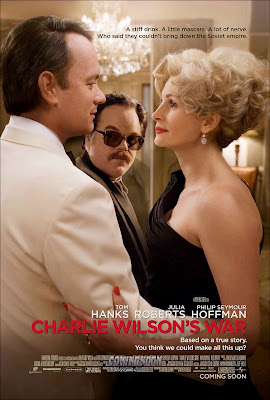
The last 'movie double' I did stretched me (and credulity) a bit so I'm going to handle 2 films with at least a modicum of common concern. Today's movie double combo is 'Charlie Wilson's War' and 'Lions for Lambs'
Coming out of watching Rambo and reminiscing about the 1980s and the war in Afghanistan, it seemed appropriate to at least look at what other texts were floating around at the moment to explain the mess, so to speak.
 The Fighting In Afghanistan
 Afghanistan is one of those places where you grow up thinking one day they'll stop fighting. The problem is that the fighting has been going on for so long, it's become all they know. As demonised as it was at the time, the Soviet incursion into Afghanistan was fueled by the constant irritation of Afghan conflicts spilling over into mother Russia over the northern border. A little like how Chechens fight on so close to Moscow is still a irritant.
In a sense, the world jumped on the Soviets because they were communists and chose to ignore why they might drive tanks over the borders in the first place. Certainly, we would not expect the Americans to drive over the border into Mexico just because of the drug trade irritation, but in the 19th century, they did, and that's how they got California and Texas. The point is, the Afghan War for the Russians started in 1980. That's more than way over half of my life that conflict has ripped Afghanistan.
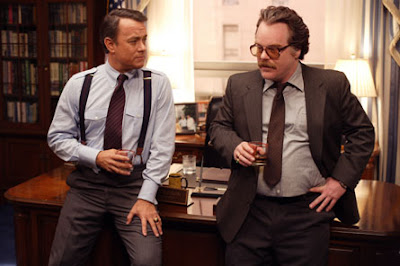
If what the 'Rambo III' movie showed was a naive pro-resistance, anti-communist posturing, 'Charlie Wilson's War' reveals that the US Government was operating with about the same idiotically simple schema. So great a perceived threat was the Soviet Communism, the US government showered the Mujihadeen with weapons with which to fight the commies. They didn't quite need John Rambo, but they sure sent a whole lot of special forces types to deliver these weapons to these people to fight the proxy war. Indeed, it was this kind of ex-military bravado of Congressman Wilson from the second ward of Texas, that culminates in the Russian retreat.
The film also covers the aftermath, where Charlie Wilson is unable to secure any money to rebuild the war-torn nation - thus laving Afghanistan to the dreadful civil wars of the 1990s.
By the time the story has moved on to the present day, it is America that is now stuck in Afghanistan fighting the war that the Russians had fought. Does this remind people of something? yes, it reminds us of the Vietnam War - ad this is where Robert Redford steps in with his film, 'Lions For Lambs'. What is clear from his film is that as well-intended as it might be, America has not really come to grips with the war it is fighting in Afghanistan.
Echoes of Vietnam - A Little Digression
 Just to be a little pedantic I want to run past a pet theory of mine.
My theory goes like this: The greatest threat to the US in the 20th Century was ideology, and the two main ideologies it confronted were Fascism and Communism. In fact there are indications that FDR's long presidency fomented the conditions whereby World War II took the shape that it did. In part it pushed Japan in with the Fascists, and then aggressively blocked trade in order to provoke the attack on Pearl Harbor - yes, the Day that Lives in Infamy, that FDR worked very hard to produce. Admiral Yamamoto might have been the star villain of the day, but FDR pretty much produced that show.
The end result was Japan surrendering to the USA, and thus reverting to the Constitutional Monarchy that it was as late as 1930. Japan's problem was that after Russia it was the country with the most sold copies of Marx's 'Capital' - the Bible for Communists everywhere. So part of the reason Japan lurched to the right in the 1930s was the great fear of Communism as well as the Russian threat to the north. Which explains the Manchurian state as a project to create a buffer state.
Anyway. With the defeat of anti-communist, Fascist Japan in 1945, the USA had to become guarantor for Japan's security in exchange of Japan giving up arms 'forever' in its 'Peace Constitution' as written by MacArthur's GHQ. It was a very clever move by Shigeru Yoshida, because it produced three key results. Japan was able to be America's ally without providing arms or lives; Japan no longer had to confront Communism by itself in the Far East, that job fell to the USA; and Japan prospered economically as a result.
So the pay off of my big theory is this: the USA was fighting the Vietnam War on behalf of Japan.
That's it.
Had WWII not taken shape the way it did and Japan sided with the West, then Japan would have kept its military presence in South East Asia. It would have fallen to Japan to combat Communism in the wake of France pulling out of Indochina, not America. Instead, America got it self dragged into the slip-stream of the evacuating French, and ended up having to expand the war bit by bit - legitimacy be damned.
The logical extension to my theory is that the War in Afghanistan for the US is a war that it inherited from the Russians in the wake of the collapse of the Soviet State, just as it had inherited the Vietnam War from a vacated power in the Far East.
Still Fighting In Afghanistan
The natural question that begs to be answered is, "why are we still fighting in Afghanistan?"
Neither of these films actually come close to addressing the issue in any adequate way or form. It is clear that for both these films and film makers, Afghanistan is a phenomenon in the Husserl sense. It's out there and our cognition struggles to come to grips with it. It's just not manifestly real enough - instead it is understood through the distorted looking glass of the media. Afghanistan may as well be on Mars or in Narnia for most Americans.
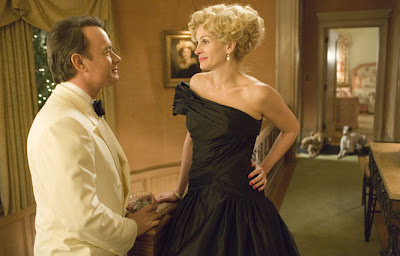 'CWW' delivers on to the fact that the war in Afghanistan from the Afghan perspective is a religious war. It is Julia Roberts' Texan fundraiser character who believes in a crusade against the God-less Communists that lobbies Tom Hanks' rather sardonic, secular Charlie Wilson in supporting the Afghans against the Russians. It is also the Allah Akbar/God is Great chant that convinces Ned Beatty's Arms Committee chief to back Charlie Wilson.
Perhaps what gets lost in the shuffle is that the Afghans were willing to shake hands with the capitalist Christian 'Great Satan' in order to defeat the Godless Communists, and that alliance was never going to endure history. It's a little disconcerting that Charlie Wilson went to help these people and he reduced the help down to sending more weapons. The whole operation to Afghanistan has ballooned into the great black market for arms in Northern Pakistan, and continues to destabilise the region; but the film is incredibly *light* in discussing those issues.
 In 'LFL', Afghanistan is like the surface of the meteor in 'Armageddon'. It is dark with blue light onto black edgy rocks, with deep snow. Two stranded soldiers US soldiers fight to the death with Taliban fighters we never get to see face to face. No glory-gore of Rambo IV here; just a prosaic tragedy. What's even sadder is that the best discourse the film has to offer as to why they are in Afghanistan is delivered by Tom Cruise, who says with the same Scientology-Stare to Meryl Streep "Do you want to win the War on Terror, yes or no?"
When Streep's character prevaricates, he thunders "It's a very simple question, Yes or No?"
It actually reminded me of the way he said "There'll be no more of this spectator-ism. You're either in the game or get out of the stadium!" in that horrible Scientology video that did the rounds. I think Tom Cruise's credibility as a human being took a huge hit with that interview.
Anyway, it's clear that 'LFL' is saying they don't really know why the USA is in Afghanistan, and that what it is trying to do there."
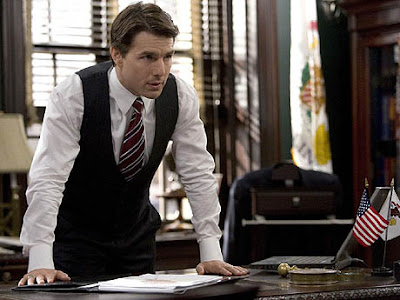 Let's face it, we live in a time when the First World is facing two ugly wars in Iraq and Afghanistan, as well as seeing the multitude of conflicts in Africa and elsewhere; and Tom Cruise's central metaphysical concern is building a five-panic-room house in Colorado for the day Xenu attacks Earth.
Err... right, Tom.
In any case, it's not entirely clear why the Americans are there but for repeated references to September 11. I don't think that is all there is to it, so I don't know why we choose to dumb ourselves down by thinking that is the case. By the same token, the film does a bit of disservice to itself there.
Cryptic Title
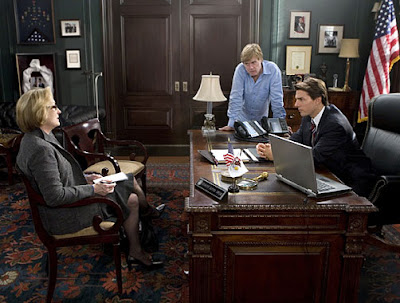 Just what does 'Lions For Lambs' Mean? you might ask.
It's a reference made in the film that explains it is how WWI Germans saw the English Army - that their soldiers were brave as Lions, but the Generals were like Lambs.
I'm not so sure the simile works at all. it's not that the USA command is meek. It's more like it's Blind to circumstance, Deaf to criticism and decidedly tactical when it probably needs to be thought more broadly strategic terms.
The film only delivers half the point. The big point it does deliver is that Tom Cruise really is an acting light weight when played against to Meryl Streep. He's simply awful in this film - a bit like a lamb sent out to face a lioness.
Hollywood Liberalism
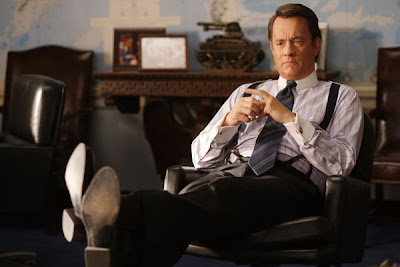 The GOP always complains that Hollywood is pro-Democrat. This is from the party that boasts Clint Eastwood AND Arnold Schwarzenegger.
Still, you do kind of understand. Hanoi Jane and all that; the Hollywood mob seem incredibly keen to say no to war even though they keep making fiction filled with the stuff.
What's really galling about 'CWW' is how the film celebrates the Soviet defeat with innocent joy and yet totally fails to face up to the failure of managing Afghanistan after that moment. The film simply rolls up a quote from Wilson that says they "completely fucked up the End Game". It's a little disingenuous to leave it at that, given the size of the fiasco. And it's not something I'm willing to lay at just George W. Bush's feet, but also to his father George Herbert Walker Bush who did plenty for Gulf War I but failed to see the missed opportunities, as well as Bill Clinton who did mostly nothing of lasting importance.
The point is, it's a bit on the nose to say it was "their fault". It was collectively, all our faults we chose to look after our backyards instead of addressing real, serious problems that were emerging out there. The wide-eyed "Oh boy shucks" of 'CWW' is totally not what the doctor ordered.
 'LFL' fares a little better in that it is willing to discuss the notion of winning the hearts and minds of the Afghan people, but it's spoken by Tom Cruise's character Jasper Irving, who thinks he's going o accomplish this through winning some battles. So in the end, nobody comes up with a concrete plan to do that; they simply disagree with more fighting. I can see why the GOP might object to Hollywood liberalism.
For my part, I'm not sure more fighting is the answer. If anything they need to come up with a strategy for demilitarising and disarming these people. And Armies can be handy for that. In any case, it's clear that the writers in Hollywood can barely get their heads around conceiving of the war in Afghanistan as an extension of "9/11"; what chance have they got of seeing the war as part of the great counter-colonial struggle in that part of the world? In neither film do the film making teams offer any concrete alternatives to the fiascoes going down in Afghanistan.
It's easy objecting to a war, and an unpopular war at that. It's another thing to conceive of how to extricate the First World from the mess that is Afghanistan. In that sense the Hawks are right to grumble about Hollywood for taking the easy shots without offering an alternative option. To date, it's been send in Iron Man, send in Rambo, send in a couple of young actors to play soldiers.
On Robert Redford
 Before Tom Cruise was the pretty boy of Hollywood that could sell schlock with his smile, there was Robert Redford. Robert Redford the actor was such an All-American boy it seemed like he was caste from a mold. The blond, blue- eyed visage, the controlled, mellifluous voice, the bolt-upright posture, the glance, the smile, all added up to the definition of a Hollywood Movies Star.
Since then it's actually remarkable how few men have actually stepped into that mold. As it turned out, they really haven't been able to make another one of these guys. Perhaps America has moved on, and perhaps even the demographic has moved on. After all, how hyper-Aryan -looking could you get beyond Robert Redford?
An yet Redford has continually made films that are against the fascist impulses of America. My favorite performance by Redford is possibly his work in 'All The President's Men' where his understated delivery underlined the gritty realism of that picture. He never got histrionic with that role, while Dustin Hoffman was let loose on the Bernstein character like a hungry hound.
The most problematised role for me is actually his part in 'The Natural'. He was simply too old to have played that role of Roy Hobbs - he looks stiff and ungainly, and you never quite buy the time line of events as a result. In any case, I still like the film and it's not like he ruins it for me; but I do remember sitting alone in the dark watching the film thinking, "this is kinda wrong, no?"
I recall being at AFTRS, and they showed 'Out of Africa' as a case where a star can distort the script. The contention was that having cast Redford against Streep, they had to expand that role to accommodate his star stature, an that this resulted in a bad script. While I never liked the film all that much, I always thought it was a great move to have Redford in it. It was interesting to see he cast Streep to play the journalist. in 'LFL'. It certainly evoked a lot of memories. It even occurred to me that they sure haven't found more where he came from.
He means well, and he's shown spine, and that's a whole lot better than many who earn stardom in Tinseltown. The last Redford sequence in 'LFL' where he puts on the jacket and ushers out the kid almost seems like a goodbye note to the audience.
The last 'movie double' I did stretched me (and credulity) a bit so I'm going to handle 2 films with at least a modicum of common concern. Today's movie double combo is 'Charlie Wilson's War' and 'Lions for Lambs'
Coming out of watching Rambo and reminiscing about the 1980s and the war in Afghanistan, it seemed appropriate to at least look at what other texts were floating around at the moment to explain the mess, so to speak.

 The Fighting In Afghanistan
 Afghanistan is one of those places where you grow up thinking one day they'll stop fighting. The problem is that the fighting has been going on for so long, it's become all they know. As demonised as it was at the time, the Soviet incursion into Afghanistan was fueled by the constant irritation of Afghan conflicts spilling over into mother Russia over the northern border. A little like how Chechens fight on so close to Moscow is still a irritant.
In a sense, the world jumped on the Soviets because they were communists and chose to ignore why they might drive tanks over the borders in the first place. Certainly, we would not expect the Americans to drive over the border into Mexico just because of the drug trade irritation, but in the 19th century, they did, and that's how they got California and Texas. The point is, the Afghan War for the Russians started in 1980. That's more than way over half of my life that conflict has ripped Afghanistan.
If what the 'Rambo III' movie showed was a naive pro-resistance, anti-communist posturing, 'Charlie Wilson's War' reveals that the US Government was operating with about the same idiotically simple schema. So great a perceived threat was the Soviet Communism, the US government showered the Mujihadeen with weapons with which to fight the commies. They didn't quite need John Rambo, but they sure sent a whole lot of special forces types to deliver these weapons to these people to fight the proxy war. Indeed, it was this kind of ex-military bravado of Congressman Wilson from the second ward of Texas, that culminates in the Russian retreat.
The film also covers the aftermath, where Charlie Wilson is unable to secure any money to rebuild the war-torn nation - thus laving Afghanistan to the dreadful civil wars of the 1990s.
By the time the story has moved on to the present day, it is America that is now stuck in Afghanistan fighting the war that the Russians had fought. Does this remind people of something? yes, it reminds us of the Vietnam War - ad this is where Robert Redford steps in with his film, 'Lions For Lambs'. What is clear from his film is that as well-intended as it might be, America has not really come to grips with the war it is fighting in Afghanistan.
Echoes of Vietnam - A Little Digression
 Just to be a little pedantic I want to run past a pet theory of mine.
My theory goes like this: The greatest threat to the US in the 20th Century was ideology, and the two main ideologies it confronted were Fascism and Communism. In fact there are indications that FDR's long presidency fomented the conditions whereby World War II took the shape that it did. In part it pushed Japan in with the Fascists, and then aggressively blocked trade in order to provoke the attack on Pearl Harbor - yes, the Day that Lives in Infamy, that FDR worked very hard to produce. Admiral Yamamoto might have been the star villain of the day, but FDR pretty much produced that show.
The end result was Japan surrendering to the USA, and thus reverting to the Constitutional Monarchy that it was as late as 1930. Japan's problem was that after Russia it was the country with the most sold copies of Marx's 'Capital' - the Bible for Communists everywhere. So part of the reason Japan lurched to the right in the 1930s was the great fear of Communism as well as the Russian threat to the north. Which explains the Manchurian state as a project to create a buffer state.
Anyway. With the defeat of anti-communist, Fascist Japan in 1945, the USA had to become guarantor for Japan's security in exchange of Japan giving up arms 'forever' in its 'Peace Constitution' as written by MacArthur's GHQ. It was a very clever move by Shigeru Yoshida, because it produced three key results. Japan was able to be America's ally without providing arms or lives; Japan no longer had to confront Communism by itself in the Far East, that job fell to the USA; and Japan prospered economically as a result.
So the pay off of my big theory is this: the USA was fighting the Vietnam War on behalf of Japan.
That's it.
Had WWII not taken shape the way it did and Japan sided with the West, then Japan would have kept its military presence in South East Asia. It would have fallen to Japan to combat Communism in the wake of France pulling out of Indochina, not America. Instead, America got it self dragged into the slip-stream of the evacuating French, and ended up having to expand the war bit by bit - legitimacy be damned.
The logical extension to my theory is that the War in Afghanistan for the US is a war that it inherited from the Russians in the wake of the collapse of the Soviet State, just as it had inherited the Vietnam War from a vacated power in the Far East.
Still Fighting In Afghanistan
The natural question that begs to be answered is, "why are we still fighting in Afghanistan?"
Neither of these films actually come close to addressing the issue in any adequate way or form. It is clear that for both these films and film makers, Afghanistan is a phenomenon in the Husserl sense. It's out there and our cognition struggles to come to grips with it. It's just not manifestly real enough - instead it is understood through the distorted looking glass of the media. Afghanistan may as well be on Mars or in Narnia for most Americans.
 'CWW' delivers on to the fact that the war in Afghanistan from the Afghan perspective is a religious war. It is Julia Roberts' Texan fundraiser character who believes in a crusade against the God-less Communists that lobbies Tom Hanks' rather sardonic, secular Charlie Wilson in supporting the Afghans against the Russians. It is also the Allah Akbar/God is Great chant that convinces Ned Beatty's Arms Committee chief to back Charlie Wilson.
Perhaps what gets lost in the shuffle is that the Afghans were willing to shake hands with the capitalist Christian 'Great Satan' in order to defeat the Godless Communists, and that alliance was never going to endure history. It's a little disconcerting that Charlie Wilson went to help these people and he reduced the help down to sending more weapons. The whole operation to Afghanistan has ballooned into the great black market for arms in Northern Pakistan, and continues to destabilise the region; but the film is incredibly *light* in discussing those issues.
 In 'LFL', Afghanistan is like the surface of the meteor in 'Armageddon'. It is dark with blue light onto black edgy rocks, with deep snow. Two stranded soldiers US soldiers fight to the death with Taliban fighters we never get to see face to face. No glory-gore of Rambo IV here; just a prosaic tragedy. What's even sadder is that the best discourse the film has to offer as to why they are in Afghanistan is delivered by Tom Cruise, who says with the same Scientology-Stare to Meryl Streep "Do you want to win the War on Terror, yes or no?"
When Streep's character prevaricates, he thunders "It's a very simple question, Yes or No?"
It actually reminded me of the way he said "There'll be no more of this spectator-ism. You're either in the game or get out of the stadium!" in that horrible Scientology video that did the rounds. I think Tom Cruise's credibility as a human being took a huge hit with that interview.
Anyway, it's clear that 'LFL' is saying they don't really know why the USA is in Afghanistan, and that what it is trying to do there."
 Let's face it, we live in a time when the First World is facing two ugly wars in Iraq and Afghanistan, as well as seeing the multitude of conflicts in Africa and elsewhere; and Tom Cruise's central metaphysical concern is building a five-panic-room house in Colorado for the day Xenu attacks Earth.
Err... right, Tom.
In any case, it's not entirely clear why the Americans are there but for repeated references to September 11. I don't think that is all there is to it, so I don't know why we choose to dumb ourselves down by thinking that is the case. By the same token, the film does a bit of disservice to itself there.
Cryptic Title
 Just what does 'Lions For Lambs' Mean? you might ask.
It's a reference made in the film that explains it is how WWI Germans saw the English Army - that their soldiers were brave as Lions, but the Generals were like Lambs.
I'm not so sure the simile works at all. it's not that the USA command is meek. It's more like it's Blind to circumstance, Deaf to criticism and decidedly tactical when it probably needs to be thought more broadly strategic terms.
The film only delivers half the point. The big point it does deliver is that Tom Cruise really is an acting light weight when played against to Meryl Streep. He's simply awful in this film - a bit like a lamb sent out to face a lioness.
Hollywood Liberalism
 The GOP always complains that Hollywood is pro-Democrat. This is from the party that boasts Clint Eastwood AND Arnold Schwarzenegger.
Still, you do kind of understand. Hanoi Jane and all that; the Hollywood mob seem incredibly keen to say no to war even though they keep making fiction filled with the stuff.
What's really galling about 'CWW' is how the film celebrates the Soviet defeat with innocent joy and yet totally fails to face up to the failure of managing Afghanistan after that moment. The film simply rolls up a quote from Wilson that says they "completely fucked up the End Game". It's a little disingenuous to leave it at that, given the size of the fiasco. And it's not something I'm willing to lay at just George W. Bush's feet, but also to his father George Herbert Walker Bush who did plenty for Gulf War I but failed to see the missed opportunities, as well as Bill Clinton who did mostly nothing of lasting importance.
The point is, it's a bit on the nose to say it was "their fault". It was collectively, all our faults we chose to look after our backyards instead of addressing real, serious problems that were emerging out there. The wide-eyed "Oh boy shucks" of 'CWW' is totally not what the doctor ordered.
 'LFL' fares a little better in that it is willing to discuss the notion of winning the hearts and minds of the Afghan people, but it's spoken by Tom Cruise's character Jasper Irving, who thinks he's going o accomplish this through winning some battles. So in the end, nobody comes up with a concrete plan to do that; they simply disagree with more fighting. I can see why the GOP might object to Hollywood liberalism.
For my part, I'm not sure more fighting is the answer. If anything they need to come up with a strategy for demilitarising and disarming these people. And Armies can be handy for that. In any case, it's clear that the writers in Hollywood can barely get their heads around conceiving of the war in Afghanistan as an extension of "9/11"; what chance have they got of seeing the war as part of the great counter-colonial struggle in that part of the world? In neither film do the film making teams offer any concrete alternatives to the fiascoes going down in Afghanistan.
It's easy objecting to a war, and an unpopular war at that. It's another thing to conceive of how to extricate the First World from the mess that is Afghanistan. In that sense the Hawks are right to grumble about Hollywood for taking the easy shots without offering an alternative option. To date, it's been send in Iron Man, send in Rambo, send in a couple of young actors to play soldiers.
On Robert Redford
 Before Tom Cruise was the pretty boy of Hollywood that could sell schlock with his smile, there was Robert Redford. Robert Redford the actor was such an All-American boy it seemed like he was caste from a mold. The blond, blue- eyed visage, the controlled, mellifluous voice, the bolt-upright posture, the glance, the smile, all added up to the definition of a Hollywood Movies Star.
Since then it's actually remarkable how few men have actually stepped into that mold. As it turned out, they really haven't been able to make another one of these guys. Perhaps America has moved on, and perhaps even the demographic has moved on. After all, how hyper-Aryan -looking could you get beyond Robert Redford?
An yet Redford has continually made films that are against the fascist impulses of America. My favorite performance by Redford is possibly his work in 'All The President's Men' where his understated delivery underlined the gritty realism of that picture. He never got histrionic with that role, while Dustin Hoffman was let loose on the Bernstein character like a hungry hound.
The most problematised role for me is actually his part in 'The Natural'. He was simply too old to have played that role of Roy Hobbs - he looks stiff and ungainly, and you never quite buy the time line of events as a result. In any case, I still like the film and it's not like he ruins it for me; but I do remember sitting alone in the dark watching the film thinking, "this is kinda wrong, no?"
I recall being at AFTRS, and they showed 'Out of Africa' as a case where a star can distort the script. The contention was that having cast Redford against Streep, they had to expand that role to accommodate his star stature, an that this resulted in a bad script. While I never liked the film all that much, I always thought it was a great move to have Redford in it. It was interesting to see he cast Streep to play the journalist. in 'LFL'. It certainly evoked a lot of memories. It even occurred to me that they sure haven't found more where he came from.
He means well, and he's shown spine, and that's a whole lot better than many who earn stardom in Tinseltown. The last Redford sequence in 'LFL' where he puts on the jacket and ushers out the kid almost seems like a goodbye note to the audience.
Subscribe to:
Posts (Atom)