'Somali Pirate' Is A Losing Script
People like this film a lot. You just need to see the Rotten Tomatoes ratings for this film and you realise quite a number of people like this film like it's some breakthrough film. It's also one of those movies where once again it's "A True Story Loosely Based On Fact" so everything you see is a little suspect.
You can run all kinds of simulations and role-plays, I tend to think Somali Pirate is just one of those starting hands that's got very limited upside. Beating upon them in a Hollywood movie seems more cruel than fair game.
What's Good About It
Lots of Hollywood-special tense moments. The character build for the Somali pirates is short-handed but good. They don't waste too much time explaining Richard Phillips. He's a ship captain, he goes to sea, misses his family when he's out to sea; all this gets told in under 5minutes screentime and really, that's all we want to know or need to know before the action begins.
What's Bad About It
I think Paul Greengrass and his wobbly telephoto look is a terrible choice in this film. For a film that's already set at sea, the wobbly cam only ads to the sea-sickness-making horror of drifting horizons. I felt ill 20minutes in and it got worse and worse. Worse still, the action sequences were so chopped up they were practically indecipherable as action. You see a flurry of motion but you don't know what the hell is going on. It's like his other work, but ... worse.
What's Interesting About It
Somali pirates on the big screen actually is a big draw card. You know me. I'm sick of Russians mafia in Black four wheel drives with machine guns and bad accents.But then one of the first bits of action in the Somali side is a convoy of Nissan 4wheel drives arriving with men touting AK-47s, demanding the fishermen go out and do more piracy. The more things change in Hollywood you realise the more it's just the wardrobe department working its budget.
Still, it's interesting to see Somalis on the Hollywood big screen. Of course, this being a Hollywood movie, they really don't get a good airing, but at least you get a picture of Hollywood trying to do something more representative of the world in which we live.
The race politics is pretty transparent. The film only lets you sympathise with the Somali pirate leader only to a certain extent and there is his right hand man who spends most of the movie angry and hostile, who basically reduces the group to a caricature as damning as the four Muslims in 'Four Lions'. You're watchingit knowing full well that they're not going to make it, and then the Navy SEALs turn up an of course this being a Hollywood movie, those guys are invincible, so you don't get the ending telegraphed to so much as given a big billboard on Sunset Boulevard with smiling Navy SEALs brandishing their sniper rifles. Okay, so that bit is not all that interesting.
The denouement is short, and you're mercifully spared the family reunion scene.
Does Anybody Remember...
... the last democratically elected Somali government head? No? Didn't think so, because I can't either.I was freshly minted a graduate out of AFTRS when the first signs of collapse in Somalia took place, and it was Bill Clinton's first military action as POTUS where he sent troops overseas. I - blithely in my youthful stupidity - tried to hook on with a camera and get out to Somalia for a look so i could make some interesting docos. Fortunately for me, I utterly failed to find any backers here in Australia or over in Japan. I say fortunate because the way Mogadishu turned out, turned into 'Blackhawk Down'. Somehow I don't think I would've survived that chaotic mess.
In my own defence, I had read "Into a Black Sun' by Takeshi Kaikoh which filled me with the delusion that I should poke my head into a hot zone with a camera. Somalia, like the Balkan wars that followed, made a point of shooting at camera people and journalists. It's hard to put this down to any particular reason, but basically the 1990s showed just how bad your cause could look to the world through media, and so it became worthwhile for people in civil wars to silence the press and documentarists by shooting at them.
All that said, I was desperately, then tepidly, then vaguely interested in Somalia for the rest of the decade, probably right up until 9/11 changed everything. The reason I bring all of this up is because I have to confess I haven't seen any signs of Somalia returning to a functioning state, and the one intervention from the outside resulted in a mess. It's not that surprising piracy has surfaced as a means for survival with the coastal population. What's probably more shocking is that there is a whole generation of Somalis who grew up under this chaos and warlord-ism, who know nothing of functioning democracy or even a proper state or that matter. You wonder how they're ever going to find their way back.
Not Post-Apocalypse, But Post Civilisation
What freaked out Tony Blair in his day as a PM was when he asked how long food supplies could hold out in the UK if all shipping were stopped. The answer he got was 72hours, and then riots would break out. Our modern civilisation is complicated and intertwined with the world, it would only take 72hours for the edifice to find itself in grave danger. Somalia as it exists today appears to be what is left after the state crumbles, and so shipments cease to arrive to a nation. The Hobbsean nasty brutish and short is what is mostly left there from what we can gather.
The general point being, there but for the grace of something larger go us. It's totally hubris on our part to think that we won't fall to such chaos. If you read about the English Civil War for instance, you come to realise that the people of England did not anticipate the war breaking out in the way that it did let alone the depredations that came about as a result of the civil war.
In that sense, Somalia is leading the way in some kind of weird experiment of civilisation collapse. Like a canary in the coal mine, if you will, Somalia illuminates the way in which a modern nation state can unravel into this strange warlord-ism. What's frightening is that maybe that kind of existence awaits us somewhere in the future when our governments lose credibility and things simply fall apart. That's the truly frightening vision. In that event, we'll all be Tom Hanks' Captain Phillips, except not as well paid for our ordeals.

A Gen-X View of the Universe.
"The Issue Isn't Pussy, It's Monkey" - from The Right Stuff
Film, Cinema, Movies, TV, Music, Rock
Showing posts with label Hollywood. Show all posts
Showing posts with label Hollywood. Show all posts
2014/04/08
2013/03/06
'Argo'
The Joy Of The Known
The deal on 'Argo' was that it won 'Best Picture' at the Oscars without even getting nominated for 'Best Director'. I don' often agree with the Motion Picture Academy, but in this instance I could see the good sense in the outcome.
Like it or lump it, the singular beneficial feature of this film is that it is an ode, a love song in praise of Hollywood. How can the Academy not lavish praise on a film that praises Hollywood so? It's hardly artful in its direction, so it is no surprise it didn't get nominated in the directing category. The Academy it seems retains a little bit of pride about what it does.
What's Good About It
Alan Arkin, John Goodman, Dire Straits, Van Halen, Led Zeppelin. Pulling one over the Nasty Iranians.I believe the Iranians are particularly insulted by this picture. Clearly they don't understand that they're not meant to like it seeing that they are the butt of the joke. In some ways, anything that gets up the nose of that horrible Theocracy is good fodder.
What's Bad About It
The suspense is hardly exciting once the premise gets under way. We know they get out, so it hardly seems the process is all that suspenseful. It seems to be missing a couple of really difficult obstacles to make it a truly riveting film.
What's Interesting About It
Watching this film was like getting plugged in the Gen-X memory machine. I remember the days when the Iranians stormed the US Embassy and held those hostages fr 444 days. I'm sure it s a proud moment for the likes of Mahmoud Ahmedinejad - who it turns out wasn't there after all - but it's one of those moments for which Iran has not paid its price. So it seems fitting that they cop a bit of retcon-humiliation from Hollywood. There's nothing like the ridicule from Hollywood as Saddam Hussein found out.
Still, the Iranian complaints seem entirely motivated by hurt pride that they should be portrayed as being so backward and craven and abusive masters of torture. Their claims that the film distorts history is probably true but I'm yet to see any film that doesn't distort history so that's not saying anything special in the context of this film. You accept that it probably didn't go down the way Ben Affleck directed it (and thank goodness for that).
Fortunately, they're not the only ones put off by the movie. The Canadians are also upset that they don't get a good enough credit for their role. What's really interesting about the outrage about the rewritten history is that New Zealand gets a mention in the list of people upset by the picture. Anything that upsets so many people must have something artistic going for it.
All The Best Lines Go To LA (and so do the chicks)
The most insightful lines in the film pertain to Hollywood and not the real world at all. The best character for the best lines was the fictional producer Lester Siegel played by Alan Arkin, followed by John Goodman's John Chambers. The line about the bullshit coalmine and fitting right in with the superficial and fickle LA set pretty much define the tone of the film: Hollywood is *it*.
In some ways this is a film that probably belongs in the genre of films about film making, without there actually being a film. The way they get the diplomats out of America almost is an adjunct to the story of faking a film production convincingly.
This is what the Iranians don't get. Young, beautiful women don't exactly travel to Tehran to become good Muslims anywhere near the same rate as they go to Los Angeles hoping to become a superstar. Los Angeles might be a toilet of a city but its allure is still streets ahead of Tehran, the capital of a country that is in massive deficit of Gross National Cool. All the great films they make are not going to change this international perception.
Is it really Zionism? Or is it that Iran has made itself firmly into an unattractive nation? 'Argo' hardly seems to be the problem.
The deal on 'Argo' was that it won 'Best Picture' at the Oscars without even getting nominated for 'Best Director'. I don' often agree with the Motion Picture Academy, but in this instance I could see the good sense in the outcome.
Like it or lump it, the singular beneficial feature of this film is that it is an ode, a love song in praise of Hollywood. How can the Academy not lavish praise on a film that praises Hollywood so? It's hardly artful in its direction, so it is no surprise it didn't get nominated in the directing category. The Academy it seems retains a little bit of pride about what it does.
What's Good About It
Alan Arkin, John Goodman, Dire Straits, Van Halen, Led Zeppelin. Pulling one over the Nasty Iranians.I believe the Iranians are particularly insulted by this picture. Clearly they don't understand that they're not meant to like it seeing that they are the butt of the joke. In some ways, anything that gets up the nose of that horrible Theocracy is good fodder.
What's Bad About It
The suspense is hardly exciting once the premise gets under way. We know they get out, so it hardly seems the process is all that suspenseful. It seems to be missing a couple of really difficult obstacles to make it a truly riveting film.
What's Interesting About It
Watching this film was like getting plugged in the Gen-X memory machine. I remember the days when the Iranians stormed the US Embassy and held those hostages fr 444 days. I'm sure it s a proud moment for the likes of Mahmoud Ahmedinejad - who it turns out wasn't there after all - but it's one of those moments for which Iran has not paid its price. So it seems fitting that they cop a bit of retcon-humiliation from Hollywood. There's nothing like the ridicule from Hollywood as Saddam Hussein found out.
Still, the Iranian complaints seem entirely motivated by hurt pride that they should be portrayed as being so backward and craven and abusive masters of torture. Their claims that the film distorts history is probably true but I'm yet to see any film that doesn't distort history so that's not saying anything special in the context of this film. You accept that it probably didn't go down the way Ben Affleck directed it (and thank goodness for that).
Fortunately, they're not the only ones put off by the movie. The Canadians are also upset that they don't get a good enough credit for their role. What's really interesting about the outrage about the rewritten history is that New Zealand gets a mention in the list of people upset by the picture. Anything that upsets so many people must have something artistic going for it.
All The Best Lines Go To LA (and so do the chicks)
The most insightful lines in the film pertain to Hollywood and not the real world at all. The best character for the best lines was the fictional producer Lester Siegel played by Alan Arkin, followed by John Goodman's John Chambers. The line about the bullshit coalmine and fitting right in with the superficial and fickle LA set pretty much define the tone of the film: Hollywood is *it*.
In some ways this is a film that probably belongs in the genre of films about film making, without there actually being a film. The way they get the diplomats out of America almost is an adjunct to the story of faking a film production convincingly.
This is what the Iranians don't get. Young, beautiful women don't exactly travel to Tehran to become good Muslims anywhere near the same rate as they go to Los Angeles hoping to become a superstar. Los Angeles might be a toilet of a city but its allure is still streets ahead of Tehran, the capital of a country that is in massive deficit of Gross National Cool. All the great films they make are not going to change this international perception.
Is it really Zionism? Or is it that Iran has made itself firmly into an unattractive nation? 'Argo' hardly seems to be the problem.
2011/06/25
Hollywood On The Ropes
Problems On The Horizon
I stumbled upon this interesting article that talks about how Hollywood is narrowing and therefore shrinking in significance.
If anything, the demographic support for cinema may actually be collapsing in the traditionally strong demographic. There are many reasons for this, but I think the main culprit is that there's just too much competition for that same disposable dollar, while piracy offers a valve for the need for cinema to be met with much less cost. After a good 20years of mining the 18-35 demographic, it is finding it hard to get the next generation of the 18-35 demographic to be as hooked into cinema as the previous generation, Gen-X. Gen-Y just isn't into cinema like that, and it's showing up in stalled growth and diminishing audiences.
The repetitive adaptation of comic book content an the retreat of mature, general content from films has made Hollywood cinema itself a little disjointed from its marketplace. It's not developing its own content, it's buying it pre-packaged so we're not even getting proper story development on the screen like we used to. Worse still, the impact of world events have been such that cinema no longer seems as inviting as it once was. 'Armageddon' is harder to watch after 9/11. Movies about war are hard to watch after Iraq. All the while cinema itself is cocooning itself into a world of violent fantasies more than offering insight or understanding. It has to be a bad step.
Which brings me to the next bit. Here's an interesting article sent in from Pleiades.
It's worth reading on. It's an article that highlights my own misgivings about where cinema is going wrong.
They're Still Talking About This?
Ugh. *facepalm*.
I don't know. It's almost not worth talking about here any more. It keeps going in circles, nothing gets better, and then Julia Leigh makes a movie that tanks. The rest of cinema are going through major ructions, and there's Screen Australia continuing with the tried and true formulae for failure. I can only shrug.
I stumbled upon this interesting article that talks about how Hollywood is narrowing and therefore shrinking in significance.
A generation of directors who thought they owned the business as kids in the 1970s had to decide whether to stay part of it or be artists. Steven Spielberg is the only one who may still be able to convince us he’s both: we will see with “War Horse” and “The Adventures of Tintin”. Francis Ford Coppola has gone back to being an artist, while moonlighting in wine and eco-villas. George Lucas exists in the gloom of his own big business. And Martin Scorsese is something of a wreck, trying to have it both ways, making music documentaries (George Harrison next) and television (“Boardwalk Empire”), and still directing movies without firing on so many cylinders (“Shutter Island”). Mostly born in the 1940s, they are of an age still to be our great directors, but they have yielded to a generation of new kids who do what the money demands. You see, we don’t have great directors any more. The computer makes our movies. Its efficient anonymity is the new style: look at the anonymous figures and the metallic sheen of “Black Ops”. That style, a kind of subtle fascism, haunts our films, from “Black Hawk Down” to “Battle: Los Angeles”.
The picture business likes to tell us, and itself, that it is doing very well. In the first decade of this century, America’s annual domestic box office pushed over $10 billion ($10.89 billion for 2010). But $10 billion, you realise now, is not so great. And in the small print you find that in 2010 1.37 billion tickets were sold, whereas in 2002 it was 1.58 billion—so in eight years, 13% of the audience has melted away. In the 1940s, as war ended and families were reunited in the dark, the figure was 4 billion tickets a year. And the population of America was half what it is now. That’s what “mainstream” once meant.
In that light, our venerable Academy of Motion Picture Arts and Sciences, now in its 80s, looks a little shaky. It has two physical incarnations: the Samuel Goldwyn Theatre on Wilshire Boulevard for tributes and events, and an exceptional research library, named after Margaret Herrick, the first librarian at the Academy, and an invaluable source for film historians. There are wistful hopes for a proper movie museum—something LA has never had. Mainly, it puts on the big show, the Oscars telecast. The bulk of the Academy’s revenue (about $70m a year) comes from that one show, and its audience has been wilting.
If anything, the demographic support for cinema may actually be collapsing in the traditionally strong demographic. There are many reasons for this, but I think the main culprit is that there's just too much competition for that same disposable dollar, while piracy offers a valve for the need for cinema to be met with much less cost. After a good 20years of mining the 18-35 demographic, it is finding it hard to get the next generation of the 18-35 demographic to be as hooked into cinema as the previous generation, Gen-X. Gen-Y just isn't into cinema like that, and it's showing up in stalled growth and diminishing audiences.
The repetitive adaptation of comic book content an the retreat of mature, general content from films has made Hollywood cinema itself a little disjointed from its marketplace. It's not developing its own content, it's buying it pre-packaged so we're not even getting proper story development on the screen like we used to. Worse still, the impact of world events have been such that cinema no longer seems as inviting as it once was. 'Armageddon' is harder to watch after 9/11. Movies about war are hard to watch after Iraq. All the while cinema itself is cocooning itself into a world of violent fantasies more than offering insight or understanding. It has to be a bad step.
Which brings me to the next bit. Here's an interesting article sent in from Pleiades.
War, violence and death have become the organizing principle of governance and culture in the United States as we move into the second decade of the 21st century. Lacking a language for the social good, the very concept of the social as a space in which justice, equality, social protections and a responsibility to the other mediate everyday life is being refigured through a spectacle of violence and cruelty. Under such circumstances, ethical considerations and social costs are removed from market-driven policies and values just as images of human suffering are increasingly abstracted from not only their social and political contexts, but also the conditions that make such suffering possible. Moreover, as public issues collapse into privatized considerations, matters of agency, responsibility and ethics are now framed within the discourse of extreme individualism. Unexpected violence, aggression and the "'masculine' virtues of toughness, strength, decisiveness and determination ... are accentuated," along with the claims of vengeance, militarization and violence.(1) The collapse of the social and the formative culture that make human bonds possible is now outmatched by the rise of a Darwinian ethic of greed and self-interest in which violence, aggressiveness and sadism have become the primary metric for living and dying. As the social contract is replaced by social collapse, a culture of depravity has emerged in American society. The spectacle of violence permeates every aspect of the machinery of cultural production and screen culture - extending from television news and reality TV to the latest Hollywood fare. Of course, this is not new. What is new is that more and more people desire spectacles of high-intensity violence and images of death, mutilation and suffering and their desires should no longer be attributed to an individual aberration, but instead suggest an increasingly widespread social pathology.
It's worth reading on. It's an article that highlights my own misgivings about where cinema is going wrong.
They're Still Talking About This?
Ugh. *facepalm*.
Certainly, positive momentum came to a shuddering halt in March, when four Australian films came and went quickly in cinemas. The Reef, Griff the Invisible, Wasted on the Young and A Heartbeat Away cost millions to make but only returned a fraction of that in cinemas. A report, to be released this month by Adelaide firm Convergen, confirms that in inflation-adjusted terms, Australian film has failed to tap into the boom in overall box office returns during the past 30 years. So, while overall demand has increased at the box office, Australian films haven't expanded their share.
An industry debate about how to improve the overall performance of the local film business is in full swing, with a push to give distributors greater influence in the movie-making process. The argument is that the current model relies too heavily on the funding and development relationship between Screen Australia and producers, which does not provide audiences with enough of what they want.
Just what that is, however, remains the $100 million (annual box office) question.
I don't know. It's almost not worth talking about here any more. It keeps going in circles, nothing gets better, and then Julia Leigh makes a movie that tanks. The rest of cinema are going through major ructions, and there's Screen Australia continuing with the tried and true formulae for failure. I can only shrug.
2011/02/21
The World Wide Cinema
Hollywood's Stake In It
Here's The Economists' take on the globalisation of distribution as seen from a Hollywood perspective.
World cinema is the catchphrase for films not dominated by Hollywood structure, or made outside of Hollywood structures, but that may well change as Hollywood's reach goes even more global. If they start buying up distribution channels in non-English speaking countries, it's going to impact on those local cinemas much more than in the past. After all, they're competing for every disposable dollar going towards the screen, around the world.
Here's The Economists' take on the globalisation of distribution as seen from a Hollywood perspective.
The success of a film outside America is not purely a marketing matter. As foreign box-office sales have become more important, the people who manage international distribution have become more influential, weighing in on “green-light” decisions about which films are made. The studios are careful to seed films with actors, locations and, occasionally, languages that are well-known in target countries. Sony cites the foreign success of “The Green Hornet” (Taiwanese hero, Austrian-German villain) and “Resident Evil: Afterlife” (Japanese location) as evidence of that strategy.
Big noisy spectacle travels best. Jason Statham, the close-cropped star of many a mindlessly violent film, is a particular Russian favourite. Films based on well-known literature (including cartoon books) and myths may also fare well. Films that trade on contemporary American cultural references are about as popular abroad as an oil slick on a NASCAR track. (Note to our non-American readers: NASCAR is an American sport involving fast cars.) Comedy travels badly, too: Will Ferrell and Adam Sandler provoke guffaws at home but incomprehension abroad. As the market swings away from America, funny films are less likely to find financing or broad distribution anywhere. “You won’t see us doing a lot of comedies,” says Brad Grey, head of Paramount Pictures.
The growing internationalisation of the film business suits the biggest outfits, and not just because they can afford explosions. The major studios’ power lies not so much in their ability to make good films—plenty of smaller operations can do that—but in their ability to wring every possible drop of revenue from a film. With their superior global marketing machines and their ability to anticipate foreign tastes, they are increasingly dominating the market. For everyone else, there is a chance to win a gold statue.
World cinema is the catchphrase for films not dominated by Hollywood structure, or made outside of Hollywood structures, but that may well change as Hollywood's reach goes even more global. If they start buying up distribution channels in non-English speaking countries, it's going to impact on those local cinemas much more than in the past. After all, they're competing for every disposable dollar going towards the screen, around the world.
2011/02/06
Blockbuster Saturation
Lemmings At The Cliff
I've been saying for a while that the movie business has got some fundamental problems that is making it unsustainable, and that we may see the end of Hollywood as we know it. Apparently I'm not alone in this diagnosis:
That's the concluding 3 paragraphs so I've cut to the chase, but the figures cited in the article leading to it exactly what I've been saying here, so I feel like I'm not some lone nut Cassandra.
The real argument is that the revenue that the studios can collect from the films is shrinking for various technological reason as well as demographic reasons, while unit cost of the films have soared to ridiculous heights. And now they're all doing this as we pick and choose which ones we want to see based on hearsay reviews moving faster than advertising, the studios can't keep their product out in the market place to find its audience. Something's got to break and it won't be audience indifference.
I think it was back in 2003 I was asked which movies I was looking forward to seeing and I replied the depressing thing was that they all had numerals behind them as they were all sequels. Yes, they were some good movies there, but it ode really ill for the creativity of the industry. Ever since the GFC, the business is even more risk averse to the point that they will only put big money into these 'proven properties' which are adaptations of comic books and graphic novels. If they still made good smaller films otherwise, it would be gratifying, but no; they're making these films at the expense of the good smaller films. The industry really is cannibalising itself. Lucas and Spielberg and James Cameron will always be able to make a movie, but just as it happened here at a smaller scale, it's at the expense of the future. The future is now, except it's also already the past.
I've been saying for a while that the movie business has got some fundamental problems that is making it unsustainable, and that we may see the end of Hollywood as we know it. Apparently I'm not alone in this diagnosis:
The idea of spending $300 million to make a two-hour fantasy is kind of weird if you think about it. That kind of spending only makes sense if you can convince millions of people to spend between $10 and $20 each to see the result. This is one case where the format is the content — there's no other format in which you could spend such an obscene amount of money on just two hours' entertainment. It's not going to happen on television, it's not going to happen with direct-to-DVD movies. There's really no other format I can think of that would justify that kind of opulence.
Back in the sixteenth and seventeenth centuries, people put on masques. These were lavish plays, put on at royal courts, or in wealthy aristocrats' houses, and they involved architecturally ambitious sets and fancy costumes. Often the whole point of these entertainments was how cool they looked — if you read their scripts nowadays, they're kind of dull, because you're not seeing the amazing costumes, scenery — and yes, special effects. The masque was a huge spectacular that dominated culture for roughly a century — and then it was extinct.
Nobody expects movie theaters to implode this year. The Hollywood blockbuster, as a format, will probably keep existing for years. But eventually, the unsustainable business model that drives these things will fall apart, and the movie as we know it will transform into something more suited to home viewing, and maybe more integrated with web content. So it's a good thing they're making tons of huge Hollywood movies right now, so we'll have plenty of examples of them to look at once they're gone.
That's the concluding 3 paragraphs so I've cut to the chase, but the figures cited in the article leading to it exactly what I've been saying here, so I feel like I'm not some lone nut Cassandra.
The real argument is that the revenue that the studios can collect from the films is shrinking for various technological reason as well as demographic reasons, while unit cost of the films have soared to ridiculous heights. And now they're all doing this as we pick and choose which ones we want to see based on hearsay reviews moving faster than advertising, the studios can't keep their product out in the market place to find its audience. Something's got to break and it won't be audience indifference.
I think it was back in 2003 I was asked which movies I was looking forward to seeing and I replied the depressing thing was that they all had numerals behind them as they were all sequels. Yes, they were some good movies there, but it ode really ill for the creativity of the industry. Ever since the GFC, the business is even more risk averse to the point that they will only put big money into these 'proven properties' which are adaptations of comic books and graphic novels. If they still made good smaller films otherwise, it would be gratifying, but no; they're making these films at the expense of the good smaller films. The industry really is cannibalising itself. Lucas and Spielberg and James Cameron will always be able to make a movie, but just as it happened here at a smaller scale, it's at the expense of the future. The future is now, except it's also already the past.
2011/01/31
Cinema In Retreat
Another One Bites The Dust
Caught this story in the SMH this morning.
If exhibitors are doing it this tough, then we can infer distributors will be doing it tough too. It kind of puts paid to the old "get a pre-sale" method of raising investment from distributors. There's no investment money coming back from the frontlines of cinema if people are staying away in droves. What's worse is that not even Hollywood fare is keeping the doors of the cinemas open. Mosman cinema was your typical multi-screen suburban cinema that made its dough through screening American movies with guns fights, car chases, and simulated sex scenes. In other words, it wasn't terribly a high-brow kind of cinema (which is not surprising given its location in the middle of consumerist philistine-ville, Mosman).
Without going into the issue of piracy; just as television took audiences out of the cinemas in the 1950s, big screen TVs for home entertainment, combined with DVD and blu-ray has killed the need to go out for the big screen experience. The unique selling proposition of cinema has taken a great hit, but it's hard to see from where the next generation of kids who grow up loving the cinema are going to arise. It may be another generation before something brings them back.
It's also not clear whether 3D is actually going to be the new USP for cinema - if anything it reminds us of the desperate attempt by the movie business in the 1950s to woo back audiences. What's striking is that as Gen-X ages and stops going to the movies, the audience numbers have suddenly dried up. We're talking about the original star wars kids plodding into middle age, as Hollywood keeps pitching product to younger and younger audiences to no avail.
If history is any precedent it means that the movie business as a whole is having to retreat back into a smaller, more nimble business. It's hard to see how this will look in a few year's time but the clock is ticking and time is running out. The massive blockbuster model of cinema may have to disappear if they cannot command the audiences as they did in years past. It's happened before.
Caught this story in the SMH this morning.
THE closure of the Greater Union cinema in Mosman comes as further proof of troubles in the Australian film industry.
While local filmmakers find it difficult to get work, and film, as an investment proposition, has retreated from fashion, the closure has underscored the impact of falling audiences.
It is the seventh picture theatre to close in Sydney since 1999.
Greater Union's owner, Amalgamated Holdings Limited, put up a sign outside the Mosman building last week announcing the closure.
''A business decision had to be made on the viability of the cinema,'' the sign said, adding that the announcement was made with ''great regret''.
If exhibitors are doing it this tough, then we can infer distributors will be doing it tough too. It kind of puts paid to the old "get a pre-sale" method of raising investment from distributors. There's no investment money coming back from the frontlines of cinema if people are staying away in droves. What's worse is that not even Hollywood fare is keeping the doors of the cinemas open. Mosman cinema was your typical multi-screen suburban cinema that made its dough through screening American movies with guns fights, car chases, and simulated sex scenes. In other words, it wasn't terribly a high-brow kind of cinema (which is not surprising given its location in the middle of consumerist philistine-ville, Mosman).
Without going into the issue of piracy; just as television took audiences out of the cinemas in the 1950s, big screen TVs for home entertainment, combined with DVD and blu-ray has killed the need to go out for the big screen experience. The unique selling proposition of cinema has taken a great hit, but it's hard to see from where the next generation of kids who grow up loving the cinema are going to arise. It may be another generation before something brings them back.
It's also not clear whether 3D is actually going to be the new USP for cinema - if anything it reminds us of the desperate attempt by the movie business in the 1950s to woo back audiences. What's striking is that as Gen-X ages and stops going to the movies, the audience numbers have suddenly dried up. We're talking about the original star wars kids plodding into middle age, as Hollywood keeps pitching product to younger and younger audiences to no avail.
If history is any precedent it means that the movie business as a whole is having to retreat back into a smaller, more nimble business. It's hard to see how this will look in a few year's time but the clock is ticking and time is running out. The massive blockbuster model of cinema may have to disappear if they cannot command the audiences as they did in years past. It's happened before.
2011/01/23
Little Fockers
Signs Of Terminal Decay
One doesn't want to bag out Hollywood gratuitously if one is a filmie because it still is the wellspring of the film business for half of the world. I've always been upfront about being a fan of Hollywood cinema. Still, it hasn't been good since the GFC set in and they curtailed development. This has led to a plethora of films where they were either the also-ran scripts prior to the GFC getting made, or 'properties with an established track record'. The latter, in most, part has meant adaptations of books and comics and sequels.
Which brings us to this film.
What's Good About It
It follows the previous film and loads up heavily on famous faces. Apart from the core cast from the first film built around Robert DeNiro and Ben Stiller, it brings back Dustin Hoffman and Barbara Streisand return with Owen Wilson as the love sick stalky friend of the wife. Added to this further are Harvey Keitel, Laura Dern and Jessica Alba who provides the freshest performance in an otherwise tired looking ensemble.
If you're into famous faces doing cameos, this is an interesting one.
What's Bad About It
It's a pointless rehash of the first 2 films. We don't learn anything new about any of the main characters. Which means it's just another squirm-fest watching Ben Stiller's character Greg try to live up to Robert DeNiro's crazy ex-CIA character's insane expectations. Consequently they're all the same tropes going into these same jokes.
There are moments of levity but it's a very empty film, even accounting for the fact that it's empty entertainment that's on offer here. As exercises in empty experiences go, it's pretty empty.
What's Interesting About It
After watching 3 of these, I'm convinced that Robert DeNiro - as funny as he was in the first one, is miscast as an ex-CIA man. He's just not a WASP, and no amount of acting/faking-it is getting him there. It's probably the worst miscast of DeNiro since 'Bang The Drum Slowly' where he played a baseball player from Georgia USA, or 'Once Upon A Time In America' where he played a Jewish Gangster. He was good in all three instances, but you never bought the premise that he was from these ethnicities, so to speak.
In turn, his best comic turn in recent years was when he played mafia boss Paul Vitti, in the first 'Analyze This'. In fact the erectile dysfunction jokes in 'Little Fockers' come straight out of 'Analyze This'. Perhaps it is against the ethnicity mismatch of 'Analyze This' that 'Little Fockers' has to be set against, because the squirming of discomfort done by Ben Stiller in this film is also a re-run of the cultural discomfort of Billy Crystal's character in 'Analyze This'.
The menace of Robert DeNiro's Paul Vitti had weight, largely because of DeNiro's career in playing Italian American gangsters. The menace of Jack in the Focker series is the weight of the surveillance state, but DeNiro's recognisability gets in the way of that menace. DeNiro's Jack is scary precisely because it's DeNiro; and that's a failure in casting.
The Post-Graduate
This contrasts greatly with the Dustin Hoffman performances as Bernie Focker. Bernie's role in this film is idiotically reduced. He is the grandfather suffering 'manopause' who goes in search of his dream dancing flamenco. As pathetic a subplot as it is, Hoffman turns in a performance that makes it look seemless and smooth and thus makes the character believable. But then, Hoffman is playing a Jewish character who is comfortable in his skin.
Watching it, I couldn't help but think of 'The Graduate' because way back then, he looked culturally uncomfortable in the context of that film which enhanced that film, and perhaps paved the way for films like 'Analyze This' and 'Meet The Parents'. It was a little more than ironic that he was dancing flamenco in a cultural mismatch.
Yet, one of the best moments visually in this film is when he ever so briefly squares off against Jessica Alba in a momentary flurry of flamenco dancing. It's arresting and you wonder why they couldn't do more of that. There's probably a great film in that story: Dustin and Barabara are an old Jewish couple, but Dustin gets seduced by a young Jessica Alba who shares flamenco dancing. It would have been better than this film.
Jessica Alba, Seductress
If Jessica Alba came on to you as hard and fast as she does in this movie, what kind of man turns her down? It's not a fair fight. I know she is one of the (many) women Derek Jeter rejected, but come on, there is no way Greg doesn't succumb to that advance. This bit of casting and performance actually strained incredulity and I don't think it says more about me than the film. You watch it and think, what's wrong with this guy Gaylord Greg Focker? You do.
Robert DeNiro AND Harvey Keitel?
There was a time when you got both these guys in a film, it meant it was going to be pretty good. This is not one of those films. This is decidedly not 'Taxi Driver'. It was sad watching the scene where Robert DeNiro and Harvey Keitel start arguing. It had no thunder, no tension. It just looked like a bad pantomime. It had nothing on the scene at the doorway in 'Taxi Driver'.
I felt cheated. This kind of pairing used to mean something, like Ali-Frasier. Harvey still looked up to it in that his character was fresh to the story but Robert DeNiro's Jack Byrnes looked foolish, and DeNiro's never looked this foolish.
Erectile Dysfunction Medication Gags
It's sort of amazing that the film spends so much screen time on erectile dysfunction medication. We already know that Robert DeNiro's screen persona includes the legendary retort, "a hard-on has got be legitimately got" from 'Analyze This'. 'Little Fockers' spends a good 15 minutes of screentime with DeNiro snooping, and then getting caught with it by his wife, then finding out he has an erection that won't subside, leading to a parody of the 'Pulp Fiction' scene where a shot of adrenalin has to be administered, but in this instance...
You get the picture.
Everybody Looks Old
They do. Because they are getting old. The jokes are old. The story is a rehash. And That's the post-GFC Hollywood of today trying to take as few risks as possible. And even with the shored up risk-hedging the film is a flop. It's as if they're trying to grab hold of as many demographics with one film, but reaching none. This is a retread of a retread story with retread stars of yesteryear, not living up to past glory.
You wonder where Hollywood can go with this kind of film making.What it reminds me the most is actually the Baltimore Orioles of the 2000s where they would try to build teams around guys who were past it. Worse still, in contracting the scope of projects so radically, Hollywood has essentially stopped bringing in new talent and new properties. By ceasing development, it has also ceased to do its own R&D for new intellectual property. The results we've been seeing in the last 2 years have been discouraging and in some instances devastating, and do not bode well in the long term. The product is going to get worse before it gets better again.
One doesn't want to bag out Hollywood gratuitously if one is a filmie because it still is the wellspring of the film business for half of the world. I've always been upfront about being a fan of Hollywood cinema. Still, it hasn't been good since the GFC set in and they curtailed development. This has led to a plethora of films where they were either the also-ran scripts prior to the GFC getting made, or 'properties with an established track record'. The latter, in most, part has meant adaptations of books and comics and sequels.
Which brings us to this film.
What's Good About It
It follows the previous film and loads up heavily on famous faces. Apart from the core cast from the first film built around Robert DeNiro and Ben Stiller, it brings back Dustin Hoffman and Barbara Streisand return with Owen Wilson as the love sick stalky friend of the wife. Added to this further are Harvey Keitel, Laura Dern and Jessica Alba who provides the freshest performance in an otherwise tired looking ensemble.
If you're into famous faces doing cameos, this is an interesting one.
What's Bad About It
It's a pointless rehash of the first 2 films. We don't learn anything new about any of the main characters. Which means it's just another squirm-fest watching Ben Stiller's character Greg try to live up to Robert DeNiro's crazy ex-CIA character's insane expectations. Consequently they're all the same tropes going into these same jokes.
There are moments of levity but it's a very empty film, even accounting for the fact that it's empty entertainment that's on offer here. As exercises in empty experiences go, it's pretty empty.
What's Interesting About It
After watching 3 of these, I'm convinced that Robert DeNiro - as funny as he was in the first one, is miscast as an ex-CIA man. He's just not a WASP, and no amount of acting/faking-it is getting him there. It's probably the worst miscast of DeNiro since 'Bang The Drum Slowly' where he played a baseball player from Georgia USA, or 'Once Upon A Time In America' where he played a Jewish Gangster. He was good in all three instances, but you never bought the premise that he was from these ethnicities, so to speak.
In turn, his best comic turn in recent years was when he played mafia boss Paul Vitti, in the first 'Analyze This'. In fact the erectile dysfunction jokes in 'Little Fockers' come straight out of 'Analyze This'. Perhaps it is against the ethnicity mismatch of 'Analyze This' that 'Little Fockers' has to be set against, because the squirming of discomfort done by Ben Stiller in this film is also a re-run of the cultural discomfort of Billy Crystal's character in 'Analyze This'.
The menace of Robert DeNiro's Paul Vitti had weight, largely because of DeNiro's career in playing Italian American gangsters. The menace of Jack in the Focker series is the weight of the surveillance state, but DeNiro's recognisability gets in the way of that menace. DeNiro's Jack is scary precisely because it's DeNiro; and that's a failure in casting.
The Post-Graduate
This contrasts greatly with the Dustin Hoffman performances as Bernie Focker. Bernie's role in this film is idiotically reduced. He is the grandfather suffering 'manopause' who goes in search of his dream dancing flamenco. As pathetic a subplot as it is, Hoffman turns in a performance that makes it look seemless and smooth and thus makes the character believable. But then, Hoffman is playing a Jewish character who is comfortable in his skin.
Watching it, I couldn't help but think of 'The Graduate' because way back then, he looked culturally uncomfortable in the context of that film which enhanced that film, and perhaps paved the way for films like 'Analyze This' and 'Meet The Parents'. It was a little more than ironic that he was dancing flamenco in a cultural mismatch.
Yet, one of the best moments visually in this film is when he ever so briefly squares off against Jessica Alba in a momentary flurry of flamenco dancing. It's arresting and you wonder why they couldn't do more of that. There's probably a great film in that story: Dustin and Barabara are an old Jewish couple, but Dustin gets seduced by a young Jessica Alba who shares flamenco dancing. It would have been better than this film.
Jessica Alba, Seductress
If Jessica Alba came on to you as hard and fast as she does in this movie, what kind of man turns her down? It's not a fair fight. I know she is one of the (many) women Derek Jeter rejected, but come on, there is no way Greg doesn't succumb to that advance. This bit of casting and performance actually strained incredulity and I don't think it says more about me than the film. You watch it and think, what's wrong with this guy Gaylord Greg Focker? You do.
Robert DeNiro AND Harvey Keitel?
There was a time when you got both these guys in a film, it meant it was going to be pretty good. This is not one of those films. This is decidedly not 'Taxi Driver'. It was sad watching the scene where Robert DeNiro and Harvey Keitel start arguing. It had no thunder, no tension. It just looked like a bad pantomime. It had nothing on the scene at the doorway in 'Taxi Driver'.
I felt cheated. This kind of pairing used to mean something, like Ali-Frasier. Harvey still looked up to it in that his character was fresh to the story but Robert DeNiro's Jack Byrnes looked foolish, and DeNiro's never looked this foolish.
Erectile Dysfunction Medication Gags
It's sort of amazing that the film spends so much screen time on erectile dysfunction medication. We already know that Robert DeNiro's screen persona includes the legendary retort, "a hard-on has got be legitimately got" from 'Analyze This'. 'Little Fockers' spends a good 15 minutes of screentime with DeNiro snooping, and then getting caught with it by his wife, then finding out he has an erection that won't subside, leading to a parody of the 'Pulp Fiction' scene where a shot of adrenalin has to be administered, but in this instance...
You get the picture.
Everybody Looks Old
They do. Because they are getting old. The jokes are old. The story is a rehash. And That's the post-GFC Hollywood of today trying to take as few risks as possible. And even with the shored up risk-hedging the film is a flop. It's as if they're trying to grab hold of as many demographics with one film, but reaching none. This is a retread of a retread story with retread stars of yesteryear, not living up to past glory.
You wonder where Hollywood can go with this kind of film making.What it reminds me the most is actually the Baltimore Orioles of the 2000s where they would try to build teams around guys who were past it. Worse still, in contracting the scope of projects so radically, Hollywood has essentially stopped bringing in new talent and new properties. By ceasing development, it has also ceased to do its own R&D for new intellectual property. The results we've been seeing in the last 2 years have been discouraging and in some instances devastating, and do not bode well in the long term. The product is going to get worse before it gets better again.
2010/02/05
Film Industry Swings And Misses
iiNet Court Case
The other news of the day of course it how iiNet beat the rap and won their case against them alleging that they were responsible for their clients' piratical downloading behaviour.
Bummer. To be perfectly honest, I can't really make a case that illegal downloaders are hurting Australian film makers per se because the films that have been made are such also-rans that it's hard to justify they charge the same sort of moneys as say Hollywood fodder. That being the case, this was a suit brought by distributors of one media against the apparent alternative distributor that is breaking their monopoly of distribution for allowing these pirated films to flow freely.
You can see that the distributors had a case on the basis of the copyrights infringed, but once again they've failed to couch the issue in a way that would stop the piracy.
It's been this blog's contention for awhile that the Cinema ticket itself has become overpriced and that this has changed the priority the public places on the cinema experience, as opposed to say, the gaming arcade experience or the music experience or even the console game experience.
Put another way, the disposable income of the market can only be split in a limited number of ways. By insisting on a high price, the Movie industry is insisting on a greater share of the disposable income pie. If the audience agrees with it, then you have 'Avatar' Box Office receipts. If they don't it's bit-torrent downloads of such dog movies as 'All About Steve'.
To be brutally honest, not everything made for the screens deserves a marquee price at the exhibitor's end. The audience is saying "no, we don't think 'All About Steve' or 'Funny People' or anything with Ricky Gervais in it, is an equivalent experience of joy/pleasure/fun when compared to 'Avatar'."
The quick answer is it's not iiNet's problem that the market thinks your product is worth only a pirate download. You should make much more of 'Avatar' and much, much, much fewer of 'All About Steve' et al. The bottom line is that Hollywood, like the Music business before it has been disrespecting the audience/consumer for a long time and is now paying the price for it, by getting disrespected right back.
The other news of the day of course it how iiNet beat the rap and won their case against them alleging that they were responsible for their clients' piratical downloading behaviour.
The Australian film and television industry has lost a case against a major internet service provider whose customers downloaded pirated movies and television programs.
The case against iiNet was filed in the Federal Court by a number of applicants including Village Roadshow, Universal Pictures, Warner Bros, Paramount Pictures, Sony Pictures Entertainment, 20th Century Fox, Disney and the Seven Network.
The legal action followed a five-month investigation by the Australian Federation Against Copyright Theft.
The companies claimed iiNet infringed copyright by failing to stop users engaging in illegal file sharing.
But today the Federal Court in Sydney ruled in the internet service provider's favour.
Justice Dennis Cowdroy said it was "impossible" to find against iiNet for what its users did.
"It is impossible to conclude that iiNet has authorised copyright infringement ... (it) did not have relevant power to prevent infringements occurring," he said.
The judge ordered the studios to pay the court costs.
Bummer. To be perfectly honest, I can't really make a case that illegal downloaders are hurting Australian film makers per se because the films that have been made are such also-rans that it's hard to justify they charge the same sort of moneys as say Hollywood fodder. That being the case, this was a suit brought by distributors of one media against the apparent alternative distributor that is breaking their monopoly of distribution for allowing these pirated films to flow freely.
You can see that the distributors had a case on the basis of the copyrights infringed, but once again they've failed to couch the issue in a way that would stop the piracy.
It's been this blog's contention for awhile that the Cinema ticket itself has become overpriced and that this has changed the priority the public places on the cinema experience, as opposed to say, the gaming arcade experience or the music experience or even the console game experience.
Put another way, the disposable income of the market can only be split in a limited number of ways. By insisting on a high price, the Movie industry is insisting on a greater share of the disposable income pie. If the audience agrees with it, then you have 'Avatar' Box Office receipts. If they don't it's bit-torrent downloads of such dog movies as 'All About Steve'.
To be brutally honest, not everything made for the screens deserves a marquee price at the exhibitor's end. The audience is saying "no, we don't think 'All About Steve' or 'Funny People' or anything with Ricky Gervais in it, is an equivalent experience of joy/pleasure/fun when compared to 'Avatar'."
The quick answer is it's not iiNet's problem that the market thinks your product is worth only a pirate download. You should make much more of 'Avatar' and much, much, much fewer of 'All About Steve' et al. The bottom line is that Hollywood, like the Music business before it has been disrespecting the audience/consumer for a long time and is now paying the price for it, by getting disrespected right back.
2009/09/08
Pricing Cinema
What It Looks Like From Outside The Biz
Here's an article that shares some insight from what the non-film making portion of the population feels about the pricing of cinema tickets in Australia.
Here's an article that shares some insight from what the non-film making portion of the population feels about the pricing of cinema tickets in Australia.
Imagine what the cinema industry could do if it matched innovation within the core product - the movie - with a more innovative in-cinema experience. Yes, big cinema chains are adding “extreme” screens, “gold-class sections”, specialist 3D cinemas and better sound and seating.
They deserve kudos for their technical innovations. But there is more to the customer experience than that. Price and service, two areas cinemas are weak on in my view, play such a big part.
I reckon cinemas could do so much more on pricing innovation, an area many entrepreneurs overlook.
Of course there are “cheap Tuesdays” but ticket prices are generally the same. So cinemas are mostly empty during the early part of the day, and crowded at nights, especially weekends.
Why not offer more innovative pricing structures that encourage people to spread their attendance.
What about $10 an adult ticket before 5pm, and $17 after 5pm? Would that get you to movies you otherwise would have missed? Would it make cinema chains more money overall by helping them sell more fat-margin candy and drinks, the real driver of cinema profits?
And there's the crux of the biscuit right there. You understand that exhibitors want to get as much on the premium product and the freshest product, but at the same time not all products are created equal, not all seats are created equal, not all times are created equal.
If the common punter has noted this:
Cinema executives will probably cringe at the thought, yet a strategy of just lifting ticket and food prices each year - without a comparable lift in value - is not great either.
...then the game is up. People are (and have) adjusted their spending strategy accordingly.
Which also goes to problems the film industry is facing globally. The ticket prices go up to pay larger and larger fees for stars. people like stars because it telescopes a whole pile of narrative issues, namely, figuring out who the story is about. It helps to be able to say, "Oh, that's Brad Pitt/Tom Cruise/Matt Damon, the leading man. It must be about his character."
Which is all part of the audience's willful suspension of disbelief. This phenomenon in turn feeds the need to procure an A-List star for your movie because the paying audience will on the whole prefer a star-driven vehicle over one that is an ensemble piece or a foreign film.
And for some time now the cost of the A-List talent has been soaring, and this has been passed directly on to ticket prices without much debate, and it has been evenly distributed across all movies, regardless of budgets and costs. So, an Australian film with a $5 million budget equally charges a $17.00 per ticket that an American film with a $250 million budget gets. In a sense, the Australian film is forced to subsidise the excesses of Hollywood movie's budget as well as the Exhibitor's real estate value - and nobody in the industry is talking about this!
2009/01/04
'The Curious Case of Benjamin Button'
Nostalgia In Reverse
I would have loved to have done a movie double of this film with either 'The Aviator' to talk about the amazing Cate Blanchett, or 'Burn After Reading' to talk about the versatility of Brad Pitt. Both actors in this film are worthy of study in this film. They sure 'go for it' in this film.
One of the first signs of an actor swinging for the fences is when they put on the aged look with prosthetic makeup and sure enough, both Blanchett and Pitt are covered and smothered in the special effects makeup. But getting past that point, what is remarkable about all of this is how seemlessly they stitch together the aging and aging-in-reverse characters as one performance.
David Fincher is is in fine form when the actors appear as unaffected as you can imagine, given the extraordinary premise of the film. The bits he fails are in the mannered narrative where the occasional flashbacks to story elements that don't belong to Pitt and Blanchett's characters Benjamin and Daisy. The fluttering exposure effect in the Clock back story was more irritating than fun, while the 7 lightning strikes elicit a laugh but are also gimmicky gags in an otherwise elegant film.
What's Good About It
There's quite a bit to like with this film. The directing, the Cinematography, the acting, the design, the attention to detail, the style in most part, all come together as an organic whole. The off-the-cuff absurdity of F. Scott Fitzgerald's original premise for his short story is painstakingly worked out with a kind of mechanical logic, which is probably why the film starts off with a story about a clock that runs backwards.
It's a haunting film that seeps into your subconscious, may strange image-driven ideas. I had very strange dreams following the viewing of this film, all of it inflected with the weird materialism of the film. The film is like a meditation on the Twentieth Century Americana, a sort of reverse of the 'Great Gatsby' as the characters hurtle towards each other, meet, and then pass each other by through time. More than symbolically, Benjamin's love interest is called Daisy, and surely this was a conscious choice made by the writer and director.
What's Bad About It
Not so much bad as ill-fitting are the aforementioned stylistic manner of the clock flashback at the start, but also the reference to the impending Hurricane Katrina disaster. It just isn't necessary because life-or-death issues in the film cannot be made more profound by Hurricane Katrina constantly moving towards New Orleans. Whatever it might mean, it just cannot match the meaning that is already living and breathing in the picture.
There is also a slight strain in time and place to get the story to work. I didn't buy the need to show the Beatles on the screen to show the 1960s were unfolding. It also made the characters just a little too old to be having their first and only child.
These are minor quibbles. Overall, the picture shows a deft hand by a very good director. It's not quite as good as 'Fight Club' or 'Zodiac', but this is an eminently watchable film that would bear up to repeated viewings.
What's Interesting About It
It's actually a creepy little story when you sit down to think about it in the cold light of day. A guy is born old and grows young through out his life. He meets a girl 5 years younger, who ends up being the love of his life and bears his child. But the earlier moments of their friendship have echoes of pedophilia - only because of the issue of age, where Benjamin is a decrepit looking old due hanging with a young girl, and this reverses to the point where an elderly Daisy has sex with a teenage Benjamin in a hotel room. It opens the door to thinking about age and sexuality without ringing all the alarm bells, though it is hard to see what conclusions one could come to.
The film's perspective on sexuality is very open. Daisy and Benjamin's relationship is founded on carnality; as is Benjamin's other important relationship with Tilda Swinton's character Elizabeth Abbott. Benjamin even says in his voice over that going to the brothel enforced the importance of work, because it is through earning coin that one gets to afford the pleasure of sex. It's not every day that an American film openly says, Love is sex, and it's pretty much tied up with money.
Sexuality is everywhere in this film, you think it's a meditation on sexuality itself; I guess it's not surprising that the cycle of birth, life and death feeds back through sex. Yet the film is decidedly un-sexy. The beautiful people that they are, Brad Pitt and Cate Blanchett don't set the screen alight with their sexiness. It's not exactly 'Nine and a Half Weeks'. Instead, the film shows a more prosaic boredom with straight Eros and an interest in mild fetishism. It's as if these characters need the trappings of objects - big beds with mosquito nets, yachts, motorcycles, hotel rooms - just to get it going. All of it with this deeply ironic Americana.
I kept wondering what the film would look like had the characters been Australians instead of Americans. I wondered what ironies would be lost and what would be gained. I mention this because Baz Luhrman wants to make his version of 'the Great Gatsby' - yes, it's a bit like wanting to make your own version of 'the Godfather' - and yet David Fincher has gone and made a meta-textual Gatsby through adapting another F. Scott Fitzgerald story. It's all thought-provoking and that's good in a movie.
My God, Was That Julia Ormond?
I couldn't figure out who was playing the grown-up daughter of Benjamin and Daisy. She seemed not particularly good looking or interesting or charming or cute. She looked incredibly plain and if anything, hard-done by age. Sort of like the woman you might see at the flea markets on a Saturday selling pot plants.
When the credits rolled and said Julia Ormond, I thought I'd fall out of my chair. Was this really the woman who played Sabrina and Guinevere? If you wanted an ironic thought about age and aging, that was it right there. It's a pretty brave performance by her too, you come to realise after leaving the cinema.
I would have loved to have done a movie double of this film with either 'The Aviator' to talk about the amazing Cate Blanchett, or 'Burn After Reading' to talk about the versatility of Brad Pitt. Both actors in this film are worthy of study in this film. They sure 'go for it' in this film.
One of the first signs of an actor swinging for the fences is when they put on the aged look with prosthetic makeup and sure enough, both Blanchett and Pitt are covered and smothered in the special effects makeup. But getting past that point, what is remarkable about all of this is how seemlessly they stitch together the aging and aging-in-reverse characters as one performance.
David Fincher is is in fine form when the actors appear as unaffected as you can imagine, given the extraordinary premise of the film. The bits he fails are in the mannered narrative where the occasional flashbacks to story elements that don't belong to Pitt and Blanchett's characters Benjamin and Daisy. The fluttering exposure effect in the Clock back story was more irritating than fun, while the 7 lightning strikes elicit a laugh but are also gimmicky gags in an otherwise elegant film.
What's Good About It
There's quite a bit to like with this film. The directing, the Cinematography, the acting, the design, the attention to detail, the style in most part, all come together as an organic whole. The off-the-cuff absurdity of F. Scott Fitzgerald's original premise for his short story is painstakingly worked out with a kind of mechanical logic, which is probably why the film starts off with a story about a clock that runs backwards.
It's a haunting film that seeps into your subconscious, may strange image-driven ideas. I had very strange dreams following the viewing of this film, all of it inflected with the weird materialism of the film. The film is like a meditation on the Twentieth Century Americana, a sort of reverse of the 'Great Gatsby' as the characters hurtle towards each other, meet, and then pass each other by through time. More than symbolically, Benjamin's love interest is called Daisy, and surely this was a conscious choice made by the writer and director.
What's Bad About It
Not so much bad as ill-fitting are the aforementioned stylistic manner of the clock flashback at the start, but also the reference to the impending Hurricane Katrina disaster. It just isn't necessary because life-or-death issues in the film cannot be made more profound by Hurricane Katrina constantly moving towards New Orleans. Whatever it might mean, it just cannot match the meaning that is already living and breathing in the picture.
There is also a slight strain in time and place to get the story to work. I didn't buy the need to show the Beatles on the screen to show the 1960s were unfolding. It also made the characters just a little too old to be having their first and only child.
These are minor quibbles. Overall, the picture shows a deft hand by a very good director. It's not quite as good as 'Fight Club' or 'Zodiac', but this is an eminently watchable film that would bear up to repeated viewings.
What's Interesting About It
It's actually a creepy little story when you sit down to think about it in the cold light of day. A guy is born old and grows young through out his life. He meets a girl 5 years younger, who ends up being the love of his life and bears his child. But the earlier moments of their friendship have echoes of pedophilia - only because of the issue of age, where Benjamin is a decrepit looking old due hanging with a young girl, and this reverses to the point where an elderly Daisy has sex with a teenage Benjamin in a hotel room. It opens the door to thinking about age and sexuality without ringing all the alarm bells, though it is hard to see what conclusions one could come to.
The film's perspective on sexuality is very open. Daisy and Benjamin's relationship is founded on carnality; as is Benjamin's other important relationship with Tilda Swinton's character Elizabeth Abbott. Benjamin even says in his voice over that going to the brothel enforced the importance of work, because it is through earning coin that one gets to afford the pleasure of sex. It's not every day that an American film openly says, Love is sex, and it's pretty much tied up with money.
Sexuality is everywhere in this film, you think it's a meditation on sexuality itself; I guess it's not surprising that the cycle of birth, life and death feeds back through sex. Yet the film is decidedly un-sexy. The beautiful people that they are, Brad Pitt and Cate Blanchett don't set the screen alight with their sexiness. It's not exactly 'Nine and a Half Weeks'. Instead, the film shows a more prosaic boredom with straight Eros and an interest in mild fetishism. It's as if these characters need the trappings of objects - big beds with mosquito nets, yachts, motorcycles, hotel rooms - just to get it going. All of it with this deeply ironic Americana.
I kept wondering what the film would look like had the characters been Australians instead of Americans. I wondered what ironies would be lost and what would be gained. I mention this because Baz Luhrman wants to make his version of 'the Great Gatsby' - yes, it's a bit like wanting to make your own version of 'the Godfather' - and yet David Fincher has gone and made a meta-textual Gatsby through adapting another F. Scott Fitzgerald story. It's all thought-provoking and that's good in a movie.
My God, Was That Julia Ormond?
I couldn't figure out who was playing the grown-up daughter of Benjamin and Daisy. She seemed not particularly good looking or interesting or charming or cute. She looked incredibly plain and if anything, hard-done by age. Sort of like the woman you might see at the flea markets on a Saturday selling pot plants.
When the credits rolled and said Julia Ormond, I thought I'd fall out of my chair. Was this really the woman who played Sabrina and Guinevere? If you wanted an ironic thought about age and aging, that was it right there. It's a pretty brave performance by her too, you come to realise after leaving the cinema.
2008/11/08
Movie Doubes
The CIA Edition
You never get your ducks to line up this nicely. Well, hardly ever anyway. Watched two films in a row at he cinemas featuring the CIA as the centre-piece setting.
 'Burn After Reading' and 'Body of Lies' are both high in star power and marquee directors taking on the rather difficult topic of espionage. 'Body of Lies' directed by Ridley Scott moves headlong into the all-serious terrain of tracking down terrorists in the middle east. Leonardo DiCaprio stars as a modern day American Lawrence of Arabia who goes almost native in trying to ferret out the enemies of the USA. Russell Crow plays the CIA analyst who guides him deeper into trouble, if not betrays him to the worst enemies through excessive abstraction and detachment. It's an action packed film with very grey moral areas explored in a frenzied, confused manner.
 'Burn After Reading' is a Coen Brothers vehicle that explores the messy lives of people living in Washington DC, which naturally (rather than tangentially) intersects with the day-to-day business of the CIA and surveillance. It's a very black comedy that revolves around the idea of known-unknowns and unknown-unknowns. In this film, the CIA fail to learn anything of value because all the action we see on the screen is inscrutable to the CIA in terms of national importance - it's not but it's deeply personally important to all the players involved.
The CIA On Screen
 The more recent incarnations of the CIA on screen have not been positive. This is most probably a reflection of the Bush year policies which have left the American public apopleptic in a kind of ethical aphasia. What can you say about the failures of intelligence that led to things like 9/11 and the invasion of Iraq? Films such as 'The Good Shepherd' have sought to shed light on the organisational culture of the CIA while films such as 'Rendition' have sought to highlight the issue of torture as subcontracted out by the CIA to other nations.
In any case, movie-land seems to have decided that the CIA is fair game. This is possibly a reaction to the 1990s where the FBI seemed to be fair game in films such as 'Silence of the Lambs' and the endless (interminable) 'X-files' franchise of TV shows and movies. I guess the perennial villain has moved on from the inscrutable serial killer in the American landscape to the inscrutable terrorist in the middle eastern landscape.
 The CIA we see on 'BoL' is every bit as Machiavellian and self-serving as the previous films have portrayed, but it paints its picture boldly as if to say, if you do enough bad things for the state, then the state looks the other way. One has to decide to abandon everyday morality to root for these characters who are working at the extremity of state control. They're all in the zone where Jack Nicholson's Colonel Jessep lived in 'A Few Good Men', and we'd better be up to handling this truth or we're just munchkins. Terrible things are done to people in the name of intelligence, including torture and framing an innocent man who gets killed by the bad guys. There's something incredibly ironic going on with 'BoL' where the tactics of the CIA men are almost indistinguishable from those of the Terrorists. It's only that the terrorists explode a bombs in public spaces killing ordinary people that keeps them a little more morally culpable than the CIA, but it's really not by that much more.
 In turn, with 'BAR', the Coen Brothers do not spare the rod as they depict the CIA as a sort of club of white guys who all went to Ivy League universities and are in most part, snarky, petty bureaucrats with too much time and not enough vision or imagination. The way Langley appears in this film is as a series of cold, echoing interiors punctuated by air-conditioned quiet rooms where people hold meetings over seemingly trivial details, far away from the maddening crowd. The very orderliness and quietness of the Langley office seems to incapacitate the intelligence apparatus from getting real. Instead, the world appears to them as trivial reports spoken i such rooms. In 'BoL' such trivia is the vital source of clues - in 'BAR', it becomes the cypher of confusion. One can't help but think that Intelligence is the industrialisation of the game 'Chinese Whispers'.
In either case I can't imagine the actual workers at CIA would take kindly to either film. Not that I care because what they do for a living should be just as subject to critique as the next job.
Surveillance As A Way of Life
 The Coen brothers have been poking fun at various parts of the USA for their cultural mores in succession. 'O Brother Where Art Thou' lampooned the South; 'Fargo' poked fun at the Mid-West; 'The Big Lebowski' dismantled LA pretensions; 'No Country for Old Men' ripped into Texan mores; and now we have a film about Washington DC. They've been very good and 'BAR' does not disappoint.
The people in Washington DC, if this film is to be believed, are incredibly savvy about surveillance and espionage, but they have no common sense. Harry, played by George Clooney used to be in 'Personal protection' but now works for the State Department. He is acutely aware that somebody is following him and his assumption is that it is an espionage organ. When he finally manages to confront one of his tails,he finds out it is a man from a detective agency hired to get divorce proceedings details against him.
When Chad, played by Brad Pitt, finds dates and numbers on a file on a CD-R, he doesn't think it is somebody's banking account details - he immediately leaps to the conclusion it is espionage material. His first plan is to track down who the disc might belong to, and then try to organise an exchange. His partner in crime Linda, played by Frances McDormand is equally savvy about espionage, if a little out-dated. When the American 'agent' fails to play ball, her immediate reaction is to drive to the Russian embassy in the hopes of securing a sale there.
The point, is, these are not the thoughts people would ordinarily have, given the evidence. The whys and wherefores of the story are totally distorted by the heightened assumptions about espionage. Maybe it is true, and that the very proximity of Langley in Virginia makes people in Washington DC assume the most espionage-ridden paranoiac scenarios in their lives. It's hard to tell from Sydney.
 Both films feature satellite surveillance images. It is how the film begins and ends in 'BAR', giving the impression that what we are seeing, is one big surveillance recording that we are watching. It's not necessarily true, but what the beginning and the ending shots signify is pretty simple. The signified blinks at us more surprised.
Satellite surveillance is also how the centre stays in touch with field agents in 'BoL'. There have been a whole bunch of movies depicting this process, from 'Enemy of the State' (directed by Ridley's brother Tony) to 'Patriot Games' directed by Phil Noyce back in the 1990s when the CIA didn't look so vulnerable. When Phil Noyce did it, it seemed it was a device to send the violence peripheral to the story, so that the characters got detached from the violence. In Ridley Scott's version, it seems the CIA handlers in Langley are far more emotionally engaged in the process as if they are playing one big PS3 shoot'em up game, but with real people.
It was Hitchcok who showed us that there was a fine line between surveillance and voyeurism in 'Rear Window', but cinema in the 2000s has hit the point where voyeurism is a legitimate state tool. It's kind of creepy we've come this far in this direction so fast. That is to say, for a business filled with death, there seems to be a lot of libido invested in to it by the characters of both films. Espionage is in a sense how love is made and how ordinary people get fucked up.
 In any case, with both films, the surveillance is not the point. They are both trying to explain how it is that the CIA has a vast apparatus for surveillance and still can't seem to get their man Osama bin Laden. Why is this so? If one were to believe the 'BoL' version, it is because they rely too heavily on technological solutions when in fact it needs very messy, untidy, difficult human solutions -all of which requires patience and silence and proper watching. The film tacitly implies that the Americans have lost the ability to wait out an opponent, and instead wants to solve it all with one big machine that solves problems through Satellites and airplanes and high tech toys.
If one were to believe the 'BAR' version, it's because the world they are practicing their surveillance upon moves too quickly and is so complicated that the men doing the surveillance cannot draw proper conclusions from what they are seeing. The ending is gut-busting ly hilarious, but when reflected upon, it's a chilling insight.
Of course a third answer would be that they just don't want to find bin Laden alive because of what he might say in the lime light of the world media. Neither film states this, but after watching both, you start to consider this as a real possibility. I mean, the CIA can't be this dumb, right? There must be a better reason!
Directors Revisiting Their Old Films
 If you do enough stuff, you find you do some things over and over again in your work. Sometimes it's intentional, other times, it's not. Each time it surfaces, you say to yourself "Oh dear". I've played similar passages in my guitar breaks, and I've even shot the same spiral staircase in 2 different films. You don't want to do it, but sometimes, the options narrow down to one and it's where you've been before. Most of the time it happens because you run out of time and you just revert to something you know will work, but when a big time Hollywood film director does it, you have to ask,"What' going on here?"
It's the moment you've inadvertently established a signature moment of your own work.
Without a doubt, Ridley Scott's most important film is 'Blade Runner'. Ever since that film, we've seen him re-do moments from that film. For instance, in 'Black Rain' Michael Douglas finds evidence in a bathtub, much like Harrison Ford's Deckard does in a hotel room. In 'Gladiator', the deep structure of the family is recycled from Blade Runner: A father with two sons - one good, one bad, one spiritual, one by biology, - and a daughter. In 'BoL', it is Leo DiCaprio's character getting two fingers broken by the villain which references Roy Batty breaking Deckard's fingers in the climactic confrontation in 'BR'.
It was a little awkward watching the moment because I instantly knew there would be two, after the first hammer strike. I don't know why he couldn't have thought of something else, but perhaps it is a signature moment he wanted to insert as a nudge and a wink to us 'BR' fans. We still love your work, Ridley.
The Coen brothers also were working to rework some of their tropes. The sequence with Tilda Swinton's Dr. Cox with the Divorce lawyer is a reworking of 'Intolerable Cruelty', but inverted because the lawyer is anything but suave and Swinton is a cold fish; she's anything but pyronic unlike Catherin Zeta-Jones in 'IC'. George Clooney's endless patter about being some kind of security specialist reminds us of his excellent turn in 'O Brother' but it is somehow deformed into an unseemly obfuscation and dissembling by a serial adulterer. Frances McDormand's Linda also seem to reprise the single minded pursuit of her her character in Fargo, but this time it's inverted to being a kind of monomania about plastic surgery rather than simply finding the truth. The moment Clooney's Harry confronts the private eye tailing him echoes of a similar moment in 'The Big Lebowski'.
All of these instances don't mean much in of themselves except when viewed against the rest of their work. Perhaps the Coen Brothers are working on their own version of conceptual continuity. If so, it is admirable.
Black Comedy Is Never Understood
 It's one thing to say people don't get irony; it's a whole new dimension of misunderstanding when it comes to black comedies. Some people just don't like them, saying they're misanthropic. I actually don't see what's wrong with a bit of misanthropic fiction. 'Wuthering Heights' for instance isn't exactly full of philanthropic impulses, and neither is the narrative voice undertaken by Jane Austen in her more famous novels. If there's one thing that makes me shudder, it's that tone of Jane Austen's incipient class-snobbery; so it's not like great fiction can't come out of such misanthropy. The other camp of critics just don't get it. Richard Corliss of 'Time' magazine wrote that he just doesn't see the point of the Coen brothers making 'BAR'.
To me, it's self explanatory. There are a lot of stupid people around, and should there be a confluence (or a perfect storm) such stupidity could multiply into what J.K. Simmons' character calls a 'cluster-fuck'. There's no damn mystery, and it's not that misanthropic to write about the foibles of stupid people going wrong - it's common fair in comedy except writers work hard to add lovable features to these characters. That's how sit-coms work. The characters are stupid and do stupid things, but we are sentimentally invested in them, for reasons we're not entirely sure. It's not misanthropic or cynical. In fact it would be more cynical to write 'Forrest Gump', but of course then we'd be back to the Tropic-Thunder-"don't play the full retard" discourse so we'll skip that today.
The point is, even masterful black comedy specialists such as the Coen brothers can make a film where the film critic of 'Time' Magazine just doesn't *get* it. What chance have I got when I, a total unknown to the world, go and make 'Key Psycho'?
Not even my friends get that one, but fans of black comedy roll around the floor laughing. Which is to say, there are few extreme misanthropic black comedy specialists working in fiction such as myself, because the market is a lot smaller and a lot less inspired than you would hope. I like doing them but I just can't justify continuing to do them. I am sick of this wall of misunderstanding. Nonetheless I like my coffee, comedy and US Presdient black, okay?
A Quick Note About Brad Pitt's Chad
This guy just keeps amazing me. His turn as Chad in 'BAR' is wonderfully nunanced and is a fine misture of neurosis and hyperactivity. It's charming as well as comic. In a sense his performance holds the film together. Across the two films, if I had to pick one performance that I thought was a standout, it was this one. I had to work really hard to recall Tyler Durden after this turn. The man is under-rated.
A Quick Note About George Clooney's Harry
George Clooney's performance in this film wouldn't be so ironic if he hadn't done 'Syrianna', donning a similar beard. I laughed at his stuff because ll I could think of was how serious he was in 'Syrianna' and how trivial his concerns were in 'BAR'. It's a great bit of casting that worked to subvert a star's own buggage.
Also, appearing with Tilda Swinton as his lover also echoed 'Michael Clayton' which was funny, as well as the moment he accidentally kills Bard Pitt's Chad, after all the 'Ocean's 11' movies.
A Quick Note About Leo DiCaprio
My partner says she likes watching any film where Leo DiCaprio looks tense like he's under a lot of stress. That's a lot of films. So I have seen a lot of Leo DiCaprio in the lst 5 years. He's very good but he's getting to be a little Johnny-one-note.
A Quick Note About Russell Crow
I don't know how to say this, but while he's not doing the 'full retard', he does seem to be doing the 'full fat'. He looked uncomfortably corpulent and on his way to late-Elvis-dom. A bit of a worry there. He sure didn't look much like Maximus, which makes him a great actor in part, but also, he did look like he's letting himself go.
You never get your ducks to line up this nicely. Well, hardly ever anyway. Watched two films in a row at he cinemas featuring the CIA as the centre-piece setting.
 'Burn After Reading' and 'Body of Lies' are both high in star power and marquee directors taking on the rather difficult topic of espionage. 'Body of Lies' directed by Ridley Scott moves headlong into the all-serious terrain of tracking down terrorists in the middle east. Leonardo DiCaprio stars as a modern day American Lawrence of Arabia who goes almost native in trying to ferret out the enemies of the USA. Russell Crow plays the CIA analyst who guides him deeper into trouble, if not betrays him to the worst enemies through excessive abstraction and detachment. It's an action packed film with very grey moral areas explored in a frenzied, confused manner.
 'Burn After Reading' is a Coen Brothers vehicle that explores the messy lives of people living in Washington DC, which naturally (rather than tangentially) intersects with the day-to-day business of the CIA and surveillance. It's a very black comedy that revolves around the idea of known-unknowns and unknown-unknowns. In this film, the CIA fail to learn anything of value because all the action we see on the screen is inscrutable to the CIA in terms of national importance - it's not but it's deeply personally important to all the players involved.
The CIA On Screen
 The more recent incarnations of the CIA on screen have not been positive. This is most probably a reflection of the Bush year policies which have left the American public apopleptic in a kind of ethical aphasia. What can you say about the failures of intelligence that led to things like 9/11 and the invasion of Iraq? Films such as 'The Good Shepherd' have sought to shed light on the organisational culture of the CIA while films such as 'Rendition' have sought to highlight the issue of torture as subcontracted out by the CIA to other nations.
In any case, movie-land seems to have decided that the CIA is fair game. This is possibly a reaction to the 1990s where the FBI seemed to be fair game in films such as 'Silence of the Lambs' and the endless (interminable) 'X-files' franchise of TV shows and movies. I guess the perennial villain has moved on from the inscrutable serial killer in the American landscape to the inscrutable terrorist in the middle eastern landscape.
 The CIA we see on 'BoL' is every bit as Machiavellian and self-serving as the previous films have portrayed, but it paints its picture boldly as if to say, if you do enough bad things for the state, then the state looks the other way. One has to decide to abandon everyday morality to root for these characters who are working at the extremity of state control. They're all in the zone where Jack Nicholson's Colonel Jessep lived in 'A Few Good Men', and we'd better be up to handling this truth or we're just munchkins. Terrible things are done to people in the name of intelligence, including torture and framing an innocent man who gets killed by the bad guys. There's something incredibly ironic going on with 'BoL' where the tactics of the CIA men are almost indistinguishable from those of the Terrorists. It's only that the terrorists explode a bombs in public spaces killing ordinary people that keeps them a little more morally culpable than the CIA, but it's really not by that much more.
 In turn, with 'BAR', the Coen Brothers do not spare the rod as they depict the CIA as a sort of club of white guys who all went to Ivy League universities and are in most part, snarky, petty bureaucrats with too much time and not enough vision or imagination. The way Langley appears in this film is as a series of cold, echoing interiors punctuated by air-conditioned quiet rooms where people hold meetings over seemingly trivial details, far away from the maddening crowd. The very orderliness and quietness of the Langley office seems to incapacitate the intelligence apparatus from getting real. Instead, the world appears to them as trivial reports spoken i such rooms. In 'BoL' such trivia is the vital source of clues - in 'BAR', it becomes the cypher of confusion. One can't help but think that Intelligence is the industrialisation of the game 'Chinese Whispers'.
In either case I can't imagine the actual workers at CIA would take kindly to either film. Not that I care because what they do for a living should be just as subject to critique as the next job.
Surveillance As A Way of Life
 The Coen brothers have been poking fun at various parts of the USA for their cultural mores in succession. 'O Brother Where Art Thou' lampooned the South; 'Fargo' poked fun at the Mid-West; 'The Big Lebowski' dismantled LA pretensions; 'No Country for Old Men' ripped into Texan mores; and now we have a film about Washington DC. They've been very good and 'BAR' does not disappoint.
The people in Washington DC, if this film is to be believed, are incredibly savvy about surveillance and espionage, but they have no common sense. Harry, played by George Clooney used to be in 'Personal protection' but now works for the State Department. He is acutely aware that somebody is following him and his assumption is that it is an espionage organ. When he finally manages to confront one of his tails,he finds out it is a man from a detective agency hired to get divorce proceedings details against him.
When Chad, played by Brad Pitt, finds dates and numbers on a file on a CD-R, he doesn't think it is somebody's banking account details - he immediately leaps to the conclusion it is espionage material. His first plan is to track down who the disc might belong to, and then try to organise an exchange. His partner in crime Linda, played by Frances McDormand is equally savvy about espionage, if a little out-dated. When the American 'agent' fails to play ball, her immediate reaction is to drive to the Russian embassy in the hopes of securing a sale there.
The point, is, these are not the thoughts people would ordinarily have, given the evidence. The whys and wherefores of the story are totally distorted by the heightened assumptions about espionage. Maybe it is true, and that the very proximity of Langley in Virginia makes people in Washington DC assume the most espionage-ridden paranoiac scenarios in their lives. It's hard to tell from Sydney.
 Both films feature satellite surveillance images. It is how the film begins and ends in 'BAR', giving the impression that what we are seeing, is one big surveillance recording that we are watching. It's not necessarily true, but what the beginning and the ending shots signify is pretty simple. The signified blinks at us more surprised.
Satellite surveillance is also how the centre stays in touch with field agents in 'BoL'. There have been a whole bunch of movies depicting this process, from 'Enemy of the State' (directed by Ridley's brother Tony) to 'Patriot Games' directed by Phil Noyce back in the 1990s when the CIA didn't look so vulnerable. When Phil Noyce did it, it seemed it was a device to send the violence peripheral to the story, so that the characters got detached from the violence. In Ridley Scott's version, it seems the CIA handlers in Langley are far more emotionally engaged in the process as if they are playing one big PS3 shoot'em up game, but with real people.
It was Hitchcok who showed us that there was a fine line between surveillance and voyeurism in 'Rear Window', but cinema in the 2000s has hit the point where voyeurism is a legitimate state tool. It's kind of creepy we've come this far in this direction so fast. That is to say, for a business filled with death, there seems to be a lot of libido invested in to it by the characters of both films. Espionage is in a sense how love is made and how ordinary people get fucked up.
 In any case, with both films, the surveillance is not the point. They are both trying to explain how it is that the CIA has a vast apparatus for surveillance and still can't seem to get their man Osama bin Laden. Why is this so? If one were to believe the 'BoL' version, it is because they rely too heavily on technological solutions when in fact it needs very messy, untidy, difficult human solutions -all of which requires patience and silence and proper watching. The film tacitly implies that the Americans have lost the ability to wait out an opponent, and instead wants to solve it all with one big machine that solves problems through Satellites and airplanes and high tech toys.
If one were to believe the 'BAR' version, it's because the world they are practicing their surveillance upon moves too quickly and is so complicated that the men doing the surveillance cannot draw proper conclusions from what they are seeing. The ending is gut-busting ly hilarious, but when reflected upon, it's a chilling insight.
Of course a third answer would be that they just don't want to find bin Laden alive because of what he might say in the lime light of the world media. Neither film states this, but after watching both, you start to consider this as a real possibility. I mean, the CIA can't be this dumb, right? There must be a better reason!
Directors Revisiting Their Old Films
 If you do enough stuff, you find you do some things over and over again in your work. Sometimes it's intentional, other times, it's not. Each time it surfaces, you say to yourself "Oh dear". I've played similar passages in my guitar breaks, and I've even shot the same spiral staircase in 2 different films. You don't want to do it, but sometimes, the options narrow down to one and it's where you've been before. Most of the time it happens because you run out of time and you just revert to something you know will work, but when a big time Hollywood film director does it, you have to ask,"What' going on here?"
It's the moment you've inadvertently established a signature moment of your own work.
Without a doubt, Ridley Scott's most important film is 'Blade Runner'. Ever since that film, we've seen him re-do moments from that film. For instance, in 'Black Rain' Michael Douglas finds evidence in a bathtub, much like Harrison Ford's Deckard does in a hotel room. In 'Gladiator', the deep structure of the family is recycled from Blade Runner: A father with two sons - one good, one bad, one spiritual, one by biology, - and a daughter. In 'BoL', it is Leo DiCaprio's character getting two fingers broken by the villain which references Roy Batty breaking Deckard's fingers in the climactic confrontation in 'BR'.
It was a little awkward watching the moment because I instantly knew there would be two, after the first hammer strike. I don't know why he couldn't have thought of something else, but perhaps it is a signature moment he wanted to insert as a nudge and a wink to us 'BR' fans. We still love your work, Ridley.
The Coen brothers also were working to rework some of their tropes. The sequence with Tilda Swinton's Dr. Cox with the Divorce lawyer is a reworking of 'Intolerable Cruelty', but inverted because the lawyer is anything but suave and Swinton is a cold fish; she's anything but pyronic unlike Catherin Zeta-Jones in 'IC'. George Clooney's endless patter about being some kind of security specialist reminds us of his excellent turn in 'O Brother' but it is somehow deformed into an unseemly obfuscation and dissembling by a serial adulterer. Frances McDormand's Linda also seem to reprise the single minded pursuit of her her character in Fargo, but this time it's inverted to being a kind of monomania about plastic surgery rather than simply finding the truth. The moment Clooney's Harry confronts the private eye tailing him echoes of a similar moment in 'The Big Lebowski'.
All of these instances don't mean much in of themselves except when viewed against the rest of their work. Perhaps the Coen Brothers are working on their own version of conceptual continuity. If so, it is admirable.
Black Comedy Is Never Understood
 It's one thing to say people don't get irony; it's a whole new dimension of misunderstanding when it comes to black comedies. Some people just don't like them, saying they're misanthropic. I actually don't see what's wrong with a bit of misanthropic fiction. 'Wuthering Heights' for instance isn't exactly full of philanthropic impulses, and neither is the narrative voice undertaken by Jane Austen in her more famous novels. If there's one thing that makes me shudder, it's that tone of Jane Austen's incipient class-snobbery; so it's not like great fiction can't come out of such misanthropy. The other camp of critics just don't get it. Richard Corliss of 'Time' magazine wrote that he just doesn't see the point of the Coen brothers making 'BAR'.
To me, it's self explanatory. There are a lot of stupid people around, and should there be a confluence (or a perfect storm) such stupidity could multiply into what J.K. Simmons' character calls a 'cluster-fuck'. There's no damn mystery, and it's not that misanthropic to write about the foibles of stupid people going wrong - it's common fair in comedy except writers work hard to add lovable features to these characters. That's how sit-coms work. The characters are stupid and do stupid things, but we are sentimentally invested in them, for reasons we're not entirely sure. It's not misanthropic or cynical. In fact it would be more cynical to write 'Forrest Gump', but of course then we'd be back to the Tropic-Thunder-"don't play the full retard" discourse so we'll skip that today.
The point is, even masterful black comedy specialists such as the Coen brothers can make a film where the film critic of 'Time' Magazine just doesn't *get* it. What chance have I got when I, a total unknown to the world, go and make 'Key Psycho'?
Not even my friends get that one, but fans of black comedy roll around the floor laughing. Which is to say, there are few extreme misanthropic black comedy specialists working in fiction such as myself, because the market is a lot smaller and a lot less inspired than you would hope. I like doing them but I just can't justify continuing to do them. I am sick of this wall of misunderstanding. Nonetheless I like my coffee, comedy and US Presdient black, okay?
A Quick Note About Brad Pitt's Chad
This guy just keeps amazing me. His turn as Chad in 'BAR' is wonderfully nunanced and is a fine misture of neurosis and hyperactivity. It's charming as well as comic. In a sense his performance holds the film together. Across the two films, if I had to pick one performance that I thought was a standout, it was this one. I had to work really hard to recall Tyler Durden after this turn. The man is under-rated.
A Quick Note About George Clooney's Harry
George Clooney's performance in this film wouldn't be so ironic if he hadn't done 'Syrianna', donning a similar beard. I laughed at his stuff because ll I could think of was how serious he was in 'Syrianna' and how trivial his concerns were in 'BAR'. It's a great bit of casting that worked to subvert a star's own buggage.
Also, appearing with Tilda Swinton as his lover also echoed 'Michael Clayton' which was funny, as well as the moment he accidentally kills Bard Pitt's Chad, after all the 'Ocean's 11' movies.
A Quick Note About Leo DiCaprio
My partner says she likes watching any film where Leo DiCaprio looks tense like he's under a lot of stress. That's a lot of films. So I have seen a lot of Leo DiCaprio in the lst 5 years. He's very good but he's getting to be a little Johnny-one-note.
A Quick Note About Russell Crow
I don't know how to say this, but while he's not doing the 'full retard', he does seem to be doing the 'full fat'. He looked uncomfortably corpulent and on his way to late-Elvis-dom. A bit of a worry there. He sure didn't look much like Maximus, which makes him a great actor in part, but also, he did look like he's letting himself go.
2008/09/16
Tropic Thunder
Diminishing Signification Through Parody
 The world is a cruel place for actors. There's just no hiding the fact that actors are totally the playthings of circumstance who get passed around as names and a brand and a look as their names become a commodity, and their identity becomes laden with roles they take on, but this experience is actually hollow because they didn't really do the things the characters did in the films or plays they appeared in, they simply acted it. Their very existence is Martin Heidegger's future, where in he said the future was a shining darkness, stretched across like a screen (I always thought he must have meant movies). This confusion of identity and meaning of course only visits itself upon the successful ones. The less successful simply travel through roles without acquiring any meaning at all. They simply pass through the business like so much scenery and fodder.
So when you consider a film directed by a star about stardom, you are forced to reckon with the dual reality where actors are playing a certain kind of fictionalisation of their largely fiction-enhanced lives, where their identities simply become crutches for their every day existence.
Tropic Thunder then is that rare film where the filmmaker tries to open up the backstage, only to turn that backstage into a cornucopia of laughs.
What's Good About It
 For a start, it's just flat out funny in at least 50% of the scenes. The much discussed 'retard' exchange is more insightful than advertised. As Robert Downey Jr., who is playing an Australian who is method-acting his way as a black American explains, playing the full retard will not net you an Oscar. It's a great thesis, explained in wonderfully succinct detail. Playing the full retard, is not good.
The comedy is decidedly black. This is no pun, even with Robert Downey Jr's Sgt. Osiris character. The humour is in many ways a kind of gallows humour best reserved for sardonic laughs. You get the feeling that the people who would enjoy this film the most are in fact, actors. Sure enough, the director steps on a mine and is dead by the end of the second reel. However, his blasted head does get played around by Ben Stiller in classic black comedy style where handling of a corpse is de rigeur. There is also the continuing sideshow of the Agent and the Studio boss which highlights much of the gallows humour.
What's Bad About It
The film takes giant swings at the ego of star actors, but at the same time, none of it is anything that is profoundly wounding. The nudge-wink factor makes the film pull short of condemning anybody. Even Robert Downey Jr.'s excellent pay-out of Russell Crow has the air of a gentle homage. I guess I wanted more poison in it, but because it's made by the people who inhabit the centre of the same star-actor universe, it stops short of being truly cutting.
 The film also never finds the right mode of comedy. In parts it is happy doing parody, but in other parts it is reaching out for a more interesting character comedy. The film vacillates between these modes of comedy and this contributes to an alienating effect. You're never sure if you're meant to invest anything into these characters. If you do, you could be betrayed by the film-makers; if you don't the story renders itself largely meaningless. It's a little confusing.
The film is at its funniest when the parody is right, or the commentary on the film business is sharp. The film is at its worst when the jokes are gratuitous fat jokes, fart jokes and animal jokes.
What's Interesting About It
The film kicks off with a bunch of trailers for fictional films. Then we are thrown into a Vietnam movie action sequence which climaxes with a parody of the the death of Sgt. Elias in 'Platoon'. Then it is revealed to be a movie in the making and we enter the world of fiction within fiction. This gets a little trickier as we navigate the book the fictional movie is based upon turns out to be a complete fabrication within the film Universe as well, when Nick Nolte confesses he was never in Vietnam, and we find he never lost his hands. So the film is about a fake film being made about a phony experience written by a phony man made by actors trying to impersonate these phony characters with as much 'realism' as they can muster.
 The film actually comes close to confronting something about fiction all the while showing the ineptness of shallow star actors to convey any real emotional truths. We almost glimpse something about why we watch this stuff. The closest film in terms of this polemic was 'Galaxy Quest' where the good aliens believed the events portrayed in a TV show much like 'Star Trek' to be true and when they find out it was fiction, fail to understand why humans would do such a thing.
Why do we do fiction? At all? It's an interesting thing to ponder.
Other Thoughts
 Robert Downey Jr. is simply amazing. After his turn as Iron Man/Tony Stark, his performance in this film is like a magic trick. His Australian accent is a little suspect, but as impersonations of Russell Crowe go, it's hilarious. If you ever meet Russell Crowe, I suggest you don't bring it up because he most likely will punch you in the face. Then again, I suspect he punches everybody in the face at least once.
Jack Black as the addict was not as interesting as his other roles in the last few years. Maybe it's good that he got away from the rock dude schtick he has been building up over 3 or 4 pictures. And yet, I kind of miss that guy. This guy he played was nowhere near as intense.
Tom Cruise... *Ugh* :(
Going into watch the film, I heard his performance as Lee Grossman was great. Perhaps because I had been told so much about it, I expected too much. I was mostly underwhelmed. All I saw was Tom Cruise paying out on studio execs. Which is fine, but it wasn't really anywhere near as brilliant as what Robert Downey Jr. was doing, nor was it as interesting as I was led to believe. As for the dance, it reminded me of his little dance routine in 'Risky Business'.
 The world is a cruel place for actors. There's just no hiding the fact that actors are totally the playthings of circumstance who get passed around as names and a brand and a look as their names become a commodity, and their identity becomes laden with roles they take on, but this experience is actually hollow because they didn't really do the things the characters did in the films or plays they appeared in, they simply acted it. Their very existence is Martin Heidegger's future, where in he said the future was a shining darkness, stretched across like a screen (I always thought he must have meant movies). This confusion of identity and meaning of course only visits itself upon the successful ones. The less successful simply travel through roles without acquiring any meaning at all. They simply pass through the business like so much scenery and fodder.
So when you consider a film directed by a star about stardom, you are forced to reckon with the dual reality where actors are playing a certain kind of fictionalisation of their largely fiction-enhanced lives, where their identities simply become crutches for their every day existence.
Tropic Thunder then is that rare film where the filmmaker tries to open up the backstage, only to turn that backstage into a cornucopia of laughs.
What's Good About It
 For a start, it's just flat out funny in at least 50% of the scenes. The much discussed 'retard' exchange is more insightful than advertised. As Robert Downey Jr., who is playing an Australian who is method-acting his way as a black American explains, playing the full retard will not net you an Oscar. It's a great thesis, explained in wonderfully succinct detail. Playing the full retard, is not good.
The comedy is decidedly black. This is no pun, even with Robert Downey Jr's Sgt. Osiris character. The humour is in many ways a kind of gallows humour best reserved for sardonic laughs. You get the feeling that the people who would enjoy this film the most are in fact, actors. Sure enough, the director steps on a mine and is dead by the end of the second reel. However, his blasted head does get played around by Ben Stiller in classic black comedy style where handling of a corpse is de rigeur. There is also the continuing sideshow of the Agent and the Studio boss which highlights much of the gallows humour.
What's Bad About It
The film takes giant swings at the ego of star actors, but at the same time, none of it is anything that is profoundly wounding. The nudge-wink factor makes the film pull short of condemning anybody. Even Robert Downey Jr.'s excellent pay-out of Russell Crow has the air of a gentle homage. I guess I wanted more poison in it, but because it's made by the people who inhabit the centre of the same star-actor universe, it stops short of being truly cutting.
 The film also never finds the right mode of comedy. In parts it is happy doing parody, but in other parts it is reaching out for a more interesting character comedy. The film vacillates between these modes of comedy and this contributes to an alienating effect. You're never sure if you're meant to invest anything into these characters. If you do, you could be betrayed by the film-makers; if you don't the story renders itself largely meaningless. It's a little confusing.
The film is at its funniest when the parody is right, or the commentary on the film business is sharp. The film is at its worst when the jokes are gratuitous fat jokes, fart jokes and animal jokes.
What's Interesting About It
The film kicks off with a bunch of trailers for fictional films. Then we are thrown into a Vietnam movie action sequence which climaxes with a parody of the the death of Sgt. Elias in 'Platoon'. Then it is revealed to be a movie in the making and we enter the world of fiction within fiction. This gets a little trickier as we navigate the book the fictional movie is based upon turns out to be a complete fabrication within the film Universe as well, when Nick Nolte confesses he was never in Vietnam, and we find he never lost his hands. So the film is about a fake film being made about a phony experience written by a phony man made by actors trying to impersonate these phony characters with as much 'realism' as they can muster.
 The film actually comes close to confronting something about fiction all the while showing the ineptness of shallow star actors to convey any real emotional truths. We almost glimpse something about why we watch this stuff. The closest film in terms of this polemic was 'Galaxy Quest' where the good aliens believed the events portrayed in a TV show much like 'Star Trek' to be true and when they find out it was fiction, fail to understand why humans would do such a thing.
Why do we do fiction? At all? It's an interesting thing to ponder.
Other Thoughts
 Robert Downey Jr. is simply amazing. After his turn as Iron Man/Tony Stark, his performance in this film is like a magic trick. His Australian accent is a little suspect, but as impersonations of Russell Crowe go, it's hilarious. If you ever meet Russell Crowe, I suggest you don't bring it up because he most likely will punch you in the face. Then again, I suspect he punches everybody in the face at least once.
Jack Black as the addict was not as interesting as his other roles in the last few years. Maybe it's good that he got away from the rock dude schtick he has been building up over 3 or 4 pictures. And yet, I kind of miss that guy. This guy he played was nowhere near as intense.
Tom Cruise... *Ugh* :(
Going into watch the film, I heard his performance as Lee Grossman was great. Perhaps because I had been told so much about it, I expected too much. I was mostly underwhelmed. All I saw was Tom Cruise paying out on studio execs. Which is fine, but it wasn't really anywhere near as brilliant as what Robert Downey Jr. was doing, nor was it as interesting as I was led to believe. As for the dance, it reminded me of his little dance routine in 'Risky Business'.
2008/08/02
The Bank Job
More Fiction Than Fact, But Fun!
 That's it, that's most of my review... So repeat after me with your best husky cockney tone: "what's it all about then eh, Jason?"
What's Good About It
I don't know why crime fiction from England is so compelling. The robbers in the East End, the sleuths, the crooked cops, the journalists, the politicians, the prostitutes and pimps; it's all a never ending circus of characters that make up the vast ocean of crime fiction in England. This film lands somewhere in the tradition with the attendant trappings. It's one part 'Get Carter', one part 'Italian Job' and one part 'The Ipcress File' - All of them are some-time-cockney-boy-done-good Michael Caine's movies. If if were still 1971, I'm guessing it would be Michael Caine organising the gang that goes digging into the vault.
 Luckily for us, it's not Caine's cine-successor Jude Law doing the stuff, but a more rough-around-the-edge Jason Statham. I don't know why, but his baldness and scruffy charm lends a certain credibility to his life-weary character. He is a wonderful star who carries enough baggage into the role to understand what we are seeing is highly contextual. Indeed, the world of London Crime in the 1970s is something that requires a nuanced, relativist mindset to navigate. Prostitution and porn, graft and greed, high office and bondage, all roll around in the mud joyously and it takes a seasoned-looking Statham to make it look overwhelming as a daily grind.
 Then there is the preposterous connectivity of the narrative that links John and Yoko through to Lord Moutbatten via Porn Barons, black activists, crooked cops and the MI5. It's all very entertaining how the screenwriters manage to juggle so many balls in the air and still get the story to hang together. Indeed, it's dressed like a heist movie, but it's only when they get to the vault to find that what they find does the story hit the thrill-gear - and that's not a bad choice.
Tim, the MI5 guy looks like an echo of Connery's James Bond - dapper, casual, with a hint of capacity for incredible violence. The Conservative politicians look like echoes of the type who got caught in the Profumo affair; and the cars look just fabulously 1971. A Ford Cortina actually looks fresh on the London streets in this film. As period pieces go, this one is very nice with many laughable touches.
What's bad About It
I imagine English boys who know the terrain so well would actually object to this film. If you're far away from London as I am and live in an entirely different kind of corrupt town, the shenanigans of the underclass of London is actually quite amusing entertainment fare.
 Also, I'm not really sure about the claims to truth. For instance, the film places Gale Ann Benson as an MI5 operative undercover - which may be true, but there are indications to the contrary - you only need to dig around with Google. I guess I'm left wondering about the facts and in so doing I feel a little disappointment with the conception of the film.
Having said all that, if the worst thing I can think of is that it plays a little hard and fast with the facts, then what am I really saying?
True Story, Loosely Based On Fact
Well, there was a bank robbery, to be sure...
Films are suppose to be fanciful. To go watch a movie and then complain that it's fanciful is a little like going to a brothel and complaining that there's too much sex going on. One of the big myths about cinema and even cinema verite documentary making is that there is a literary 'Naturalist' representation of anything going on in front of the lens; or that this naturalistic representation survives the process where there is picture editing, sound effects added, music composed, and then colour-graded. It's just not feasible that any object can go through this process and be naturalistic or for that matter approach the kind of literary naturalism or realism.
Cinematic meaning is a lot more motile and fleeting than that, and we should all be aware that we could all be misreading the text - but that's all okay. Texts are there to be fundamentally misread. My year 12 English teacher Mr Lucas would spew, but that's the kind of world we live in now. So just because they say it's based on a true story, don't complain when it doesn't ring true. After all, we live in post-Post-Modern Times where authoritative texts are largely stripped of the said gravitas. There is no space for capital 'T' truths in the Dream Factory. The rest is just... entertainment.
Criminality, 1970s Style
 If I were doing a 'movie double', the film I would pull out of the video store would be 'American Gangster'. Both feature a moment in history when Black activism crossed over into violence and crime as well as shed insight into the nature of how crime and policing inevitably seem to meet up, resulting in corruption. Simply put, the amount of money in crime grew so fast and far outstripped the capacity of police to pay enough to its own.
Indeed, revelations this week about the late Abe "Mr. Sin" Saffron in our own city of Sydney and his relationship with the police and politicians shows that there was a point in time in the First World that was totally vulnerable to this problem. It's actually a mystery if it ever really ended. Here's a dose of the SMH article:
Compared to that, you sort of wonder why blackmail photos of Princess Margaret having an orgy in the Carribean is such a big deal.
A Nice Touch
At one point, Terry falls into a burial cavern that dates to 1665 - the year of the Great plague of London. It's poignant to recognise history is everywhere in a town like London.
The nice touch they missed is this: Sherlock Holmes' office was on the corner of Baker Street and Marylebone Road - something that was not missed by the real robbers who spray-painted: "Let Sherlock Holmes try to solve this."
 That's it, that's most of my review... So repeat after me with your best husky cockney tone: "what's it all about then eh, Jason?"
What's Good About It
I don't know why crime fiction from England is so compelling. The robbers in the East End, the sleuths, the crooked cops, the journalists, the politicians, the prostitutes and pimps; it's all a never ending circus of characters that make up the vast ocean of crime fiction in England. This film lands somewhere in the tradition with the attendant trappings. It's one part 'Get Carter', one part 'Italian Job' and one part 'The Ipcress File' - All of them are some-time-cockney-boy-done-good Michael Caine's movies. If if were still 1971, I'm guessing it would be Michael Caine organising the gang that goes digging into the vault.
 Luckily for us, it's not Caine's cine-successor Jude Law doing the stuff, but a more rough-around-the-edge Jason Statham. I don't know why, but his baldness and scruffy charm lends a certain credibility to his life-weary character. He is a wonderful star who carries enough baggage into the role to understand what we are seeing is highly contextual. Indeed, the world of London Crime in the 1970s is something that requires a nuanced, relativist mindset to navigate. Prostitution and porn, graft and greed, high office and bondage, all roll around in the mud joyously and it takes a seasoned-looking Statham to make it look overwhelming as a daily grind.
 Then there is the preposterous connectivity of the narrative that links John and Yoko through to Lord Moutbatten via Porn Barons, black activists, crooked cops and the MI5. It's all very entertaining how the screenwriters manage to juggle so many balls in the air and still get the story to hang together. Indeed, it's dressed like a heist movie, but it's only when they get to the vault to find that what they find does the story hit the thrill-gear - and that's not a bad choice.
Tim, the MI5 guy looks like an echo of Connery's James Bond - dapper, casual, with a hint of capacity for incredible violence. The Conservative politicians look like echoes of the type who got caught in the Profumo affair; and the cars look just fabulously 1971. A Ford Cortina actually looks fresh on the London streets in this film. As period pieces go, this one is very nice with many laughable touches.
What's bad About It
I imagine English boys who know the terrain so well would actually object to this film. If you're far away from London as I am and live in an entirely different kind of corrupt town, the shenanigans of the underclass of London is actually quite amusing entertainment fare.
 Also, I'm not really sure about the claims to truth. For instance, the film places Gale Ann Benson as an MI5 operative undercover - which may be true, but there are indications to the contrary - you only need to dig around with Google. I guess I'm left wondering about the facts and in so doing I feel a little disappointment with the conception of the film.
Having said all that, if the worst thing I can think of is that it plays a little hard and fast with the facts, then what am I really saying?
True Story, Loosely Based On Fact
Well, there was a bank robbery, to be sure...
Films are suppose to be fanciful. To go watch a movie and then complain that it's fanciful is a little like going to a brothel and complaining that there's too much sex going on. One of the big myths about cinema and even cinema verite documentary making is that there is a literary 'Naturalist' representation of anything going on in front of the lens; or that this naturalistic representation survives the process where there is picture editing, sound effects added, music composed, and then colour-graded. It's just not feasible that any object can go through this process and be naturalistic or for that matter approach the kind of literary naturalism or realism.
Cinematic meaning is a lot more motile and fleeting than that, and we should all be aware that we could all be misreading the text - but that's all okay. Texts are there to be fundamentally misread. My year 12 English teacher Mr Lucas would spew, but that's the kind of world we live in now. So just because they say it's based on a true story, don't complain when it doesn't ring true. After all, we live in post-Post-Modern Times where authoritative texts are largely stripped of the said gravitas. There is no space for capital 'T' truths in the Dream Factory. The rest is just... entertainment.
Criminality, 1970s Style
 If I were doing a 'movie double', the film I would pull out of the video store would be 'American Gangster'. Both feature a moment in history when Black activism crossed over into violence and crime as well as shed insight into the nature of how crime and policing inevitably seem to meet up, resulting in corruption. Simply put, the amount of money in crime grew so fast and far outstripped the capacity of police to pay enough to its own.
Indeed, revelations this week about the late Abe "Mr. Sin" Saffron in our own city of Sydney and his relationship with the police and politicians shows that there was a point in time in the First World that was totally vulnerable to this problem. It's actually a mystery if it ever really ended. Here's a dose of the SMH article:
THE disgraced former Liberal premier Bob Askin was not only on the payroll of the late crime boss Abe Saffron, but was the recipient of payments via horse races that were fixed as "a courtesy to premier Askin".It's really hard to stomach this sort of criminality where top elected officials are on the take, but there you go. The pay offs were $5,000 to $10,000 per week in 1970s money. Just think about the enormity of such sums. Why wouldn't a cop go on the take?
Askin and a police commissioner were among those who received thousands of dollars a week from Saffron, the crime figure's son has confirmed in a book on his father, to be released soon.
Saffron was also involved in loan sharking. One of his borrowers was Kerry Packer.
Despite Saffron's lifelong denial of involvement in criminal activity, in Gentle Satan Saffron's only son, Alan, 59, says his father controlled the vice trade, including illegal gambling and prostitution, in every state except Tasmania and the Northern Territory, and bribed a host of politicians and policemen to ensure he was protected.
At one stage, the American "Mob" tried to persuade Saffron to operate a casino in Las Vegas on its behalf, but his father declined, he said.
Mr Saffron details his father's "excellent business relationship and long-standing friendship" with Askin and the police commissioner of the day, Norm Allan, who died in 1977. Questions were asked about the size of Askin's estate, almost $2 million, when he died in 1981. Askin was knighted in 1972, while he was premier.
"There have been many accounts of my father's relationship with these two men but none realised the depth of his association and influence. Both were totally corrupt and my father's excellent business brain and complete integrity in his dealings with them allowed him to exploit their greed to its fullest," he writes.
Compared to that, you sort of wonder why blackmail photos of Princess Margaret having an orgy in the Carribean is such a big deal.
A Nice Touch
At one point, Terry falls into a burial cavern that dates to 1665 - the year of the Great plague of London. It's poignant to recognise history is everywhere in a town like London.
The nice touch they missed is this: Sherlock Holmes' office was on the corner of Baker Street and Marylebone Road - something that was not missed by the real robbers who spray-painted: "Let Sherlock Holmes try to solve this."
2008/07/27
Movie Doubles
Apropos To 'Rambo'...
The last 'movie double' I did stretched me (and credulity) a bit so I'm going to handle 2 films with at least a modicum of common concern. Today's movie double combo is 'Charlie Wilson's War' and 'Lions for Lambs'
Coming out of watching Rambo and reminiscing about the 1980s and the war in Afghanistan, it seemed appropriate to at least look at what other texts were floating around at the moment to explain the mess, so to speak.
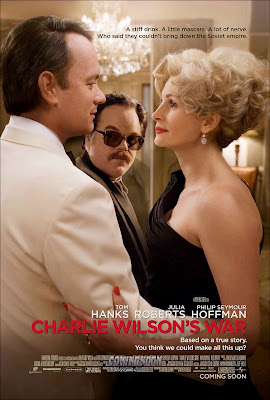
 The Fighting In Afghanistan
 Afghanistan is one of those places where you grow up thinking one day they'll stop fighting. The problem is that the fighting has been going on for so long, it's become all they know. As demonised as it was at the time, the Soviet incursion into Afghanistan was fueled by the constant irritation of Afghan conflicts spilling over into mother Russia over the northern border. A little like how Chechens fight on so close to Moscow is still a irritant.
In a sense, the world jumped on the Soviets because they were communists and chose to ignore why they might drive tanks over the borders in the first place. Certainly, we would not expect the Americans to drive over the border into Mexico just because of the drug trade irritation, but in the 19th century, they did, and that's how they got California and Texas. The point is, the Afghan War for the Russians started in 1980. That's more than way over half of my life that conflict has ripped Afghanistan.
If what the 'Rambo III' movie showed was a naive pro-resistance, anti-communist posturing, 'Charlie Wilson's War' reveals that the US Government was operating with about the same idiotically simple schema. So great a perceived threat was the Soviet Communism, the US government showered the Mujihadeen with weapons with which to fight the commies. They didn't quite need John Rambo, but they sure sent a whole lot of special forces types to deliver these weapons to these people to fight the proxy war. Indeed, it was this kind of ex-military bravado of Congressman Wilson from the second ward of Texas, that culminates in the Russian retreat.
The film also covers the aftermath, where Charlie Wilson is unable to secure any money to rebuild the war-torn nation - thus laving Afghanistan to the dreadful civil wars of the 1990s.
By the time the story has moved on to the present day, it is America that is now stuck in Afghanistan fighting the war that the Russians had fought. Does this remind people of something? yes, it reminds us of the Vietnam War - ad this is where Robert Redford steps in with his film, 'Lions For Lambs'. What is clear from his film is that as well-intended as it might be, America has not really come to grips with the war it is fighting in Afghanistan.
Echoes of Vietnam - A Little Digression
 Just to be a little pedantic I want to run past a pet theory of mine.
My theory goes like this: The greatest threat to the US in the 20th Century was ideology, and the two main ideologies it confronted were Fascism and Communism. In fact there are indications that FDR's long presidency fomented the conditions whereby World War II took the shape that it did. In part it pushed Japan in with the Fascists, and then aggressively blocked trade in order to provoke the attack on Pearl Harbor - yes, the Day that Lives in Infamy, that FDR worked very hard to produce. Admiral Yamamoto might have been the star villain of the day, but FDR pretty much produced that show.
The end result was Japan surrendering to the USA, and thus reverting to the Constitutional Monarchy that it was as late as 1930. Japan's problem was that after Russia it was the country with the most sold copies of Marx's 'Capital' - the Bible for Communists everywhere. So part of the reason Japan lurched to the right in the 1930s was the great fear of Communism as well as the Russian threat to the north. Which explains the Manchurian state as a project to create a buffer state.
Anyway. With the defeat of anti-communist, Fascist Japan in 1945, the USA had to become guarantor for Japan's security in exchange of Japan giving up arms 'forever' in its 'Peace Constitution' as written by MacArthur's GHQ. It was a very clever move by Shigeru Yoshida, because it produced three key results. Japan was able to be America's ally without providing arms or lives; Japan no longer had to confront Communism by itself in the Far East, that job fell to the USA; and Japan prospered economically as a result.
So the pay off of my big theory is this: the USA was fighting the Vietnam War on behalf of Japan.
That's it.
Had WWII not taken shape the way it did and Japan sided with the West, then Japan would have kept its military presence in South East Asia. It would have fallen to Japan to combat Communism in the wake of France pulling out of Indochina, not America. Instead, America got it self dragged into the slip-stream of the evacuating French, and ended up having to expand the war bit by bit - legitimacy be damned.
The logical extension to my theory is that the War in Afghanistan for the US is a war that it inherited from the Russians in the wake of the collapse of the Soviet State, just as it had inherited the Vietnam War from a vacated power in the Far East.
Still Fighting In Afghanistan
The natural question that begs to be answered is, "why are we still fighting in Afghanistan?"
Neither of these films actually come close to addressing the issue in any adequate way or form. It is clear that for both these films and film makers, Afghanistan is a phenomenon in the Husserl sense. It's out there and our cognition struggles to come to grips with it. It's just not manifestly real enough - instead it is understood through the distorted looking glass of the media. Afghanistan may as well be on Mars or in Narnia for most Americans.
 'CWW' delivers on to the fact that the war in Afghanistan from the Afghan perspective is a religious war. It is Julia Roberts' Texan fundraiser character who believes in a crusade against the God-less Communists that lobbies Tom Hanks' rather sardonic, secular Charlie Wilson in supporting the Afghans against the Russians. It is also the Allah Akbar/God is Great chant that convinces Ned Beatty's Arms Committee chief to back Charlie Wilson.
Perhaps what gets lost in the shuffle is that the Afghans were willing to shake hands with the capitalist Christian 'Great Satan' in order to defeat the Godless Communists, and that alliance was never going to endure history. It's a little disconcerting that Charlie Wilson went to help these people and he reduced the help down to sending more weapons. The whole operation to Afghanistan has ballooned into the great black market for arms in Northern Pakistan, and continues to destabilise the region; but the film is incredibly *light* in discussing those issues.
 In 'LFL', Afghanistan is like the surface of the meteor in 'Armageddon'. It is dark with blue light onto black edgy rocks, with deep snow. Two stranded soldiers US soldiers fight to the death with Taliban fighters we never get to see face to face. No glory-gore of Rambo IV here; just a prosaic tragedy. What's even sadder is that the best discourse the film has to offer as to why they are in Afghanistan is delivered by Tom Cruise, who says with the same Scientology-Stare to Meryl Streep "Do you want to win the War on Terror, yes or no?"
When Streep's character prevaricates, he thunders "It's a very simple question, Yes or No?"
It actually reminded me of the way he said "There'll be no more of this spectator-ism. You're either in the game or get out of the stadium!" in that horrible Scientology video that did the rounds. I think Tom Cruise's credibility as a human being took a huge hit with that interview.
Anyway, it's clear that 'LFL' is saying they don't really know why the USA is in Afghanistan, and that what it is trying to do there."
 Let's face it, we live in a time when the First World is facing two ugly wars in Iraq and Afghanistan, as well as seeing the multitude of conflicts in Africa and elsewhere; and Tom Cruise's central metaphysical concern is building a five-panic-room house in Colorado for the day Xenu attacks Earth.
Err... right, Tom.
In any case, it's not entirely clear why the Americans are there but for repeated references to September 11. I don't think that is all there is to it, so I don't know why we choose to dumb ourselves down by thinking that is the case. By the same token, the film does a bit of disservice to itself there.
Cryptic Title
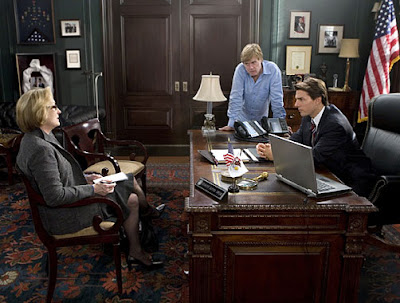 Just what does 'Lions For Lambs' Mean? you might ask.
It's a reference made in the film that explains it is how WWI Germans saw the English Army - that their soldiers were brave as Lions, but the Generals were like Lambs.
I'm not so sure the simile works at all. it's not that the USA command is meek. It's more like it's Blind to circumstance, Deaf to criticism and decidedly tactical when it probably needs to be thought more broadly strategic terms.
The film only delivers half the point. The big point it does deliver is that Tom Cruise really is an acting light weight when played against to Meryl Streep. He's simply awful in this film - a bit like a lamb sent out to face a lioness.
Hollywood Liberalism
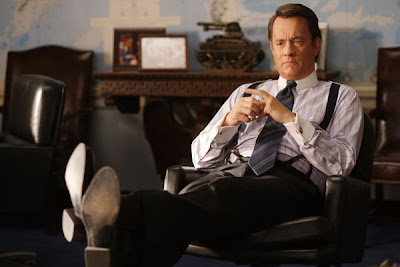 The GOP always complains that Hollywood is pro-Democrat. This is from the party that boasts Clint Eastwood AND Arnold Schwarzenegger.
Still, you do kind of understand. Hanoi Jane and all that; the Hollywood mob seem incredibly keen to say no to war even though they keep making fiction filled with the stuff.
What's really galling about 'CWW' is how the film celebrates the Soviet defeat with innocent joy and yet totally fails to face up to the failure of managing Afghanistan after that moment. The film simply rolls up a quote from Wilson that says they "completely fucked up the End Game". It's a little disingenuous to leave it at that, given the size of the fiasco. And it's not something I'm willing to lay at just George W. Bush's feet, but also to his father George Herbert Walker Bush who did plenty for Gulf War I but failed to see the missed opportunities, as well as Bill Clinton who did mostly nothing of lasting importance.
The point is, it's a bit on the nose to say it was "their fault". It was collectively, all our faults we chose to look after our backyards instead of addressing real, serious problems that were emerging out there. The wide-eyed "Oh boy shucks" of 'CWW' is totally not what the doctor ordered.
 'LFL' fares a little better in that it is willing to discuss the notion of winning the hearts and minds of the Afghan people, but it's spoken by Tom Cruise's character Jasper Irving, who thinks he's going o accomplish this through winning some battles. So in the end, nobody comes up with a concrete plan to do that; they simply disagree with more fighting. I can see why the GOP might object to Hollywood liberalism.
For my part, I'm not sure more fighting is the answer. If anything they need to come up with a strategy for demilitarising and disarming these people. And Armies can be handy for that. In any case, it's clear that the writers in Hollywood can barely get their heads around conceiving of the war in Afghanistan as an extension of "9/11"; what chance have they got of seeing the war as part of the great counter-colonial struggle in that part of the world? In neither film do the film making teams offer any concrete alternatives to the fiascoes going down in Afghanistan.
It's easy objecting to a war, and an unpopular war at that. It's another thing to conceive of how to extricate the First World from the mess that is Afghanistan. In that sense the Hawks are right to grumble about Hollywood for taking the easy shots without offering an alternative option. To date, it's been send in Iron Man, send in Rambo, send in a couple of young actors to play soldiers.
On Robert Redford
 Before Tom Cruise was the pretty boy of Hollywood that could sell schlock with his smile, there was Robert Redford. Robert Redford the actor was such an All-American boy it seemed like he was caste from a mold. The blond, blue- eyed visage, the controlled, mellifluous voice, the bolt-upright posture, the glance, the smile, all added up to the definition of a Hollywood Movies Star.
Since then it's actually remarkable how few men have actually stepped into that mold. As it turned out, they really haven't been able to make another one of these guys. Perhaps America has moved on, and perhaps even the demographic has moved on. After all, how hyper-Aryan -looking could you get beyond Robert Redford?
An yet Redford has continually made films that are against the fascist impulses of America. My favorite performance by Redford is possibly his work in 'All The President's Men' where his understated delivery underlined the gritty realism of that picture. He never got histrionic with that role, while Dustin Hoffman was let loose on the Bernstein character like a hungry hound.
The most problematised role for me is actually his part in 'The Natural'. He was simply too old to have played that role of Roy Hobbs - he looks stiff and ungainly, and you never quite buy the time line of events as a result. In any case, I still like the film and it's not like he ruins it for me; but I do remember sitting alone in the dark watching the film thinking, "this is kinda wrong, no?"
I recall being at AFTRS, and they showed 'Out of Africa' as a case where a star can distort the script. The contention was that having cast Redford against Streep, they had to expand that role to accommodate his star stature, an that this resulted in a bad script. While I never liked the film all that much, I always thought it was a great move to have Redford in it. It was interesting to see he cast Streep to play the journalist. in 'LFL'. It certainly evoked a lot of memories. It even occurred to me that they sure haven't found more where he came from.
He means well, and he's shown spine, and that's a whole lot better than many who earn stardom in Tinseltown. The last Redford sequence in 'LFL' where he puts on the jacket and ushers out the kid almost seems like a goodbye note to the audience.
The last 'movie double' I did stretched me (and credulity) a bit so I'm going to handle 2 films with at least a modicum of common concern. Today's movie double combo is 'Charlie Wilson's War' and 'Lions for Lambs'
Coming out of watching Rambo and reminiscing about the 1980s and the war in Afghanistan, it seemed appropriate to at least look at what other texts were floating around at the moment to explain the mess, so to speak.

 The Fighting In Afghanistan
 Afghanistan is one of those places where you grow up thinking one day they'll stop fighting. The problem is that the fighting has been going on for so long, it's become all they know. As demonised as it was at the time, the Soviet incursion into Afghanistan was fueled by the constant irritation of Afghan conflicts spilling over into mother Russia over the northern border. A little like how Chechens fight on so close to Moscow is still a irritant.
In a sense, the world jumped on the Soviets because they were communists and chose to ignore why they might drive tanks over the borders in the first place. Certainly, we would not expect the Americans to drive over the border into Mexico just because of the drug trade irritation, but in the 19th century, they did, and that's how they got California and Texas. The point is, the Afghan War for the Russians started in 1980. That's more than way over half of my life that conflict has ripped Afghanistan.
If what the 'Rambo III' movie showed was a naive pro-resistance, anti-communist posturing, 'Charlie Wilson's War' reveals that the US Government was operating with about the same idiotically simple schema. So great a perceived threat was the Soviet Communism, the US government showered the Mujihadeen with weapons with which to fight the commies. They didn't quite need John Rambo, but they sure sent a whole lot of special forces types to deliver these weapons to these people to fight the proxy war. Indeed, it was this kind of ex-military bravado of Congressman Wilson from the second ward of Texas, that culminates in the Russian retreat.
The film also covers the aftermath, where Charlie Wilson is unable to secure any money to rebuild the war-torn nation - thus laving Afghanistan to the dreadful civil wars of the 1990s.
By the time the story has moved on to the present day, it is America that is now stuck in Afghanistan fighting the war that the Russians had fought. Does this remind people of something? yes, it reminds us of the Vietnam War - ad this is where Robert Redford steps in with his film, 'Lions For Lambs'. What is clear from his film is that as well-intended as it might be, America has not really come to grips with the war it is fighting in Afghanistan.
Echoes of Vietnam - A Little Digression
 Just to be a little pedantic I want to run past a pet theory of mine.
My theory goes like this: The greatest threat to the US in the 20th Century was ideology, and the two main ideologies it confronted were Fascism and Communism. In fact there are indications that FDR's long presidency fomented the conditions whereby World War II took the shape that it did. In part it pushed Japan in with the Fascists, and then aggressively blocked trade in order to provoke the attack on Pearl Harbor - yes, the Day that Lives in Infamy, that FDR worked very hard to produce. Admiral Yamamoto might have been the star villain of the day, but FDR pretty much produced that show.
The end result was Japan surrendering to the USA, and thus reverting to the Constitutional Monarchy that it was as late as 1930. Japan's problem was that after Russia it was the country with the most sold copies of Marx's 'Capital' - the Bible for Communists everywhere. So part of the reason Japan lurched to the right in the 1930s was the great fear of Communism as well as the Russian threat to the north. Which explains the Manchurian state as a project to create a buffer state.
Anyway. With the defeat of anti-communist, Fascist Japan in 1945, the USA had to become guarantor for Japan's security in exchange of Japan giving up arms 'forever' in its 'Peace Constitution' as written by MacArthur's GHQ. It was a very clever move by Shigeru Yoshida, because it produced three key results. Japan was able to be America's ally without providing arms or lives; Japan no longer had to confront Communism by itself in the Far East, that job fell to the USA; and Japan prospered economically as a result.
So the pay off of my big theory is this: the USA was fighting the Vietnam War on behalf of Japan.
That's it.
Had WWII not taken shape the way it did and Japan sided with the West, then Japan would have kept its military presence in South East Asia. It would have fallen to Japan to combat Communism in the wake of France pulling out of Indochina, not America. Instead, America got it self dragged into the slip-stream of the evacuating French, and ended up having to expand the war bit by bit - legitimacy be damned.
The logical extension to my theory is that the War in Afghanistan for the US is a war that it inherited from the Russians in the wake of the collapse of the Soviet State, just as it had inherited the Vietnam War from a vacated power in the Far East.
Still Fighting In Afghanistan
The natural question that begs to be answered is, "why are we still fighting in Afghanistan?"
Neither of these films actually come close to addressing the issue in any adequate way or form. It is clear that for both these films and film makers, Afghanistan is a phenomenon in the Husserl sense. It's out there and our cognition struggles to come to grips with it. It's just not manifestly real enough - instead it is understood through the distorted looking glass of the media. Afghanistan may as well be on Mars or in Narnia for most Americans.
 'CWW' delivers on to the fact that the war in Afghanistan from the Afghan perspective is a religious war. It is Julia Roberts' Texan fundraiser character who believes in a crusade against the God-less Communists that lobbies Tom Hanks' rather sardonic, secular Charlie Wilson in supporting the Afghans against the Russians. It is also the Allah Akbar/God is Great chant that convinces Ned Beatty's Arms Committee chief to back Charlie Wilson.
Perhaps what gets lost in the shuffle is that the Afghans were willing to shake hands with the capitalist Christian 'Great Satan' in order to defeat the Godless Communists, and that alliance was never going to endure history. It's a little disconcerting that Charlie Wilson went to help these people and he reduced the help down to sending more weapons. The whole operation to Afghanistan has ballooned into the great black market for arms in Northern Pakistan, and continues to destabilise the region; but the film is incredibly *light* in discussing those issues.
 In 'LFL', Afghanistan is like the surface of the meteor in 'Armageddon'. It is dark with blue light onto black edgy rocks, with deep snow. Two stranded soldiers US soldiers fight to the death with Taliban fighters we never get to see face to face. No glory-gore of Rambo IV here; just a prosaic tragedy. What's even sadder is that the best discourse the film has to offer as to why they are in Afghanistan is delivered by Tom Cruise, who says with the same Scientology-Stare to Meryl Streep "Do you want to win the War on Terror, yes or no?"
When Streep's character prevaricates, he thunders "It's a very simple question, Yes or No?"
It actually reminded me of the way he said "There'll be no more of this spectator-ism. You're either in the game or get out of the stadium!" in that horrible Scientology video that did the rounds. I think Tom Cruise's credibility as a human being took a huge hit with that interview.
Anyway, it's clear that 'LFL' is saying they don't really know why the USA is in Afghanistan, and that what it is trying to do there."
 Let's face it, we live in a time when the First World is facing two ugly wars in Iraq and Afghanistan, as well as seeing the multitude of conflicts in Africa and elsewhere; and Tom Cruise's central metaphysical concern is building a five-panic-room house in Colorado for the day Xenu attacks Earth.
Err... right, Tom.
In any case, it's not entirely clear why the Americans are there but for repeated references to September 11. I don't think that is all there is to it, so I don't know why we choose to dumb ourselves down by thinking that is the case. By the same token, the film does a bit of disservice to itself there.
Cryptic Title
 Just what does 'Lions For Lambs' Mean? you might ask.
It's a reference made in the film that explains it is how WWI Germans saw the English Army - that their soldiers were brave as Lions, but the Generals were like Lambs.
I'm not so sure the simile works at all. it's not that the USA command is meek. It's more like it's Blind to circumstance, Deaf to criticism and decidedly tactical when it probably needs to be thought more broadly strategic terms.
The film only delivers half the point. The big point it does deliver is that Tom Cruise really is an acting light weight when played against to Meryl Streep. He's simply awful in this film - a bit like a lamb sent out to face a lioness.
Hollywood Liberalism
 The GOP always complains that Hollywood is pro-Democrat. This is from the party that boasts Clint Eastwood AND Arnold Schwarzenegger.
Still, you do kind of understand. Hanoi Jane and all that; the Hollywood mob seem incredibly keen to say no to war even though they keep making fiction filled with the stuff.
What's really galling about 'CWW' is how the film celebrates the Soviet defeat with innocent joy and yet totally fails to face up to the failure of managing Afghanistan after that moment. The film simply rolls up a quote from Wilson that says they "completely fucked up the End Game". It's a little disingenuous to leave it at that, given the size of the fiasco. And it's not something I'm willing to lay at just George W. Bush's feet, but also to his father George Herbert Walker Bush who did plenty for Gulf War I but failed to see the missed opportunities, as well as Bill Clinton who did mostly nothing of lasting importance.
The point is, it's a bit on the nose to say it was "their fault". It was collectively, all our faults we chose to look after our backyards instead of addressing real, serious problems that were emerging out there. The wide-eyed "Oh boy shucks" of 'CWW' is totally not what the doctor ordered.
 'LFL' fares a little better in that it is willing to discuss the notion of winning the hearts and minds of the Afghan people, but it's spoken by Tom Cruise's character Jasper Irving, who thinks he's going o accomplish this through winning some battles. So in the end, nobody comes up with a concrete plan to do that; they simply disagree with more fighting. I can see why the GOP might object to Hollywood liberalism.
For my part, I'm not sure more fighting is the answer. If anything they need to come up with a strategy for demilitarising and disarming these people. And Armies can be handy for that. In any case, it's clear that the writers in Hollywood can barely get their heads around conceiving of the war in Afghanistan as an extension of "9/11"; what chance have they got of seeing the war as part of the great counter-colonial struggle in that part of the world? In neither film do the film making teams offer any concrete alternatives to the fiascoes going down in Afghanistan.
It's easy objecting to a war, and an unpopular war at that. It's another thing to conceive of how to extricate the First World from the mess that is Afghanistan. In that sense the Hawks are right to grumble about Hollywood for taking the easy shots without offering an alternative option. To date, it's been send in Iron Man, send in Rambo, send in a couple of young actors to play soldiers.
On Robert Redford
 Before Tom Cruise was the pretty boy of Hollywood that could sell schlock with his smile, there was Robert Redford. Robert Redford the actor was such an All-American boy it seemed like he was caste from a mold. The blond, blue- eyed visage, the controlled, mellifluous voice, the bolt-upright posture, the glance, the smile, all added up to the definition of a Hollywood Movies Star.
Since then it's actually remarkable how few men have actually stepped into that mold. As it turned out, they really haven't been able to make another one of these guys. Perhaps America has moved on, and perhaps even the demographic has moved on. After all, how hyper-Aryan -looking could you get beyond Robert Redford?
An yet Redford has continually made films that are against the fascist impulses of America. My favorite performance by Redford is possibly his work in 'All The President's Men' where his understated delivery underlined the gritty realism of that picture. He never got histrionic with that role, while Dustin Hoffman was let loose on the Bernstein character like a hungry hound.
The most problematised role for me is actually his part in 'The Natural'. He was simply too old to have played that role of Roy Hobbs - he looks stiff and ungainly, and you never quite buy the time line of events as a result. In any case, I still like the film and it's not like he ruins it for me; but I do remember sitting alone in the dark watching the film thinking, "this is kinda wrong, no?"
I recall being at AFTRS, and they showed 'Out of Africa' as a case where a star can distort the script. The contention was that having cast Redford against Streep, they had to expand that role to accommodate his star stature, an that this resulted in a bad script. While I never liked the film all that much, I always thought it was a great move to have Redford in it. It was interesting to see he cast Streep to play the journalist. in 'LFL'. It certainly evoked a lot of memories. It even occurred to me that they sure haven't found more where he came from.
He means well, and he's shown spine, and that's a whole lot better than many who earn stardom in Tinseltown. The last Redford sequence in 'LFL' where he puts on the jacket and ushers out the kid almost seems like a goodbye note to the audience.
Subscribe to:
Posts (Atom)