Showing posts with label Prog Rock. Show all posts

2016/12/27

Listening To...

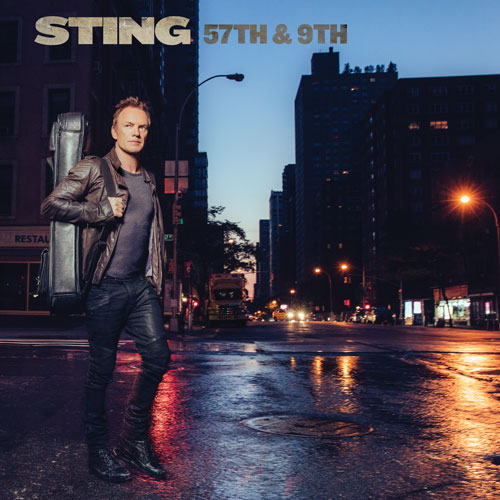
'57th & 9th' - Sting


The good news is 2016 didn't claim him and here's a new album. The not so good news is that it's so-so. The better news is that it's ostensibly a straight up rock album. For somebody who bought his damn Lute record with Deutsche Grammophon, you approach it with trepidation. It really has been a while since Sting gave us a straight up rocker.

He's been talking about this one like he's going back to his roots but of course his roots is jazz, so it's a bit deceptive. I guess some of these numbers could be perceived to be Police-like numbers, but the beats-per-minute slows down rapidly during the album and gets a little snoozy. I'd hoped he'd go through the whole album at 145bpm, because that's where The Police found gold on 'Outlandos' and 'Regatta', but also, no, he slips back towards a 'Nothing Like The Sun' vibe which isn't what was really being hoped for.

If anything, the single cut 'I Can't Stop Thinking About You' should have been done with the Police. The rest, not so much. I guess if the album rocked any harder, it would have been quicker to reassemble the Police, but that's one place to which he's never really going back. More's the pity.

Blast From The Past 'Alchemy' - Dire Straits


I picked this up because I recently got into a conversation with an old friend about just what the hell happened to Dire Straits after their fourth studio album 'Love Over Gold'. Well, they did this double live album which features a bit of Brett Whitley art on the cover. It was quite something back in the day, with its mind-blowing gatefold double LP cover. Behold:
Oh yeah.
As it turns out, the live versions these classic Dire Straits tracks go on and on and it got me thinking about why I liked the album 'Love Over Gold' so much and of course Mark Knopfler does the Steve Howe thing of swapping guitars mid-song and radically going from classical guitar tones to Stratocaster. That, is one of the hallmarks of prog rock, together with the really long songs; so it finally dawned on me just how much prog rock Dire Straits were doing on their first four albums without really telling the world that's what they were doing. You could draw a line from 'And You And I' to 'Romeo and Juliet'. If you substitute out Roger Dean and insert Brett Whitely, well, you get the idea.

What happened with Mark Knopfler after 'Alchemy' was he moved on to playing a Gibson Les Paul a lot more as his main guitar, than his Stratocaster, and suddenly it sounded a lot less interesting for me. 'Brothers in Arms' was the huge international hit, but I really don't like that album as much as I like the first four studio albums. As with Sting, he's never really managed to recapture that magic of his early work.

2015/07/07

Honey I Bolted Together A Telecaster

The Latest In The Guitar Lab


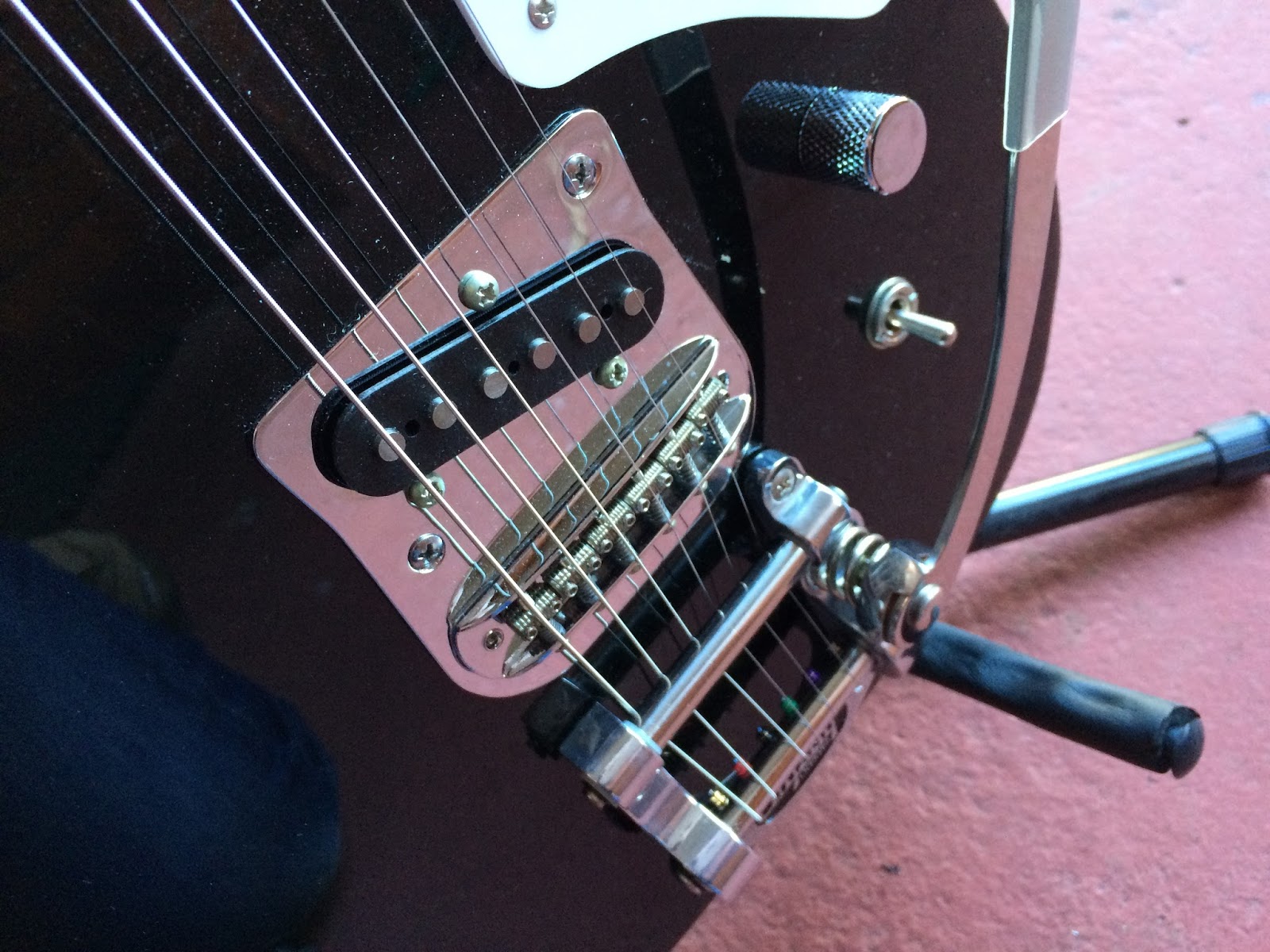
It's been a while since I've built a guitar. It's a mix of the AUD slipping from parity, the general sense of "what more do I need to do?" and running out of steam that's kept me from doing anything, but this week I've managed to get my gumption up and screwed on a neck to a body. Yep, 4 screws and suddenly I had myself a new guitar.

The neck is a Mexican Stratocaster neck. The frets feel small compared to the normal jumbos I'm used to, but it's a very nice vintage gloss finish neck. It's not quite a flat deck - there's a bit of a camber but barely noticeable when you play. The only thing that's not stock about it are the Fender locking tuners I've put on to it.


The body is the wild card in this marriage of parts. It's a Squire Vintage Modified Cabronita body that was going for cheap, even though it was loaded. The pickups are stock Fender pickups - a Fidelitron in the neck which mimics the Gretsch Filtertrons, and a Alnico V single coil in the bridge. There's much scuttlebutt on the net as to who exactly manufactured the single coils. There's strong unconfirmed suspicions/nods that it's a Tonerider. The body wood is basswood, but it is very heavy and solid.


There is also a Bigsby-licensed tremolo on it, which is surprisingly sturdy but a *bitch* to restring. Overall the guitar has a nice vintage-y tone to it and plays really well.

2014/11/16

Yes - State Theatre 15/Nov/2014

Majestic Nostalgia

There's nothing so life affirming as hearing the music you loved growing up, played live by the very people. There's definitely something comforting in hearing something you know like the back of your hand, visiting the emotional landscape you trod so often in your adolescence. At some point that's all the pleasure you need, all the comfort you need. Should Yes be breaking new ground even unto this point in their careers? Is that a fair kind of expectation? Should their fans have to step up to new horizons with this band? It sure makes one wonder.

In the mean time, a night of Yes going through mostly their older portions of their successful catalogue is a night of majestic nostalgia.

What's Good About It

What's good about Yes this time through is that Jon Davison has become more accustomed to the music and found his voice within the music. The last time I saw them, Davison had just arrived and was singing in only his fifth gig with the band. The band have also tinkered with the arrangements so even the really familiar tracks had little interesting wrinkles in them.

The light show was better than last time and they sound really good in the State Theatre. It just seems to be a good fit for the music and the sound and the space. With a few odd moments, the playing is still superb. Overall, the band still has the nimbleness of turning on a dime as well as the rigorous discipline of playing complex passages with precision.

More importantly the gestalt of Yes music was very much alive and present, and so the sonorous passages of their most splendiferous amazing wonderful extraordinary beautiful music, came alive. There were no metaphorical clowns, no tigers, lions or bears. Just the glory of Yes music.

Jon Anderson quipped last year "Squire said, 'we don't do reggae'". It's a very good thing that Yes play on the beat, uncompromising and hard. It's the way rock bands ought to be.

What's Bad About It

They started a little slow with the opening number 'Close to the Edge'. It was so noticeably slow that I thought it was going to be a really long night. At one point, after the choral section of 'Close to the Edge' you could hear Geoff Downes push the beat to speed it up but the band fell back to the slower pace straight after the organ break. Sometime during the late part of 'And You And I' the band sort of woke up and started playing at a more familiar speed. By the time they were into 'Siberian Khatru', they were playing with gusto, which was a relief.

It was probably more 'interesting' than 'bad', but for the first twenty minutes it really felt like it was going to be a 3hour concert of Yes-In-Slo-Mo.

What's Interesting About It

With any Yes concert, you always find the choice of material interesting. This concert featured a full in-order play through of 'Close to the Edge' and 'Fragile'. In-between were a couple of tracks form the new album 'Heaven And Earth', while the encore was 'I've Seen All Good People' and 'Owner of a Lonely Heart'.

On the one hand, it was a selection that really favours the golden era of the early 70s when they made their mark, with a couple of current pieces and the hit single from the 1980s. You can't fault the choice, but on the other hand you're left wondering about all the other great moments. There's effectively nothing from 'Tales from Topographic Oceans' through to 'Drama', then 'Big Generator' through to 'Fly From Here'. That's a lot of great music they're not addressing at all. They can't please everyone, but they didn't really go out of their way to please anybody but the Baby Boomers and one token gesture to their 80s success.

That being said - and I don't mean the above as negatively as it might sound - it was a setlist of beautiful Yes music. The highlight of the night was surely the material off 'Fragile' where the most progressive arrangements were brought to life. 'We Have Heaven' segueing into 'South Side of the Sky' was masterfully executed and the vocal arrangements really blossomed beautifully in those sections. 'South Side of the Sky' is one of those rarer gems of Yes' catalogue that doesn't make it on to the set list as often as say, 'Roundabout' or 'Heart of the Sunrise', so it was fully contextualised against the rest of 'Fragile'. The downside is that you wonder if they couldn't find a way to play more  grand things than 'Cans and Brahms' and 'Five percent For Nothing'.

For Absent Friends

'Cans And Brahms' and 'Five Percent For Nothing' were the oddities of the night. 'Cans and Brahms' was in its heyday, Rick Wakeman's spot to show off his chops and the latest sounds of his arsenal of Keyboards. Geoff Downes has the chops, but when he plays it, it becomes historic curio that highlights the quaint old keyboard sounds.

'Five Percent For Nothing' was Bill Bruford's short compositional contribution to 'Fragile'. When the band plays the highly abstract jazz-inflected piece, we're reminded that Bill's long absence from the band, and the guys are just going through the motion for the sake of completeness in playing the whole album. They're both strange moments in the concert. By going for completion, the band opens up an emotional space where other members used to sit, and we become aware of it.

And of course, as good as Jon Davison is, the biggest absent friend is Jon Anderson. Having seen his solo show last year, there were moments I reflected on him not being in the band. Last time they were here without Anderson, it seemed to open up new possibilities. This time through it seemed more of a sad absence.

I Worried About Alan White

In previous occasions, Alan White was the rock solid time-keeper, giving tremendous impetus to the music. This night made me wonder a bit, what with the slowness the start as well as the drum sound not being as prominent and powerful as last time. He just didn't quite sound like ALAN WHITE, the guy who has that big sound on 'Instant Karma' as well as the thunderous fills on 'Drama'. Last time I saw Yes, I walked away feeling like he played the best. This time I felt worried for the first parts of the night, like maybe he was under the weather or something. It just didn't have the same sort of oomph as last time.

And that makes you worry. Bands slow down over time. It's inevitable with maturing and ageing. The flash and sizzle gives way to considered deliberation, but a more prosaic explanation is that people grow old. While the band laboured through the early part of 'Close to the Edge', I really thought "jeez, is the end of Yes nigh?"
It reminded me of Peter Banks' death. It did.

When the pace finally picked up - thankfully - the usual bump-and-grind came back. I guess intimations of mortality is part of great art but for a moment there, I really worried.

Steve Howe And The Mid Range Honk

One of the most interesting things about Yes if you're a guitar geek like me is how Steve Howe changes guitars. It's rare that somebody plays 3 prestige semi-acoustics, let alone the Fender double neck slide guitar and the Line 6 Guitar on the stand. Across all the guitars he plays, there is one thread to the sound that marks out his tone and it's this mid-range honk. A lot of guitar players - especially guys given to distortion and overdrive cut the mids. That scooped mids on the guitar is the sound of metal, and this the big difference why Yes just won't sound metal, even with all the furious riffing.

Because Steve Howe plays these semi-acoustics and usually with a clean tone, he can keep the mid-range in there. In turn, the midrange is everywhere in his tone across all the guitars including the solid bodies. There are moments he sounds unlike any other player on the planet - it can only be Steve Howe playing. Then there are moments his tone even sounds like Frank Zappa's clean tone on 'Zoot Allures', when he gets on the red Stratocaster. When he hits the harmonics, they have this ballsy mid tone that gives them a bloom and sparkling full-ness. It's quite the master lesson in tonal control.

Steve Howe has also changed the solo he plays on 'Owner Of A Lonely Heart'. It's thankfully, no longer the weird country lick melange but a closer approximation of the angular pentatonic played by Trevor Rabin on the original. It sounds a lot better now. The 80s hyper-modernism of the song is brought back into sharp focus.

More Rickenbacker 4001

Chris Squire on the other hand had fewer changes of bass guitars than last time. Most of the night he was on his Rickenbacker 4001 bass.  This is most likely because most of the material played was from the era where the Rickenbacker was central to the sound. If there was one upside to the setlist, it was that there was plenty of Rickenbacker 4001 action and as you know, I like it that way.

I think his particular 4001 is a 1964 model. That thing is like 50years old now, and still going strong.

The man who described playing in Yes to be like being a trapeze artist where precision is everything, played and sang with about precision as humanly possible. That alone is always a kind of spectacle.

'Heaven And Hell Earth'

I'm not a fan of the new album that came out earlier this year. It doesn't really kick up a pulse and it doesn't really go in for prog rock ideas much; instead, it gives way to a kind of MOR/AOR vibe which frankly doesn't fit in with the rest of their oeuvre. I was going to write about it, but I was so disappointed I shelved doing the crit on this blog. It was like a moment where the band took a turn and went the other way to where you wanted them to go (which is how I feel about Peter Gabriel after 'So').

Be that as it may, as they say in mobster movies, the 2 songs from the album played live sounded great. The band certainly plays this material live with much more conviction than you hear on the album. They sounded a lot more interesting and complex - exactly the way Yes is supposed to be. I'm beginning to think that maybe the mix on the album is not representative of the music that's actually on it.

Play Any 3 Albums

It's highly unlikely but I want them to move outside of the early 70's a bit. If it's wish-casting, I'd like to hear 'Relayer', 'Drama' and 'The Ladder' in its entirety. I'd even settle for 'Tomato' or 'Open Your Eyes'. If the encore was 'Roundabout' or 'Starship Trooper' after doing that, I'd be more than totally okay with it.

2014/09/19

Quick Shots 18/Sep/2014

The Sort-of-Zeppelin Album


I've got myself a copy of "Three Week Hero" by PJ Proby. "Three Week Hero" is that rare album that boasts Led Zeppelin as the session musicians, just as they were on the cusp of turning into Led Zeppelin from being the New Yardbirds. The story is well told so it's not worth rehashing but basically Jimmy Page and John Paul Jones had one last session to do as session musicians and they pulled in the rest of Led Zeppelin - Robert Plant and John Bonham - to round out the backing band.

The funny thing is that it's immediately obvious it's the guys from Zeppelin doing their thing. The instruments are the very same that feature on 'Led Zeppelin I'. The music itself is hopelessly psychedelic hippy-ism so the band just trundles along. The octane value never goes up so the album never grooves or kicks like 'Led Zeppelin I', so it's an odd experience. I guess it's a record that shows how soul destroying session work would have been.

PJ Proby made the observation that he never saw the guys from the band again. I have a hunch I might never listen to this album again.

The Human Stamp Collection Album


The other CD I got form Amazon is this little number. Lots of people from 70s and 80s prog acts make an appearance on this album.I've had it for a couple of days in the car and it's got its moments. It's certainly better than 'Heaven and Earth' by Yes, namely because it actually has a pulse.

It's sort of got a great collection of Bass players going, with Chris Squire, Tony Levin and John Wetton making an appearance. Steve Hillage is also on it as are Rick Wakeman and Geoff Downes. Better still, when they come on, you can instantly tell it's them, which is really cool. Somebody has to make prog albums.

Spiritual BS For The Musically Inclined


I've been trying to get a hold of Rudolf Steiner's lectures on music for some years now. The quest started when I went through a phase of listening to lots and lots of Glenn Gould playing Bach and Oscar peterson playing jazz and Steve Vai playing his way-out guitar. I kind of talked myself into a concept frenzy of reaching for the esoteric in music through music and of course nobody had written anything about such notions except tangentially, Rudolf Steiner's lectures kept being referenced.

Well, here they are in one book and it makes for some seriously whacky - nay whacked out- reading. I can't say I ascribe, say, any of my music to spiritual states of my mind and dreaming lucidly in my sleep. And I sure as heck don't know if Steiner was even passingly familiar with jazz or blues (he was too early in history for rock), so there's really nothing of practical value here, but it does show somebody trying to write something about music without actually being a musician. It's weird - a bit like if I wrote a book on architecture or woodblock printing and ascribed all the creative process to sleeping and lucid dreaming. You'd think I'd gone nuts. Well, that's how nutty this book is.

2014/07/25

Unfinished Business In The ALP

Gillard Wanted To Handball The PM Chair To Combet

I like Greg Combet. He's the only politician I know of who has admitted to being a fan of Frank Zappa. He's done now, but while he was around, I had hopes for the man. Perhaps these hopes were misplaced, given that the sort of man who likes Frank Zappa might look at Australian Politics and choose to walk away. I have to respect that as a voter, but it's still sad. Maybe it got too hard to work in Parliament all week and go home and put on a Frank Zappa record and there is Frank singing "Keep it greasy so it goes down easy". I'd imagine the cognitive dissonance might become unbearable. And so it is that he left Parliament at the end of his term at the 2013 election.

The news today - more like a non-news really - is that Julia Gillard offered to hand him the Prime Minster's chair, just to fend off Kevin Rudd. This is pretty bleak material.
An embattled Julia Gillard secretly offered to stand down as Prime Minister in June 2013 and secure the leadership for then Climate Change and Industry minister Greg Combet in order to fend off Kevin Rudd, Mr Combet has revealed.

But dogged by months of ill-health, and unsure that a switch to a third leadership contender so close to an election would improve Labor’s position, Mr Combet declined the chance to be prime minister.

‘‘I was struggling a good deal personally by the time June [2013] came around’’ Mr Combet told Fairfax Media in an interview this week. ‘‘I was in constant pain with the problems that I was having, and the thought of taking on additional responsibility and not being 100 per cent fit to do it, in that febrile environment, it didn’t look easy.’’

This ALP factional infighting is pretty awful stuff. It partly goes with the terrain of the Westminster system, and over the years we've been made to be inured to its odd outcomes. The ins and outs of these machinations are way beyond the purview of the electorate, and are subject to influences from such things as the Unions and lobby groups. It's just difficult to understand how they could have cocked up so many decisions along the way.
He says he remains convinced that former Opposition Leader Kim Beazley would have won the 2007 federal election and become a highly successful Labor Prime Minister if Mr Rudd had not dislodged him.

ACTU polling as part of the Your Rights At Work Campaign in the run up to the 2007 election left him ‘‘completely convinced Beazley would have won’’, which would have resulted in a ‘‘vastly more experienced, mature person as Prime Minister presiding over, for want of a better description, a really grown up government, avoiding all the mistakes’’.

‘‘Neither Julia nor Kevin had had a lot of experience in leadership roles and I think that impacted on their capacity to do the job’’ Mr Combet told Fairfax Media.

So at least we were right all along in 2007, that the Rudd-Gillard leadership was a balls-up waiting to happen. It's a shame I can't point to neither Kevin Rudd nor Julia Gillard as the same kinds of leaders as Paul Keating, Bob Hawke and Gough Whitlam before them. The tumultuous six years in government exposed all the problems of the ALP that went unsolved since Keating lost in 1996. The problem is compounded by the fact that neither Kim Beazley nor Simon Crean were able to restructure the party in the way it needed to be restructured, and Mark Latham's turn was certainly hobbled by the same influences that replaced Beazley twice, that put in Rudd, removed Rudd, removed Gillard and essentially burnt the metaphorical house down.

Oh, and Ms. Gillard, I will never forget the slight you made when you said you were not a social democrat.

Here's Mark Latham being particularly frank about it.
Faulkner’s reform plan, to be put to State Conference this weekend, is to allow ALP branch members to select the party’s upper house tickets. Having given rank-and-file members a say in the selection of Labor’s federal and state leaders, why shouldn’t they be empowered to preselect upper house candidates? Why doesn’t Clements trust the True Believers who staff the polling booths, who keep their local branches alive, who fight so passionately for the cause of Labor?

Far from restricting rank-and-file union involvement, democratisation encourages it. It says to union members: don’t allow union secretaries doubling up as factional bosses to make all the big decisions. Join your local ALP branch and have a direct say in how the party is run: in picking federal and state leaders, in selecting Labor’s lower and upper house candidates.

This is what Faulkner is trying to achieve: Labor as a membership-based party, rather than a narrow factional-based clique.

Mark Latham's been made out to be a crazy person by the media which must be galling because he commentates in the media; and once upon a decade ago, he was the guy trying to put together a way back to office, when the party machine had run through both Beazley and Crean and found them wanting. It's hard to forget those terrible years either, together with the terrible campaign and defeat that followed. And all that time, the likes of Mark Arbib and Paul Howes were fucking shit up from behind the scenes.

It's really hard to forgive the ALP. Especially if you don't want to vote for the right.

2014/06/28

Crimson ProjeKCt @ The Hi-Fi - Sydney 27/Jun/2014

21st Century Touring Band

King Crimson have had so many member changes there have even been off-shoot bands that play King Crimson material but in a different vernacular such as the Crimson Jazz Trio. It shouldn't be surprising to see Adrian Belew fronting a band that features Tony Levin and Pat Mastelotto playing King Crimson numbers. Rumour has it that founding patriarch Robert Fripp never wants to tour Australia so this is about as close to seeing King Crimson live in Australia we're ever going to get. The other 3 members Julie Slick, Tobias Ralph and Markus Reuter round out the formidable sextet and the rest is prog rock, loud and raw. Beware the dinosaurs.

This is the first time I know of that some incarnation of King Crimson are playing their numbers in Australia. I have waited for this for over 30years. Kind of goes to show Australia is still a cultural backwater.

What's Good About It

King Crimson have so many different phases to match the number of personnel who have come and gone. This band does not feature any of the members from the the pre-1974 bust up that prompted Robert Fripp to leave the business for 2 years and then move to New York, and yet their renditions of the 70s classic numbers such as 'Larks Tongues in Aspic Part I' and 'Red' are played immaculately. The post 90s double-trio numbers get a good working out as well, but the real meat and potatoes of the King Crimson material lies in the tricolour albums 'Discipline', 'Beat' and 'Three of a Perfect Pair'. Having missed all of King Crimson's live phases and career,  this is about as good as it gets, and it's pretty damn good fare.

What's amazing about this incarnation of Crimson and its repertoire is that they play it with such gusto and for something like 3 hours, you certainly get your money's worth. You come to realise that the recorded version of the music is just a shadow of this roaring red-blooded rock act. The music played live is far less mannered and much more rudely energetic and in your face. The performance bristles with energy.

The jaw dropping chops, the astounding array of sound and technology, the astonishing artistic choices, the tight control that gives way to sonic abandon, the abstraction, the integration of arrangements, is all entirely mesmerising. You sure don't notice the three hours fly by.

What's Bad About It

Musically, nothing.

The venue lighting guys were terrible. They didn't light the front of the stage properly so we watched Adrian Belew in silhouette, back lit from the stage lights above and back, all night long. It was ridiculous. It was like some high school revue effort and I'm pretty sure there are some high school revues that are lit better than that.

What's Interesting About It

The twin drumming by Pat Mastelotto and Toby Ralph was a revelation. It made me wonder what it might have been like with the B'boom era double trio setup with Bill Bruford, but in most part Mr. Bruford wasn't missed. The polyrhythms, the syncopation, the dialogic interaction, the experimentation with sounds and extended spaces all built to a tremendous sonic punch. You don't see bands with two drummers often but when you do, it changes the perception of rock music. It's a testament to their musical nous and intelligence that the drum interactions come over so well.

The night had a few surprising moments. Tony Levin and the Stick Men half of the double trio played 'Breathless' off Robert Fripp's solo album 'Exposure' (a touch stone for gonzo guitar as well as punk metal, musique concrete and Frippertronics). Amazingly, it sounded very much like the recorded version. Tony Levin was doing the Robert Fripp bits on the Stick and Markus Reuter was doing the Tony Levin bits from the album. Pat Mastelotto was doing a great interpretation of Jerry Marotta.

The encore decidedly wasn't '21st Century Schizoid Man'. The band opted to go with 'Elephant Talk', and 'Thela Hun Ginjeet'.

Adrian Belew - Guitar Rhinoceros, Twang-bar King

I had the exquisite pleasure of standing right in front of Adrian Belew all night long, so I got a close quarter look at how he goes about doing his thing. The most extraordinary thing - amongst many extraordinary things - is how well his guitar keeps tune because he rides the whammy bar hard. He rides it with his palm, he taps it with his ring finger and pinky, he gently shimmies with it and dives right down so the knob hits the neck pickup. It's like what you imagine Hendrix to have been like with the whammy, but it's more. More of everything, all rolled into his musical expression and style. He elicits overtones and harmonics from very different places to where other more conventional players elicit them and he bangs and whallops and bends the body and to get the whole guitar to resonate. It's avant-garde guitar. It's what Pete Townshend probably wanted to do but couldn't so he opted to smash his guitars instead.

It's not just the whammy bar thing. It's the loops, the effects, the abstracted shards of noise, the piano sounds off the guitar synth, the brutal distortion tone that comes and goes with a tap of his foot, the seemingly infinite array of tones coming from the Parker Fly, and then there's the actual playing technique that has to be seen to be believed. It's like he's the jester in the Court of the Crimson King as he foot taps and finger taps and twiddle knobs in between playing complicated phrases, all with gusto and panache. He's one of those people who just invent things and it's perfect. It's like how only John McEnroe plays tennis like John McEnroe. Only Adrian Belew plays guitar like this. I've seen Andy Summers at equally close quarters and Adrian left Andy for dead.

...and he sounds just like on the records. People use the word 'awesome' way too lightly to the point it has lost deeper meaning, and that's a shame. Adrian Belew live on stage is the proper true definition of 'awesome'.

Tony Levin - Stick Monster

I have a personal pantheon of bass heroes. A lot of them are prog rock guys from England that I natter on and on about - Squire, Entwistle, Wetton, Karn... The big exception is Tony Levin who is just about dead centre in my pantheon but I don't talk about him much because I can't begin to emulate what he does. I can come at the other guys because they play bass guitar as a lower register extension of guitars. Tony Levin plays the Chapman Stick - tapping away furiously - and when he plays a normal(-ish) bass, he plays the strings with percussive extensions on his index and middle fingers. I'm not sure what those extensions are made of, and how he goes about getting that tone he gets, but it's a monster tone.

Seeing him live is a revelation. Especially because I've been reading his name on my fave album covers for most of my listening-collecting life starting at 'Double Fantasy' by John Lennon. Yes, he's the bass player there. He's on Peter Gabriel's solo albums; Pink Floyd's 'Momentary Lapse of Reason';  and he's even on 'Anderson Wakeman Bruford Howe' - if you can't wrangle Chris Squire, you get Tony Levin! - not to mention the 1980 onwards King Crimson albums; and he sounds different every time out on all those records. There is no particular Tony Levin sound you can nail him to (unlike say Chris Squire who can be honed in on with a Rickenbacker 4001 bass) or a Tony Levin style except the aesthetic surprise you get when you hear his sound. And all the while, you can sort of play his bass lines on a normal bass guitar to a point but it's just not like anything anybody else does. It's completely original and unique.

So yeah, I finally got to see Tony Levin live, got totally blown away, and walked away with very few hints on how to do that stuff.

The Adrian Belew Power Trio

Which brings me to Julie Slick on bass over on stage right; She seems to know exactly what to do to emulate Tony Levin. At one point Tony got his Stick caught in his belt and so he sort of stopped playing and adjusted his belt mid-song while Julie Slick kept the bottom end engine room going. It was seamless.

Adrian Belew's half of the double trio played a few non-Crimson numbers and were wild.  They are ecstatic players. But if you can play like that you'd be ecstatic too.

Random Thoughts

Adrian Belew is a gentleman. They say "never meet your heroes", but every gonzo guitar player should have the joy and pleasure of meeting Adrian Belew.

Tony Levin looks like Walter White. Just much nicer and more approachable.

Julie Slick wore these really funky shoes with one foot blue and the other yellow, adorned by dogs.  They were cool.

No Robert Fripp? No Problem. Markus Reuter had those chops down. He even looked a little like Robert Fripp with the glasses.

Pat Mastelotto looked a lot more imposing in person than in photos. He has a lot of power.

2014/01/02

Quick Shots 01/Jan/2014

Hey, First Post Of the Year From Me

I've been busy watching a few silly movies on FetchTV in between the seasonal obligations. It's pretty cool watching on FetchTV because it saves the on the trip to the video store if nothing else and it sure beats buying more media. I've been stuck in the bad habit of buying stuff because I still have the carry-over from the ear when DVDs were actually worth something. It was ever so brief, but they were important for a good half a decade there until Blu-Ray came along and scotched that little bubble.

My New Years resolution last year was that I shouldn't just buy more media, but a) sometimes it is easier to just buy the box set and b) sometimes it's better to own than rent and c) it's impossible to stick to arbitrary rules meant that I bought my fair share of stuff. It's a bit of a worry if you can't remember if you've bought something or simply watched it on a rented bit of media, but if I think I'm going to go, "you have to watch this scene!?" or "you just have to hear this guitar solo!" then it's better to own this stuff.

Still, it's weird having a pile of this media that grew to be irrelevant so quickly. At least with LPs and CDs, there's an argument to be made that mp3s are a their best worse than either LPs or CDs, and that moving on to just data on hard disks isn't really an improvement in your listening pleasure. Besides which, you can squeeze a hello of a lot more out of LPs and CDs by having better speakers and amplifiers. Video is different.

With 4k TV looming in the not too distant future, even the marvelous Blu-Ray 1080p format is going to look pretty outdated in the next few years. I'm sure there's 8k and 16k TVs beyond that, and without an NBN pumping at last 50mbps it's going to be difficult to run the IPTV services on 4k and up download services, so maybe buying media won't become totally extinct. Let me just say, 4k is gorgeous. You're going to want this much more than the time you went from SD PAL or NTSC to HDTV. (That being said, I do seriously  wonder if there's any joy in seeing 4k TV footage of Kanye West or Miley Cyrus twerking.)

Getting Bad Advice

The news this week that's been most grating has been this business of Maurice Newman proclaiming that climate science on global warming is delusional.
In an opinion piece in The Australian newspaper, Maurice Newman, the Prime Minister's pick as head of his Business Advisory Council, claimed high energy costs caused by the carbon tax and the renewable energy target, introduced by the Howard government, had eroded Australia's competitiveness. Under Labor and the Greens, Australia had been taken ''hostage'' by ''climate change madness'', Mr Newman wrote.

"Newman!!"

It's really no big deal except for the fact that it's wrong and willfully wrong, and that he is slated to offer up advice to the Prime Minister based on this kind of idiotic denialism. If nothing else, it shows Tony Abbott still thinks the science on this is 'complete crap'. What's even weirder is that because the first 100days of Tony Abbott's time in office was 'complete crap', we're not surprised in the least bit find that his business advisor is a highly motivated climate change denialist.

Can We Please Stop With The Government Debt Hysteria?

This one came in from Skarp last week but I've been a bit preoccupied. Paul Sheehan - he of the rather squeaky voice and reflexively right-leaning views - wrote this rather tawdry column.
At 12.30 on Tuesday, Hockey, who has also been the stand-out thespian of the new federal parliament, will unveil the real horror, dysfunction and narcissism of Kevin Rudd's contribution to Australian political history, disably assisted by Julia Gillard. Hockey will release the mid-year economic and fiscal outlook, known in the trade as MYEFO, which will show a budget deficit much worse than Labor led us to believe, probably close to $50 billion, debt obligations much higher than Labor led us to believe, and unfunded liabilities that are so irresponsibly crushing the government will have to walk away from many of them. The most monumental folly is the National Broadband Network, whose economic rationale was worked out on a piece of paper by Rudd. The scheme subsequently created by former communications minister Stephen Conroy would cost more than $70 billion and never recover its cost of capital. The Abbott government will have to start again.

The way that paragraph is written, you'd think that the sky was going to cave in. Fortunately, professor Steve Keen had this article as a retort:
I’m not going to debate (or defend) Kevin Rudd’s personality, but getting this hysterical over a $50 billion deficit in a $1.5 trillion economy? Oh come on: that is slightly less than 3 per cent of GDP (the precise GDP figure is $1.525 trillion, according to the Australian Bureau of Statistics). Comparable figures for some of our trading partners are 5.5 per cent for the USA, 6 per cent for the UK, and 10 per cent for Japan. Australia’s deficit for 2013 is almost 50 per cent below the expected average for the OECD of 4.8 per cent of GDP.

Of course, finding that out doesn’t require a trip overseas: all you have to do is search the web. But what a trip overseas might alert Sheehan to is the economic performance of the rest of the planet – and especially of those parts of it that, as he does, make the size of the government deficit the only stick by which economic performance is measured.

The rest of the article is Keen dismantling Sheehan's stated position that all this debt is somehow crippling and wrong.Austerity i a terrible thing; not to mention the fact that it doesn't work.

You sort of wonder how people like Paul Sheehan keep jobs as columnists. It's like he gets paid not for his thinking and critical faculties - which on the whole seem faulty anyway - but for how hard his blowhard entries blow. And they really blow. Sheehan's symptomatic of what's making the media market worse in this era. You just can't trust what any of these sloppy commentators write.  but somehow they're up there with a public soapbox on the SMH masthead spreading his kind of nonsense. I mean really! Why do they have to give 'equal time' to stupidity and misinformation?

But back to Keen's take home message about Government debt:
I would far rather see governments acknowledging the problem of private debt, and doing something concrete to reduce it – since the financial sector should never have been allowed to create much of that debt in the first place. But as a second best policy, government spending should buffer the impact of the decline in private sector deleveraging. To do otherwise is to turn a serious recession into a genuine Depression – as Europe has done.

Behind the veneer of apparent fiscal prudence, that is what hysterical articles like Sheehan’s are encouraging – in utter denial both of the actual cause of the crisis and, more importantly for a journalist, in ignorance of what even casual empiricism shows has been the actual impact of austerity.

That, just about sums it all up.

2013/09/16

The Zero Year Of Your Coordinates

Your Mother Should Know

I recently did a bunch of covers of side 3 of the Beatles' 'White Album'. What prompted it was a combination of coming off a 12 song set of fairly difficult and challenging tracks which exhausted me and the desire to just play a bunch of stuff I liked as a teen. After I posted them up, it occurred to me that the 'White Album' was recorded in 1968, placing it 45 years ago.

Now, I don't know about you, but that is actually an interminably long time in the timescale of pop music. Paul McCartney is about to come out with a new album (called 'New') so he's still going strong after the morbidly death-obsessed 'Memory Almost Full' album, but I sat and tried to figure out how music that old - 45years! - must look like to say, an 18year old today.

If I subtract 45 from the year I was 18, it goes firmly into the late 1930s. Now, I had no shot of owning any music from the late 1930s, let alone being more than passingly familiar with it. Quite frankly I - or my other music listening, record-buying friends- would have been extremely unlikely to be familiar with anything that old.

And yet, Walk-Off HBP went to see Ringo Starr earlier this year because his daughter wanted to see Ringo, so clearly the charms of music that's 45-50 years old is not entirely lost on kids of today. Obviously it's going to vary from person to person, household to household, family to family. Even so, you wonder about the distance of this time that separates one from the moment of recording.

Bono was saying in some interview someplace that each time U2 go into a studio there's a challenge of doing better than before but also an equally large battle to be relevant. So it can't be easy for anybody to be doing any recording 10years, 20years and 30years in. You sure don't see Led Zeppelin heading for the studio with Jason Bonham, you don't see a new album from the Rolling Stone every 2years, it just doesn't happen.

That being said recorded music has one advantage over literature and movies and it is the ability music has to be consumed over and over again. Even your most favourite movie can only be sat through a handful f times unless you want to make a total study of it. Your favourite albums will be by our side in decades to come, surviving multiple listens upon listens. I think the reason why music drags me back is that in the end I can control my output in a ay that is closed off to me in the cinema. I'm doing more and more recordings because I am able to complete thoughts, ideas, concepts; then execute and finish; and in finishing, I am able to move on to the next thing.

This is in stark contrast to the horrors of being a screenwriter and waiting for people to get back to you about your script; and in most instances, nothing gets made even if people tell you how much they like your writing. Frank Zappa certainly wasn't wrong when he said "music is best".  There's certainly a lot of wisdom in that observation.

2013/01/04

Firebird VII

Firebird Sweet


My Big Guitar Project for 2012 turned out to be this red Gibson Firebird VII with gold trim like the picture above. It's a bit of confluence of things that led to this project but when I list to factors, you might grok in fullness the weird road to the Gibson Firebird VII.

The most familiar Firebird player in my collection of CDs is Clarence Gatemouth Brown. He had a swanky Firebird V, and there is no duplicating his clean tone without some Firebird under your fingers. It's just the way it is, because not only is the cut of the body an oddball shape, Firebirds sport minihumbuckers and walnut bodies, with through-body necks.

Other oddities in the Firebird design would be the through-neck design and the Cadillac-fin styling of the body (it was designed by a car designer Gibson Co. hired). It has had many variants over the years, but perhaps the most appealing to me is the Firebird VII with the 3 pickup with Maestro Vibrola arm. Yes, it's Gibson's copy of the Fender Stratocaster - even though they'd never admit the bleeding obvious - and being a dyed-in-the-wool Strat player, the one that resonates the most is the FB VII.

Of course, Gibson wares in Australia are always priced for lawyers, advertising execs and drug-dealers, so it was going to be hard to say, "Oh I'll check out the Gibson". Sure. On my way home from buying my Aston Martin Bond car.

Anyway, I thought if I could pick up an Epiphone version of the FB VII, I wouldn't mind loading it up with Seymour Duncans and giving it a red hot go. Of course, Epiphone stopped making their version some years back, so the opportunity seemed to be less than initially imagined. Then along came a full custom shop "body and neck only" in good nick, so that made me empty my piggy bank.

The thing about electric guitars is that you can go through life not knowing the subtleties of what goes into the sound and still be a great player. But if you want to be a unique player, you have to be willing to go much further afield than Strats, Telecasters, Les Pauls and Flying Vs. Similarly, with the choice of wood, you have to leave behind Swamp Ash or Alder or Mahogany. Walnut is the thing! (technically, there is mahogany sandwiched in the FB VII, but the 'wings' are Walnut).

Walnut warrants a bit of explication. Alembic use Walnut to build thru-body neck designs for their high end product. The grain is open but tight and so there is a fair chunk of density. It has a higher tone than Mahogany, Swamp Ash or Alder, but is not as bright as Maple. Walnut shows great resonance when you rap it with your knuckles. One of my pet dream projects is to build a guitar around a big Walnut body - like a L5S body - and a Walnut neck, to get the maximum wood tone of Walnut and call it 'Wally'.

The surprsing thing about the Firebird design is just how much wood there is in it. When I sit it next to a Stratocaster, it's clear it has so much more wood in the headstock and body. This is important because what gives an electric guitar distinctive tone is the wood; and the more wood there is, the more complex and rich the decay of the envelope. Add in the fact that there is no neck joint and you have the recipe for a very rich sounding guitar.

I installed Seymour Duncan SM-1n in the neck and S-M3n and SM-3b for the middle and bridge positions. They're all wound around Alnico V magnets instead of ceramic magnets, which gives them a warmer, 'rounded' tone. I guess one could dream about getting Alnico II versions from somewhere, but Alnico Vs should be good enough for now.

Wiring up was a little strange. The Firebird chamber is very small, and it sports 3 Volume knobs and 1 Tone, but only a 3 way switch. I tried using a 6 way switch but that didn't work out too well. The 3 Volume pots makes things  interesting, especially because there's effectively no Master Volume control, but there is a master Tone control. You do have more control over tonal combinations between the pickups but the wiring is convoluted as a result of the choice.

The tuning pegs were also an interesting problem. Because of the oddball design in the headstock and tuners, I had to get Steinberger Gearless Tuners. These are interesting things because they work like a clamp and a shifter rather than the traditional winding on to posts. They too were a learning exercise but now that they're on, they seem to be very stable tuners.

The weird thing about the Gibson Firebird is that there is nothing apart from the body and neck that can't be improved by third party parts. The Seymour Duncans are better than the Gibson minihumbuckers; the third party Vibrola copy is more stable than the original; there is a roller saddle bridge with locking posts out there that is an improvement on the Tune-o-matic bridge favoured by Gibson. All the same, when you string it up and set up the action, you're confronted by the great craftsmanship on the body and neck. It sure makes you wonder about the Gibson company.

2012/10/15

'Garni du Jour' Again

That Ain't The Music, They're Just The Lyrics

Here's good ole David Dale, frustrated by contemporary pop music's total inability to come up with a sophisticated lyric that tickles David Dale's fancy. The headline says 'the day the music died' but really, his complaint is about the poor abstraction and bad taste in the lyrics; and really can one blame him?
Australia's top-selling singles of the past 10 years (and typical lyrics)
❏ Party Rock Anthem, LMFAO (sold more than 800,000 copies): ''I'm runnin' through these hos like Drano, I got that devilish flow, no halo.''
❏ Somebody That I Used To Know, Gotye (700,000+): ''No, you didn't have to stoop so low, have your friends collect your records and then change your number.''
❏ Sexy and I Know It, LMFAO (600,000+): ''We headed to the bar, baby don't be nervous; no shoes, no shirt and I still get serviced.''
❏ Call Me Maybe, Carly Rae Jepsen (550,000+): ''You took your time with the call, I took no time with the fall; you gave me nothin' at all, but still you're in my way.''
❏ Moves Like Jagger, Maroon 5 (550,000+): ''You say I'm a kid, my ego is big; I don't give a shit and it goes like this.''

Admittedly, those lyrics look pretty bad. But if the group is called 'LFMAO' then maybe it's not quite right to be expecting lyrics of any depth or meaning. Or maybe the apparent banality is implicit to the times in which we find ourselves living? In which case, should we be surprised?

Still, the whole article brought me to think about the real death of music, and I have to say it is these reality TV singing contest shows like X Factor' and 'The Voice'. For the love of god, if there is one place music is being killed, it's on these TV shows where people who have no insight into the songs they're singing are judged on rather subjective, obscure, arcane performance points while session musicians pump out 2minute abridged versions of classic songs.

No, really, they're terrible, and they have nothing to do with the qualia that makes music good. It's freaking glorified Karaoke put to the service of TV stations and advertisers, dressed up as music, with semi-pro singers fronting for the execrable business. So if David Dale really wants to take a hatchet to the death of music that he liked, well, he can have a go at these awful shows, one of which produced Adele (to whom he gives a free pass). No, Mr. Dale, it's worse than that.

Once upon a time, there was rock music, and it had a shot at being something tat could really communicate something important. Then, the cultural mainstream bought into it and the record labels sold the artists down the river, ever in the search of wider profits. And to this end it was all about packaging and looks and style; not writing and performing - As Frank Zappa called it, the 'Garni de Jour' phenomenon. You slap a piece of burnt meat between two bits of bread, and it's a burger. You add a tired piece of parsley next to it, and that's 'Garni du Jour' - and somehow this dried bit of parsley is meant to make the whole dining experience better.

Frank Zappa also made the observation that people also hate music, but love the packaging. People say they like music, but what they really like is the 'Garni du Jour'; and if the mass market is saying that the music business is crazy to focus on the segment of the market that -*gasp*- is actually interested in music being music for the sake of music.

That's how music died - when the music business decided the 'Garni du Jour' was much more important than the quality of the meat in between the bread making up the burgers they were peddling. Similarly, all these reality TV singing contest shows are all judging on the 'Garni du Jour' elements of each of these singer's 'marketability'. If they win, they can go on to sing the incredibly insightful lyrics David Dale so detests. It's not about the music, it's not even about the lyrics. Truth be told, it's all about all those *stupid* performance notes handed out by the likes of Simon Cowell and the rest of those 'judges'.

2012/08/30

Blast From The Past - 'Asia' & 'Alpha'

Dragon Ball & Pyramid

I've got myself stuck in a weird rut at home where I've been listening to Asia. What I really should be doing is writing a crit of their latest album, the just-released 'XXX', but I can't say I've got my head around it enough to write anything insightful. The problem I'm having with 'XXX' is that it all sounds like rehashes of musical ideas they exhausted in their first two albums. Thus, I've been turning over these two discs with some morbid intensity, more than any kind of nostalgia.

I hadn't really noticed this but during the GFC, the original lineup of Asia had gotten together and put out a quick couple of albums in 'Omega' and 'Phoenix', both of which I haven't managed to get my mitts upon. It'll happen - 'Omega' is already on its way from Amazon. In the mean time, of course, the only reference I have are the original two albums, and it's made for some interesting listening.


Goodness those Roger Dean covers are beautiful. They're some of his best covers.

Way back when in the ole' mists of time, when Asia first came out with their eponymous album, they had a hit single in 'Heat of the Moment'. It got tons of airplay. I dare say there are 80s nostalgia stations still whipping that track out once in a 48hour cycle of their rigid playlists. I don't know which was more surprising; the supergroup lineup or the fact that the prog rock alumni went and recorded a hit single.  After all, Steve Howe has 'Tales from Topographic Oceans' on his resume, Carl Palmer has 'Karn Evil 9' with its three impressions and  John Wetton played on some pretty long improv bits on 'Larks Tongues in Aspic' and 'Starless and Bibleblack'. A punchy little hit single for the ages?

'Alpha' quickly followed and that was just as carefully confected pop as 'Asia' was carefully confected stadium rock anthems. I remember feeling an immense amount of frustration as I listened to them that these albums were definitely lacking in long pieces with big instrumental sections. It was harder to take because I loved 'Drama' by Yes and here were Geoff Downes and Steve Howe doing pop rock. The sum total experience across both albums felt like much less than the parts and ingredients going in.


Listening to both albums today, I feel like I've grown into these songs more. It's still prog rock, but less mannered, less figurative, less abstract, and less convoluted - and I'm old enough now to handle these albums being that way. I don't need all of my music to be chicanes and break-neck changes and diabolically convoluted time signatures. I'm finding I've got a lot of time for this stuff today.

I figure that in Steve Howe's mind, Asia is an opportunity to just go out there and rock. There's no whimsy like  'Circus of Heaven' or 'Madrigal' or 'Wondrous Stories'. Instead there's John Wetton singing about resenting undeserved medals for generals and generally living a rough and tumble life where people go on secret missions and trade punches. The singing persona he sports sounds like a Steven Seagal movie character; a bit like his previous work in the band 'U.K.'.

Carl Palmer's work stands up to the test of time the most for me. He's very crisp and measured without being machine-like; it's simply tremendous playing. Geoff Downes sounds like a catalogue of 80s synth sounds but I guess that's what makes Asia so punchy and pop. It's more amusing than anything.

Anyway, I'm just putting this up in a way as to get myself to writing something about 'XXX'. By the way, I went looking for a digital image of the 'XXX' album cover and typed in 'XXX' and 'Asia' into the Google image search and I have to tell you it's pretty unsavory.


2012/04/14

Yes - State Theatre 13/Apr/2012

"Yes, Yes, The Moment I See You, It's So Good To Be With You"

Prog Rock Mastodons Yes hit town for one night and played at the State Theatre. The lineup included old perennials Steve Howe, Alan White and Chris Squire, but also Geoff Downes on keyboards and new guy Jon Davison on vocals. Yes, the big surprise was that Benoit David who replaced Jon Anderson, wasn't there. Somehow Yes had managed to find another castrati in a hurry and plugged him into the rigours of singing and fronting for this immensely acrobatic music.

It's been a good decade since Yes toured Australia and last time they toured with the 'golden era' lineup that included Rick Wakeman and Jon Anderson. On that occasion, they worked their way through the massive pieces like 'Ritual' and 'Awaken' as well as extended solos from Rick and Steve. I remember feeling it was great to see them but they didn't quite have the oomph as I had hoped. Part of that feeling was the impersonal space of the Empty Container Centre last time.

This recent show was a totally different kettle of fish. In every way, the State Theatre with its overwrought decor, is a far more appropriate space for this incredibly rococo kind of Rock. You can insert all the Spinal Tap jokes you like but the smaller space added a great deal of immediacy and intimacy to the music.

What Was Good About It

With Yes, it's always about the performance, so it goes without saying it was impeccable. They seemed to be having a much better time of it this time around. Steve Howe was doing more dancing around and Chris Squire being the front man seemed more relaxed.

Jon Davison is a great substitute for Anderson, Horn and now David. At moments he sounded uncannily like Jon Anderson circa 1972 on record. His voice helped wind the clock back a long way without it going to nostalgia but to a renewed, vigorous rendition of the classics.

Because of the lineup, they were free to play a slightly upbeat catalogue of songs. They played 'Tempus Fugit' off 'Drama'. I thought I'd never hear that live, but live long enough and miracles happen. It was truly a spectacle, and that was just the second song of the night. It never would have happened with Jon Anderson singing.

The other notable thing was the strength of the material off 'Fly From Here' and how much they played form the new album. It was very good to get a feel for how forward looking they were at this point in their career. They trotted out the golden oldies too, but there was a solid 30minutes of 'Fly From Here' in the show, and I think that bodes well for the band.

What Was Bad About It

'Owner of a Lonely Heart'. A horror.

I know it was their *big* hit in the 1980s, but without Trevor Rabin on guitar, it's really hard to get the full vibe of the original; but all the same Steve Howe put in such a bizzarro effort. We know he doesn't like the song, nor does he like Trevor Rabin, but the contempt was too obvious. When it got to the solo, he busted out country licks. It was a parody performance more than a proper interpretation. If Geoff Downes has to suck it up and play Rick Wakeman bits and Alan White has to play Bill Bruford bits, I don't quite get why Steve Howe can't knuckle down and learn that solo. Even I can do an approximation - It's not that hard. Surely a master guitar player like Steve Howe can do his approximation better.

Or maybe the vernacular of 80's shred is totally alien to Steve Howe.  I don't know. But I've seen it on DVD too - it is one song that Yes trot out because it was their big hit, but never seem to nail properly. That country inflected pitch-shifter leadbreak sounds ridiculous.

Also, there's always a guy who's waiting for that song at a Yes concert because that's all he knows about them. He probably got suckered into the concert on the strength of that song alone. He has to jump up when it starts. It's tragic.

What Was Interesting About It

The whole night was a kind of masterclass. There was so much to take in and to try and grok.

Chris Squire and his Rickenbacker bass were prominent as you'd expect. He seemed to be on the Rickenbacker more than he was last time in Sydney. Steve Howe also seemed to have cut a guitar or two from his constant changes. The Steinberger headless didn't make an appearance.

Because of their varied catalogue, it's always interesting what they don't play.

  • They didn't play anything from the 60s before Steve Howe joined.

  • They didn't play anything from 'Relayer'. Not surprising

  • They didn't play anything from 'Tormato'. A little surprised they didn't do 'On The Silent Wings of Freedom'.

  • They played 'Wondrous Stories', but not 'Awaken' from 'Going For The One'.

  • They did not play anything from 'Tales From Topographic Oceans'. You can sort of see why.

  • They didn't play 'Close To The Edge' either.

  • They didn't play anything from the 90s: 'Magnification'. "The Ladder' 'Open Your Eyes' 'Keys to Ascension', 'Talk', 'Union' all got short shrift.


Then again, this could be because Jon Davison was doing only his fifth gig with Yes and his strengths were in doing the old standards. Still, the overall feeling was that Yes were still a band moving forwards playing new stuff as well as their ancient classics. Afterwards, I walked out of the theatre feeling like there was still another album in these guys.

Steve Howe And His Guitars

Steve Howe's Gibson ES 175 has a 3rd pickup in it. I don't know how long he's had it, but I was surprised to see it. On a related note, Steve Howe is a much more supple and fluid player on the ES 175 than he is on the Gibson Les Paul. He just seems to coax more out of the ES 175 than he does on the Les Paul. All the 1970s stuff sounds just like the albums coming off the ES 175.

As the material gets more modern, he seems to shift from the ES 175 to the Les Paul and then to the red Stratocaster. Much of the 'Fly From Here' material was done with the Stratocaster. I think it's interesting how the Stratocaster thing has eventually caught up with him. It's a little bit like with Pete Townshend who spent the 1970s playing on Gibsons, only to end up on a Stratocaster (a red one too) at the turn of the millennium. Howe too seems to have gravitated to the Stratocaster for both tone and playability.

The old faithful Fender pedal steel was still there, obviously to play 'And You And I' but also sections on 'Fly From Here'. The Mandolin made a couple of appearances too. The guitar tech who kept swapping instruments on cue was remarkable. At one point Steve Howe reached out mid song to get a cup of water for him - and Howe didn't miss a beat when he came back in to play.

Geoff Downes Has Serious Chops

You know he does at the back of your brain, but when you hear him do all those Wakeman parts without breaking a sweat, you realise how scary good he is. He's not showy like Wakeman, but through the nonchalance you get glimpses of a pretty stunning player. He's not playing in Yes by mistake; he's as good as any of the other keyboard players that have worked in Yes. His track record of being with The Buggles and Asia often nets him a reputation that ranks him lower than Rick Wakeman or Patrick Moraz but it's an incorrect appraisal.

Yes need to do another album with Geoff Downes.

The Best Rhythm Section In Rock

I still think it's these guys. I know there are now younger and flashier players, but Alan White and Chris Squire play such complicated stuff in lock-sync with tremendous feel. It's unlike anything else in rock. Yes, I know once upon a time there were John Paul Jones and John Bonham who always get their props and there was Moon and Entwistle, but Alan White and Chris Squire are spectacular as a duo, have been for a very long time, and are still alive to keep on doing it as well as any other time in their long careers.

My own theory why the 'Anderson Wakeman Bruford Howe' project didn't really work was because it was missing these two doing the engine room stuff. Together with Steve Howe, they are Yes.

That Rickenbacker Bass

The most notable thing about Chris Squire's Rickenbacker bass might be how small it looks on the man. It looks like about the size of a Strat on an ordinary person. And he totally monsters the thing as he plucks, picks, squeezes, throttles and bashes all kinds of tones out of it.

A lot of Yes music is possible because a big burly bear of a man can manhandle a Rickenbacker bass like it was some deep-toned ukulele. In turn, that Rickenbacker 4001 bass of his is really old school. It has the old style 'toaster' in the neck and the 'horseshoe' by the bridge. They're not the 'hi-gain' pickups of later models - It's amazing what he coaxes out of them.

Progressive Rock?
Once upon a time it might have been progressive, but there's been so much music and history under the bridge since then, it seems embarrassing to call this stuff progressive any more. It's a funny world; somebody was trying to tell me that there was such a thing as Progressive House. I kind of blinked as I tried to wrap my head around it. If Symphonic Rock was as nonsensical as saying Strawberry Bricks, then surely Progressive House is like saying deluxe turd burger.

I don't really know where music is meant to progress to, or why it necessarily has to progress anywhere. Indeed, the career of Yes might be a case in point for how not to progress. Still, issues of genre are not as interesting or valuable  as issues of qualia and quality. If anything about Yes matters, it's always going to be composition, recording and performance above all. Did rock progress as a result of Yes? Maybe in some parts. But in most parts, it degenerated with the subsequent styles.

It's hard to argue for Yes music having a shred of relevance to today's world, given that what is on radio and popular is now totally unlike even rock music itself. It's always going to be music for musicians and the discerning. There's a place for it in the world, but it's always disappointing how marginal it ends up being. The world would be better with more of this players' music, but there's not enough of a market who get it and can support it robustly.

2012/03/08

Planet Terror Compendium

Replacement Level Parts, Playable Strat

Last year when I built Sexcalibur from parts, I have to say it was a pretty deluxe kind of operation. If there was a wonderful thing I could throw at, I wouldn't hesitate to grab it and stick it in. To date, it is the most elaborate electric guitar I own. It may get even more elaborate if I decide one day to put in the super-switch to replace the current 5 way switch. Sexcalibur was supposed to be the electric guitar to end all electric guitars for me, and it sort of was until after I finished, I got the bug to simply put together more projects because the assembly process was such fun.

This of course led me to the Moby Rick Rickenbacker 4001 re-conditioning project that ate my brain, and then a kit guitar and fixing my friends multiple guitars... In all of this frenzy I came up with the concept of doing a project where I would source third party guitar parts and create what is known as a Parts-caster. And being a bit of a sometime baseball stats nerd, I thought it might be fun to source particular parts; that is to say, source parts that were the least expensive but still reliable. In short, a Parts-caster made up of replacement level parts.

Working The Problem

There are some things in a guitar that demand a higher standard than other parts. The canoe jack plate should look good, but the variance in function between a cheap Chinese steel one and a nice chrome one from North America is not much.

The place where you cannot give up any performance on a guitar equipped with a tremolo is in fact the tuners. There are a lot of dodgy tuners available  out there for joke-like prices for Chinese tuners, but you want something that either locks or is geared at a high ratio, if not both. Fortunately Wilkinson make such a tuner. These babies have thumb wheel locks, much like the Spertzels on the real US Fender Stratocasters. The saving is only $20 compared to a set of Fender locking tuners, but this is the bit you just can't compromise.

The search for a neck was interesting. There are quite a few third party makers for guitar necks, but it's actually hard to find the right price for the right neck. I guess that's the nature of most markets, but careful parsing of all the necks available yield a a Squier Fender neck from the 1980s or 1990s. It is a fairly thick neck with minimal camber. It is maple with a rosewood fretboard, and a badly done black paint job on the front of the headstock. All the same, the frets were impeccable and the rosewood fretboard was actually one of the best I'd ever felt. Rather ironic for a piece that as being sold for a give-away price.

The body also took me on a wild goose chase. the first body I tried was made of Paulownia, but it turned out the neck pocket was out of alignment an incorrectly routed. It was a shame because it promised to sound very good. This led me to a alder body out of a supplier in HK who sells these for an ungodly cheap price of $45. This one fit the neck like a glove. However, it is very heavy.

The other part I should mention is that there are quite a few manufacturers out there doing interesting things. They sport their own little brand names such as 'Guitarheads' and 'Diesel'. While I haven't fully explored their wares properly, I will vouch for their hot rail pickups. they're very gritty and have a healthy output with plenty of articulation.

The Parts, Costed


The neck was $50.

The body was $45.

Tuners are from Wilkinson.  $35

I got a pair of roller string trees. $5.

The Tremolo comes from Canada. It's the old style 6 screw version. $20.

The Knobs are from Japan. I got a full set of 3 pot knobs and 1 knob for the 5 way switch.  $15

The harness is some kind of Korean or Chinese Strat harness. The pots were in metric. It saved me a load of hassle, so it was worth just grabbing a whole harness. $20.

I pulled off the ceramic capacitors and put in a paper oil capacitor I got for $6.

The 'Planet Terror' Scratchplate and Backplate came in from Canada as well. $45

The pickups are generic Hot Rails. I don't know where they are made, but they're dirt cheap and actually sound really good. They even come with 4 wire config which means I could theoretically coil tap; for the life of me I can't bring myself to do it. Set of 3: $45.

That comes to about $286. Having assembled it and played it, I can tell you it's much better than anything you can buy for that price; it plays like something at least twice as expensive.

2012/01/08

'Brighton Rock'

Running Up In Front Of The Hundred Faces

I laughed so much I thought maybe I've become psychopathic. This is a great tribute film masquerading as a Grahame Greene adaptation. I knew the film was set in 1964 as opposed to its original period, and people have been wondering why it had to be, just to accommodate the youth riots. The quick and dirty answer is that this film has less to do with recreating Grahame Greene's novel so much as retracing 'Quadrophenia'. It's blatant, but knowing it helps you really enjoy this film. I know I did.


If you don't know or like 'Quadrophenia', this film is likely to fall on blind eyes, so to speak.


What's Good About It


There's plenty to like in this film. It looks like they made this film out of off-cuts from Quadrophenia in parts and then it segues into its own thing just beautifully. The cinematography, the production design, the editing, are all lovingly rendered. The performances are great and there's really never a dull moment as you watch Pinkie the psychopath cause havoc.


Also, the moment pictured above, where Pinkie on his stolen scooter with Phil Davis' Spicer in tow, finds itself leading the mod's scooters is priceless. Phil Davis of course was in 'Quadrophenia' playing Chalky. There is also a shot of the hotel steps which is the same angle as the one in 'Quadrophenia'. It was so close, I expected Sting - or somebody who looked like Sting - to come bounding out dressed as a Bell Boy. It didn't happen, but my heart quickened in anticipation. It's that kind of film. If you know and love Quadrophenia, then 'Brighton Rock' is a must-see film.


What's Bad About It


I think that for a film that works so hard to work in the riots and the Quadrophenia look, it might have y'know, slotted a Who song in there somewhere.


What's Interesting About it


Alas, I should have done a movie double with 'Quadrophenia'. Oh well... For instance, the landscape relationship apparently doesn't make sense, but only if you don't know 'Quadrophenia'. The reviewer above complains most bitterly that Dover makes an appearance for no good reason. Well, in 'Quadrophenia', Jimmy the personality-afflicted mod rides the lambretta he stole from Sting's character, right up to Beachy Head where he destroys the scooter in a gesture of identity suicide. So in this film, the psychopathic Pinkie takes his young wife Rose up to Beachy Head on a stolen lambretta to urge her to suicide. While I've never been to Brighton, I know the Brighton Beach in that movie fairly well. Once the riot breaks out, I kept expecting to catch glimpses of action that matched 'Quadrophenia'. The shot where some youths break a shop window shot from inside, clearly is in reference to the earlier picture.


There's Crazy And Then there's Psychopathy


What really pops out about both films is the apparent hands-off attitude to insanity. In 'Quadrophenia', it is quite possible Jimmy has gone schizophrenic because of his drugs, but it's never made explicit as an explanation. In 'Brighton Rock', it's never quite explained how or why Pinkie comes into the world, but it is clear that from the beginning, there is something deeply wrong with this character. Indeed, Pinkie is at once a total misfit from the get-go. He's a young hoodlum, raised by a hoodlum, who witnesses the death of his father figure, as well as getting facially disfigured.


Psychological problems always make for good drama, and in a sense this is why drama queens we meet in real life might be people harbouring a personality disorder or an outright insanity of some kind. One other thing that can be said for certain is that having crazy characters means he writer does not have to delineate a motivation that we find logical. In other words, you don't know what they're going to do next because if there's only crazy logic to it, then it means it's not going to be rational.


Still, the film works very carefully as to why Pinkie does certain things. The father figure in the photo is dressed in a war time parka, so he puts it on on the important day. He steals a lambretta scooter, which combined with the war time parka makes him look the part of the mod. Clearly it's a gag. It's totally crazy-reasoning for the character that somehow lands Pinkie at the head of the mod crowd, who are in  one sense the expression of the dysfunction in British society; but the film works very hard to get him there. Now, the deeper question to ask is whether the craziness of the rioting youths and the hoodlum violence of Pinkie and his gangster life are interchangeably equivalent in English culture.


Is Pinkie violent because he's just born that way? Or is it a social problem of England that manifests itself as both the senseless youth riots and the psychopathic killer that is Pinkie? And that question might be the reason why the film makers decided to update Brighton Rock to the era of the riots. The cathrsis of death at Beachy Head in 'Brighton Rock' is not only evoking 'Quadrophenia', it is symbalically raising the issue of why there are such people. Is society headed over the cliff with Pinkie?


In light of the recent riots in the UK, it does make you wonder if there's a lot more crazy out there than we thought.


Teenage Wasteland, It's Only Teenage Wasteland


Pete Townshend made a million out of singing about how awkward being an adolescent can be. Indeed, the phrase "teeange wasteland" sums up so much of the angst and inadequacy of feeling these characters growing up and coming of age in the 1960s.  There's a little alleyway in Brighton that has turned into a shrine because of the sex scene that was shot for 'Quadrophenia'. It's all part of the emotional terrain that is worked hard in 'Brighton Rock', for both Pinkie and Rose are awkward adolescents who have only ventured into adulthood with the minimum of emotional equipment. The kiss in the rain is particularly awkward and strange, and it harks back to the awkward sex in the alley from the earlier film.


One of the unstated issues in the film is the inadequacy of both Pinkie and Rose in their inability to express their inner turmoil. Rose thinks she has made a connection with Pinkie, simply because he tells her they have a connection. She nary searches her own feelings before she's decided that she is going with him to the ends of the world. Pinkie doesn't even know how he feels because he's too traumatised and he's a psychopath. His stated reasons for doing things are ironically at odds with what he really seems to want. This dynamic of two inadequate people groping for a relationship finds a connection with the abortive sexual encounter in the alleyway in 'Quadrophenia'. Phil Daniels' Jimmy thinks he's the problem while he worships Steph, and it turns out Steph can only be described as a feckless girl with personality problems of her own. Rose and Jimmy are both yearning for the other person without knowing who the other person is, and in both films they finish up not knowing.


Is Pinkie Evil?


The world that is presented in 'Brighton Rock' is tangibly limited and the horizon for its characters are nowhere near as wide as the ocean. They swim in a small pond of a community, and are largely incapable of change. The gritty social realism in the film is enough to make you recoil in horror, just looking at the council building flat or the ugly backstreets. The England of 1964 is nowhere near as glamorous as the swinging 60s ought to feel. It is in this cosseted world that Pinkie has grown into being, perhaps like a tumour.


On the face of it, there's no arguing the fact that Pinkie is evil. But it's also pretty clear that Pinkie is a psychopath. It brings up the point whether criminality is a function of society and mental illness. Pinkie is at once a belligerently hostile young man who earns his angry young man epithet easily, but he's also incredibly recessive for his obvious moral weaknesses. Similarly, Rose is only socially normative to the degree that Catholic guilt has shaped her into a cowering woman, but we find in her alliance with Pinkie against Ida that her morality doesn't run all that deep. It falls upon deaf ears that she could be charged with being an accomplice. They're both far more crazy than they are criminal, although their criminality does cause problems for them; it's almost as if it is a side issue. They're rebels without a cause and without a clue.


It might seem like the same old depressing film making to some but this film does offer up some interesting insights into the socius of 1964 England. I guess my best advice is that you take in 'Quadrophenia' before you sit down to watch this film.

2011/12/28

Memento Mori Theory Of Art

Depictions of Death Make For Important Art

Over the break I wanted to briefly write down some observations about the power of memento mori, but then I lost my post; then I tried to reconstruct it and lost my train of thought. Here is what remains of the wreck.

Memento Mori is of course the reminder of our mortality that is woven into themes and paintings. There's a theory going around that the purpose of artistic endeavor itself is a kind of memento mori, and what makes art truly important is how powerful this reminder can be. This would explain the persistent popularity of such genres as Gothic Horror in literature or Goth as a style, and even heavy metal music. What struck me about this is that it is actually difficult to make something lasting without memento mori. In turn, the most popular works of any artist picked at random probably deals with death.

Shakespeare's most famous play is 'Hamlet', and it has the famous "alas poor Yorrick" scene with skull in hand as well as the soliloquy about living and dying. If that is too literal, then at least it is worth considering that memento mori in literature marks most of the great books in any list. In the Iliad, there's Achilles' lament for Patroclus mirrored with Priam's lament for Hector. In the Odyssey, there is the episode where Odysseus talks to the dead in Hades; The epic of Gilgamesh is about Gilgamesh's search for immortality because deep down he fears death. It's everywhere in classical literature. This is a tradition in narratives that flows through to modern texts.

So it seems to work for the importance stakes by just inserting death. For instance, if Madame Bovary or Anna Karenin didn't die in those books, would they have been revered less or more? What makes every photo taken during the US Civil War so artistic but the intrinsic knowledge that all he people in it are dead, and that if they were soldiers, some of them likely died not long after the photo was taken. Doesn't Ken Burns' Civil War documentary series milk this for all its worth? This suggests you can have a pretty good work of art and add death and it probably adds profundity - and what else is this profundity but the sentiment that is provoked by the memento mori?

Try this for an example: Hans Christian Andersen's 'Little Mermaid' has a sad ending. When Disney gets its hands on it, it has a happy ending, and a spin off TV series to boot. Which is more profound? We know it's the original version with the death. I'm not really going anywhere special with all this except to say that it is a lot more ingrained in the arts than we might think at first glance. Is important Art then good art? The sizable audience to the Disney 'Little Mermaid' franchise might suggest otherwise. Critics always pick the less popular, but death-wedded original.

Modern Substitutions

I know I've mentioned this before that if you stick the Holocaust reference in to your film somewhere, it doubles your chances for an Oscar. This is suggested by some to be because the Academy is filled with Jewish people, but the more direct reason is that the Holocaust has placed itself as the ultimate memento mori that substitutes for all the massive death and destruction wrought in World War II. A film increases in importance simply because you have the Holocaust as part of the story; like a talisman it activates our awareness of death. Considering that Stalin's regime killed more of its own people than the Nazis did to their own and others, and the demonisation of Communism through the twentieth century, it's interesting to note that communism, gulags and the GRU don't have quite the memento mori effect of Nazis, death camps and the SS. By comparison, the dull utility of comunism and communist design has far less weight in fiction and the arts in general.

Of course, it is easier to understand Nazism in  light of memento mori because in most part it was an attempt to aestheticise ethics. Thus, Hitler and Himmler adorned the SS uniforms with mystical symbols and a deaths head. It's an instant fetishisation of death that is familiar to us. It is a familiar move because we've seen it before and since. But the allure of aesthetising death itself as a political act couldn't possibly have so much meaning without the power of death in art itself.

The modern world of media and pop culture is filled with more references to death than you can poke a stick at.

Here are some examples worth pondering. My favorite Pink Floyd album is 'Animals'; The best-selling work by Pink Floyd is 'Dark Side of The Moon' which in survey of ideas such as time and money, deals with death with the song 'The Great Gig In The Sky' (which I covered, by the way, here).

For all its celebration of sex, a lot of rock is a kind of memento mori, what with all the heroes who have died young. The list of dead rock musicians who didn't make it to a ripe old age is a significant list of names starting with say, Buddy Holly and Richie Valens.You only have to write the names of dead rock stars and it suddenly evokes the body of work in rock. Try these names: John Lennon, Brian Jones, Jimi Hendrix, Jim Morrison, Janis Joplin, John Bonham, Marc Bolan, Keith Moon, Syd Vicious, Kurt Cobain. When you watch the Foo Fighters live, David Grohl himself becomes a kind of living memento mori in the memory of Kurt Cobain, which explains the morbid fascination surrounding the Foo Fighters.

Yet, of all the sub-genres of rock, the most enduring branches are in fact Metal and Goth because their visual motifs remain largely unchanged. Death features prominently in the oeuvre of metal and goth. Album after album by Iron Maiden is filled with ironic images of death. Death is central thematic unity of Metal. One could argue the excesses are a kind of kitsch but if you judge the sales of Iron Maiden albums to their die-hard fans, you'd have to conclude it is doing its job.

Recently I put together an electric guitar from Warmoth parts for a friend. It had one knob - a volume knob  and it was important that it had a death skull on it. The meaning of it was simply to imbue the guitar with a memento mori. "all shred axes should have a memento mori," he proclaimed. It makes some sort of intrinsic and extrinsic sense, not only because it is to play heavy metal, but because deeper down playing music makes you count down time; and thoughts of time inevitably lead to thoughts of death, vis a vis 'Dark Side of the Moon'.

The main character in the Star Wars cycle turns out to be Anakin, who is Darth Vader, and Vader's helmet is like a skull with a helmet. In the original three movies, Darth Vader is like the big memento mori character - who of course dies at the end of 'Return of the Jedi'; and in the more recent prequel trilogy, the audience grapples with Anakin's descent into being Darth Vader.  It's part of existentialism that the prior acknowledgment of one's one mortality enables one to take on the challenge that the remaining time in our lives present, and yet it actually has artistic roots in things that go back to pre-history.

The point of all this is to say, it is everywhere, if you simply choose to look.

2011/10/28

Blast From The Past - 28/Oct/2011

Tarkus


It's been an interesting week for me with Walk-Off-HBP sending me this link of one Rachel Flowers. Ms Flowers is a 17 year old high school student who happens to be blind but is also a piano prodigy. Having run out of things to play, she has seized upon the catalogue of Keith Emerson recordings and made it her internet repertoire. The results are simply astounding.


Karn Evil 9 First Impression
Tarkus (on Piano)The Endless Enigma

...and so on. There are more videos of her playing swathes of ELP and all of it is jaw dropping, and staggeringly good. It makes you want to see if Keith Emerson has anything to say about it, but so far there hasn't been anything.

That opened the flood doors of YouTube into finding a version of Tarkus played by the Tokyo Philharmony Orchestra. Arranged by Takashi Yoshimatsu and conducted by Hiroshi Sado, this version  brings to life the Modernist angular harmonies and the sheer aggression of the sonic attack that was Tarkus. It's a corker. Don't miss it if you like Tarkus.  You can even get it on CD.


And then, there is Tarkus as played by a nine year old Japanese girl on an Electone at a competition. What's remarkable about this rendition is how complete the sonic assembly is to the extent that not only is she hammering out Keith Emerson's part, she's programmed Carl Palmer's part on the drum machine. It's as complete a sound of Tarkus you can get without Greg Lake. She did this some years ago. She's 13 now, and here's her doing Karn Evil 9 Second Impression. I liked this comment by the girl who goes by MiZ, in response to the praise that said it must be amazing when you unleash this prog rock at recitals and she says:
Thank you, but you find that the fine judges at competitions and recitals tend to prefer classical music and orthodox jazz. Prog just doesn't seem to cutit with this crowd. I cry every time they post results. :(

Which kind of cuts to core of the prejudice and lack of understanding out there for ... well, ...ALL of Prog but particularly ELP. However that's not something new.

Sometimes Emerson Lake & Palmer get short shrift even in the progressive rock conversations. Out of the triumvirate of Yes, King Crimson and ELP, the third has had the distinct disadvantage of being unable to change as mercurially as the other to bands. Indeed, the level at which the band is locked to their names has made it all but impossible for them to swap and change members in search of a new direction. Their work this side of 1980 has been disappointing compared to the dizzying heights of their early 1970s work. Maybe it's not surprising given just how much music has come since.

Yet, look at all these seriously talented musicians taking on board these works today. What does it say? I thought it was a really good opportunity to dust off my copy of Tarkus by ELP and have a blast. Forty years on (OMG!) the production sounds dated; some of the vernacular of the music is so much of the 1970s but Tarkus itself is packed with the most ambitious arranging and playing I can think of from 1971. Consider in 1971 they were putting this up against say Led Zeppelin doing 'Stairway to Heaven' or Paul McCartney doing his first album with Wings, the disappointing 'Wild Life'. The weird thing is, Tarkus, the one-side suite of songs, never really gets old on me. I listen to it with essentially the same awe I felt for it as a teenager. All of the angularity, the layered mono-synths, the distorting organs, the modern dissonance brings pure awe at the technique and the vision.

ELP did go on to record even more amazing things, but Tarkus is the first sign post that set the ambitions of rock very, very high. I don't think too many rock bands have gone and visited that sign post since, but today we find more and more musicians are finding it. Long Live Prog Rock, Long Live ELP.

Blog Archive