Showing posts with label Politics. Show all posts

2022/07/08

View From The Couch - 08/Jul/2022

Shinzo Abe (21/09/1954 - 08/07/2022)

An assassin walked up to the former Prime Minister of Japan as he was delivering a speech and let off 2 shots. Mr Abe was taken to a hospital but died form his wounds there. The assassin Tetsuya Yamagami was arrested on the spot. He is allegedly an ex-Maritime Self Defence Serviceman. The shotgun used was allegedly hand made. He has been interrogated by police and so far has offered that he did not do it because of political beliefs or convictions. More news to come.

People have been messaging me for an opinion and to be honest, I don't really have one. If Shinzo Abe was not assassinated for his political beliefs, then he must have been killed over a personal beef which we cannot fathom right now. If anything, of all the Japanese politicians, he might have been the most likely to Abe assassinated for his political beliefs, in as much as he was vilified for a lot of strange things during his long tenure as Prime Minister the second time around. 

The image of Shinzo Abe differs greatly from inside Japan compared to the rest of the world To the rest of the world, he was the affable yet staunch supporter of liberal democracy, who tirelessly met with many foreign leaders and kept the liberal democracies focused on their joint security. The tributes pouring in from world leaders are an indication of just how energetically he represented Japan and this notion of liberal democracies. Albanese, Turnbull, Scomo, Kevin Rudd all offered tributes, as have Jacinda Ardern, Boris Johnson, Tsai Ing-wen, and Nerandra Modi. The picture emerges of an active participant in global processes such as the G7 and G20.

In Japan, however, he's seen more as a throwback to an older style of politics. He is from a political dynasty of Liberal Democrats. His forebears were Prime Ministers, his father was a senior LDP politician, and his brother is currently a senior LDP politician as well. There is this unrelenting feel of nepotism, entitlement, and money-politics all entwined in the classic LDP manner. Perhaps this is why people sought to frame him as corrupt, but at the same time, none of the alleged scandals really turned up any real dirt. It was more image than substance, and the image was possibly couched in terms of an older politics from the days of his forebears. 

The fear had always been he is government would somehow re-write the 'Peace Constitution' of Japan and turn it back into a fully militarist war mongering nation. The people who accused him of these plans never really found the evidence that he was doing such things. In the 8year 9 months in power the second time, he did no re-write the constitution. This may partly be because he seemed to spend an inordinate time defending himself from the suggestion that maybe his influence as Prime Minister might have been fraudulently mis-used by a friend of his wife to obtain public land to build some school.

The point is, he was hardly the militarist everybody feared him to be. If he ever really were one, he was all talk. Instead he went around the world shoring up the flagging fortunes of liberal democracies and kept working towards things like the Quad. As it turned out, he was decidedly a lot more interested in security than conquest. All this internationalism and concern for global security was maybe rare coming from a modern Japanese Prime Minister, but in that sense he redefined Japan's role in the world through better diplomacy. 

And then he resigned. The last 2 and a half years of living through the pandemic made his presence a lot lighter, paler and less defined. Shinzo Abe ultimately embodied the best and worst aspects of politics in modern Japan. Perhaps then it is unsurprising that his demise comes from the barrel of a hand-made gun, fired by an ex-MSDF, non-political assassin (if such thing is even possible). The contradictory strangeness and preposterousness of his assassin oddly befits the complicated persona of his political life. Yet the plaudits are correct. Democracy and globalism lost a champion today. 


2021/12/14

Quick Shots 14 Dec 2021

Yikes It's December Already 

Sorry I've been away. I've been meaning to write about a few things along the way but life has a way of just making you do other stuff than just blog. 

Through the 24months of this Pandemic so far, I've been re-mixing and re-mastering stuff. I'll have a new album of songs coming out in March next year. It's all brand new songs - nothing from the dim dark past or back catalog of stuff. But I've also been going back in time and I've gone through the stuff I did over on iCompositions between 2012 and 2014. It's like 50 tracks I'm sorting through as I do other projects so I've been stupid-busy. 

I Got Asked About Hillary Rodham Clinton

I think HRC must have some book coming out because she's started to surface in the media a bit more. She made some post about the speech she would have given if she had won the Presidency. Look, I get it. It was an awful moment not just for her, but for America and the free world. The Donald Trump Presidency was like a populist enema that collectively gave us the shits non-stop for 4years, culminating in the storming of the US Capitol. The shit, so to speak, has been running long and hard. So believe me as somebody who would have preferred not to go through that said shit that a HRC Presidency would have been much more preferable to the shit-fight we went through. 

Be that as it may I think HRC in 2016 might have been the worst candidate the Dems might have settled upon - orthodoxy or not. I know, that in the end Bernie Sanders is just too weird for the Democratic power brokers and that it really felt like it was her turn. And yet she proceeded to lose the Rust belt to DJT, and that was that. There was an inherent problem in sticking a candidate up whose husband effectively sold out the Rust Belt with NAFTA. She couldn't very well get up there and disown and lambast Bill Clinton's Presidency, could she? And in any other election where the Republicans put up a candidate like a Bob Dole or a John McCain, maybe Hillary might have slid by that issue; but of course she was up against a populist monster who managed to successfully mine that exact resentment against 'the elites' - which undeniably, of whom she was one.

So all in all HRC had to be a case of the right candidate, wrong election. 

The question I got asked was whether I thought HRC was right. Of course she was right. But if the question concerned whether it had to be her to save the day in November 2016, we now know that was not the case. And again, I'm not saying this as a Bernie Sander supporter - I'm saying, of all the candidates in all the Democratic Party machine apparatus, they had to insist on HRC as the candidate in the exact election she was the worst candidate to win back the Rust Belt. She was right about America, but she was wrong about the legitimacy of her candidacy. However, I don't think she'll ever wrap her head around that. Because if she did, she sure as hell won't be coming out with some book now. 

Comic Book Movies

I've decided I'm okay with comic book movies. I know Martin Scorsese spoke up against the And then it was Ridley Scott. And then eventually it was Jane Campion who offered up the critique that she just hates them. Okay, if we had any pride as film makers, it would rankle that that such toy fiction - as finely tuned and amazingly honed as they are - would blow away what serious adults are trying to do in fiction. Then it occurred to me we're still talking movies. Movies are populist. If the crowd loves it, then there's probably something in that. As it is, the corporate entertainment machine is trying to make Star Wars films to make lots of money and none of those recent ones have exactly won over the crowds. So whether it's SciFi or comic book movies or serious drama, there's a certain level at which good, is good. And maybe even that kind of bland ordinary unassuming good, is good enough for the crowd.  

The thing that tipped me off to this conversion in my head wasn't Jane Campion telling us how she "just hates them" and me wincing when I read that. It's the fact that I enjoy them in spite of my general blasé contempt for comic book movies. I know it's only comic book stuff where Spider-Man swings from buildings and stops the bad guy. But if I'm being honest - on a visceral level - I'm probably going to enjoy that spectacle much more than 'The Irishman' or 'The Last Duel' or 'The Power of the Dog'. I can guarantee you that these serious movies don't and won't hit an emotional high mark that Spider-Man likely will. And maybe that makes me really anti-intellectual. But if I'm the anti-intellectual for liking Spider-Man over what Marty, Ridley and Jane have got on offer, I would like to posit that maybe they're just pseudo-intellectuals. After all, as Hitchcock put it so eloquently, "it's only the movies!"

Yes, for fuck's sake. 


2021/09/13

Justice For Lewis II

Democracy, When Everybody Suffers

I'm still bummed about just how many animals lost their lives in the Black Summer bushfires. 

I've tried a few times to come at it here but I end up writing ever more of the same kind of denunciation of the current government. It's hard to denounce tis government in new ways given that the way in which they are profoundly so fucked is so singular. At a certain point we have to swallow our discontent and reservations and say it is what it is. 

Still, I can't help but wonder if I had any control over the events; and about the only control I had was to vote against this government who had basically jettisoned any idea of proper emissions control back in 2014. I've voted against theme every time, and still they kept winning the hearts and minds of arseholes who think emissions control shouldn't happen or should cost them nothing. A lot of them claim to be patriots which is laughable because how could you claim to love this land if you're willing to let whole ecosystems go up in smoke? Those people have no credibility. We should be incredulous. 

And still they are in power, letting bad shit happen and claiming not to "hold the hose". It's that kind of hands-off-the-wheel impression this government gives off about anything to do with Global Warming that gets my goat. If they had listened to the professional advice, they would have acted accordingly and put some money aside for the necessary equipment and labour for the fire season ahead. Instead they cut those budgets and spent it on pork barrelling sports rorts instead. After they won their 'miraculous' election (pardon me while I go vomit), they were bewildered to find they still held office and had pressing responsibilities. 

It's not that the fires came from nowhere - the government was warned by experts. For them to pretend that things were out of control because this was all 'acts fo God' was ridiculous to the extreme. On some level we can say we brought this on ourselves for having voted in this mendacious government. Except the animals that perished in the fires didn't get a vote - They for one didn't vote for this shitty government. They didn't ask for this mess. What happened to them was totally tragic.  


Come Join The Fun!

2016/10/10

Is It An Election Or A Circus?

One Of The Most Disturbing Things

By this time all of you with a connection to the internet should know that Donald Trump took a big hit last week, when a 2005 recording was released wherein he displayed the most misogynistic frat-boy sensibility we all suspected he had. In fact if you didn't suspect it or felt compelled to defend it, it probably meant you had it as well. Since then his polls have plummeted, and it's been such a meltdown in the media about it. Republicans who once offered their support to the Donald are now withdrawing it; some are even calling for him to pull out. It's all looking a bit untenable for the Donald.

President Obama has said:
"One of the most disturbing things about this election is just the unbelievable rhetoric coming at the top of the Republican ticket,"

"I don't need to repeat it. There are children in the room."
... which pretty much sums it up. If you thought Mitt Romney giving a speech about the 47% of Americans being freeloaders was damning, this bit of audio consigns Trump to the ranks of those who truly did not deserve to run.

The more interesting thing this week is that Donald Trump's 2005 leaked audio has become something of an enabling cipher for our politicians to discus the American election - something that politicians rightfully avoid doing.
A handful of Australian politicians have now expressed their opinions on the Trump scandal ahead of the second presidential debate. 
Prime Minister Malcolm Turnbull labelled Trump's comments "loathsome" and said they deserved the "absolutely universal condemnation that they have received". 
Minister for Women Michaelia Cash said Mr Trump's comments were "demeaning, they were disappointing and they were wrong, full stop". 
Deputy Prime Minister Barnarby Joyce, while labelling Mr Trump's comments as unacceptable, criticised both the Democrats and Republicans for digging up rubbish from each other's past. 
"I just think this whole debate in the United States is turning into a dirty, filthy concoction which belies the respect the American people deserve," he told ABC radio.
"They're all digging up rubbish from each other's past and I just think the whole thing is pretty unsavoury."
It's not just a bunch of nobodies saying this stuff in the press, and that's a little surprising.
Regular sparring partners Pauline Hanson and Derryn Hinch, two of the most outspoken crossbench senators, have exchanged heated words in the hallways of Parliament House about Trump's attitudes to women. 
Fairfax Media's political reporter Fergus Hunter reports that the spat, caught on camera, followed a television interview where the pair were asked about whether Trump should quit the race for the White House. 
As the pair left the television studio and walked on to their next Parliament House engagements, Senator Hinch pursued his Senate colleague over her attitude.
"That you, as a woman, could even make any justification for what he has said and what he has done is just ...," he said. 
"Well, I didn't condone what he said," responded Senator Hanson. 
"No, you said the people of America will decide. If you are even slightly right, then God help the country and God help the world. The man is a sexual predator and he is a disgrace," the former broadcaster said, before getting a lift.
Great Googly-moogly. One can only imagine the rest of that conversation. On the one hand you have the crank Pauline Hanson tacitly trying to continue support for the unsupportable Trump, and on the other side you have a shock-jock-turned-pollie looking for some moral high ground; The two of them arguing over a candidate whose approach to elections was to turn it into a reality show. You can't come up with this stuff.
Australian Labor senator Doug Cameron doubts there will be a Trump presidency.
"Why would any woman in America vote for Trump?" he asked. 
"The sooner he's defeated, or the sooner he gives in the better." 
New Labor MP Emma Husar said Australia would work with whoever was elected, but called Trump a "pig". 
"He's an absolute repugnant animal who deserves to have every single Republican who is well-respected over there walk away from him," she told reporters.
You know, in the days not so long ago, our politicians would have refrained from saying stuff like this. What the hell is Senator Hussar going to do should the Donald pull out an unlikely win and visit Australia? Hide? Apologise? Yes the Donald is a terrible human being, but is it that necessary for a Senator in Australia to be hammering in nails of his political coffin when others inches own country are doing a perfectly good job? It actually doesn't say anything good about our polity. If lack of restraint is Donald Trump's problem, then our politicians could have done better showing that very same restraint.

A World With POTUS Trump

Peter Hartcher has this article:
The US under a President Trump would withdraw Australia's security guarantee and become a "rogue superpower", according to a scholarly analysis commissioned by Australia's Lowy Institute. 
The results would be so dire that the US election is the most consequential for world order since World War II, and the most consequential for the US since the election of Abraham Lincoln in 1860, the report says. 
"For the first time one of the two major party nominees for the presidency, Donald Trump, is campaigning on a platform of weakening the core elements of the international order, including the US alliance system and an open global economy," concludes Thomas Wright from the Brookings Institution in Washington. 
He says Australia's alliance with the US would suffer directly as a result. 
The Republican candidate has said he'd be prepared to re-negotiate or abandon US alliances with Japan, South Korea and NATO, but has not specifically mentioned Australia. 
"Honestly, I think you are probably in the same category" as those US allies, Dr Wright told Fairfax Media. "He just hasn't been asked.
It's a genuinely scary world where Trump's in charge. There's not a lot of conversation about it in Australia, but there's quite a bit of it in Japan where they've budgeted the possibility of a complete US Withdrawal, and just how much money would have to be spent by Japan to fill that vacuum. In short, Japan would have to re-arm in a way that would bring back a proper military. A Trump-led US pull out to from Japan and Okinawa will necessitate Japan return to being a military power.  Presumably the same would apply for Taiwan, Philippines, Malaysia, Indonesia and Australia. Not only would that be a more dangerous world, it would be more expensive in a time when governments don't have money.

Peter Hartcher is so disturbed by this, he wrote a further comment piece on the same topic:
In trying to make believe that Donald Trump is not as dangerous as he promises to be, millions of people have resorted to denialism.
On three levels. 
First, that he could not possibly win. This remains in the hands of events, of course. But even after he was exposed boasting of sexually assaulting women, US betting odds on Sunday gave him one chance in five of taking the presidency. 
Two, that he could not possibly be serious about the things he's said. He does enjoy being outrageous. And on many issues he has had more positions than a yoga instructor. 
(edit) 
The third and final level of denialism is that even if he's elected and even if he tried to press ahead with his policies, the American system would stop him.
Wright agrees that Trump would be frustrated on domestic initiatives by the Congress or Supreme Court. 
But on his foreign policy ideas? Wright's analysis paper, to be published by the Lowy Institute on Monday, says: "He will have a freer hand internationally. There is no body or law that can prevent him from aligning himself with Putin, ignoring an ally, or shaking things up with a far-reaching foreign policy statement. And, as we have seen, grievance against the rest of the world is not just a part of Trump's ideology, it is at its very core."
Denialism is no defence. Trump, even now, is possible. He's serious, and some of his most dangerous ideas could become real.
Well that's all well and good, but our country has very little sway over the electoral outcome in the USA. So denialism or not, there's solid chance that Donald Trump might still survive this round of scandals and end up POTUS and unleash fresh hell. Should that happen, those Australian politicians who slammed him are going to look really dumb for having done so.

Yeah, it's a problem.

Populism And The Politics Of Blame-Throwing

As with Australia, you do wonder how in the hell America got to where they are now. After all, if Pauline Hanson is back, and she's sort of okay with Donald Trump, you know he's appealing to the demographic of wilful ignorance and cranks. That there are so many of them attests to the 'success' of conservative governments who tried to create a populace more prone to populist arguments by degrading the quality of public education.

In ever way possible, the Donald Trump candidacy is a symptom of the anti-intellectual malaise thetas endemic amongst the conservatives. What the Republicans didn't count on was for the election to be hijacked by a reality show host who understood the schema of democracy's prime election as nothing but a popularity contest; And this, was essentially made possible by the very education-deprive populace the conservatives helped neglect - not nurture - who decided to choose the person who made the show more interesting.

The impact of Reality TV in the last 15years has been devastating. It's no coincidence that Pauline Hanson herself was a contestant on dancing with the stars. If one thing these shows have taught the populace, it is the entertainment to be had by having fractious, conflict-generating individuals on the show to stay longer. Donald Trump himself understands this very well, and so went about the primaries behaving more like a boor than a candidate, and still managed to win because he drew upon the votes who understood this dynamic the most. If the Republicans didn't see this coming, that would be because they were complaining about a black man being in the White House a little too much. It would appear their neurosis was entirely misplaced.


2016/07/06

View From The Couch - 06/Jul/2016

Forget Marx, It's Piketty

It's amazing the philosophical backbone of the political left has remained Marxism. Now, I'm not one of those people that point at the USSR (or 'Communist' China) to point out the flaws of Marxism in practice. It goes without saying that what transpired in the USSR was some kind of communism but mostly a totalitarian nightmare and the new-liberals of this world have gotten tremendous mileage out of that confusion in order to legitimate their dodgy little creed of trickle-down economics and user-pays and each man for himself in unregulated free-for-all markets.

Marx and Engels have formed the centrepiece of Leftist thinking for so long that not many people even question the assertions or the inherent assumptions in the works of Marx and Engels. And so we sort of had to wait until somebody utilised big data to see if some of the things Marx and Engels talked about were indeed true. The good news is that they were very much true about the nature of capital. What they missed was the rise of technology and the leapfrogging growth in productivity - which is why capitalism won't sell-destruct quite the way Marx had it.
All of this is in Tomas Piketty's book 'Capital in the Twenty-First Century'.

It seems appropriate that we look at Piketty's claims today because Marx just isn't going get this done.
In short, the arguments have centred on two poles: the first is a tradition that begins with Karl Marx, who believed that capitalism would self-destruct in the endless pursuit of diminishing profit returns. At the opposite end of the spectrum is the work of Simon Kuznets, who won a Nobel prize in 1971 and who made the case that the inequality gap inevitably grows smaller as economies develop and become sophisticated. 
Piketty says that neither of these arguments stand up to the evidence he has accumulated. More to the point, he demonstrates that there is no reason to believe that capitalism can ever solve the problem of inequality, which he insists is getting worse rather than better. From the banking crisis of 2008 to the Occupy movement of 2011, this much has been intuited by ordinary people. The singular significance of his book is that it proves "scientifically" that this intuition is correct. This is why his book has crossed over into the mainstream – it says what many people have already been thinking. 
"I did deliberately aim the book at the general reader," says Piketty as we begin our conversation, "and although it is obviously a book which can be read by specialists too, I wanted the information here to be made clear to everyone who wants to read it.'
----- 
"I began with a straightforward research problematic," he says in elegant French-accented English. "I began to wonder a few years ago where was the hard data behind all the theories about inequality, from Marx to David Ricardo (the 19th-century English economist and advocate of free trade) and more contemporary thinkers. I started with Britain and America and I discovered that there wasn't much at all. And then I discovered that the data that did exist contradicted nearly all of the theories including Marx and Ricardo. And then I started to look at other countries and I saw a pattern beginning to emerge, which is that capital, and the money that it produces, accumulates faster than growth in capital societies. And this pattern, which we last saw in the 19th century, has become even more predominant since the 1980s when controls on capital were lifted in many rich countries."

Sign up to our Bookmarks newsletter
Read more
So, Piketty's thesis, supported by his extensive research, is that financial inequality in the 21st century is on the rise, and accelerating at a very dangerous pace.
In future, you'd hope the Left start from Piketty and not Marx and Engels. At least it's founded on real, comprehensive big data. It wouldn't be conjecture or theory, it would be empirically backed up. Because let's face it, the only way we're going to beat this neo-liberalism crap is to keep showing these idiot conservatives how it fails the majority of the people, the majority of the time.

The Greens In Their Predicament

The Greens find themselves in a political no-mans land as the political landscape itself shifts around them.
“We can continue to be led by a nice-guy, mainstream footy-playing doctor and negotiate incremental change ... Or maybe as a party of really smart, but often too-privileged-to-quite-get-it members, we should take a long hard look at ourselves and make some radical changes.” 
Cunningham’s comments are significant because it’s incredibly rare for senior party figures to speak on the record about the Greens’ internal political tensions. The party often feels under siege from media attacks and, unlike in the major parties, public, on the record introspection after poor election results is almost never heard of. Cunningham said it was important to speak up because “we will never move from the 10% plateau unless we do a deep analysis of why we are stuck here”. 
Di Natale is regularly described as a leader who shifted the Greens towards a more “mainstream”, moderate position. The truth is the party has long been on a trajectory that prioritises parliamentary deal-making. In 2010 the party was able to secure significant policy wins through this approach, though they were punished at the ballot box in 2013 and weren’t able to recover this election.  
The problem the Greens face is that they have pursued a “steady as she goes” approach over the past decade while the Australian public has been simultaneously losing its faith in politics and rejecting the whole concept of political stability and business as usual. This is why the party has been unable to capitalise on voter distrust with the political establishment in the same way as Nick Xenophon and other minor parties and independents. They have spent the last few terms of parliament trying to become the political establishment while voters have spent every election since 2007 punishing whoever is in power.
I've often wondered why I don't feel compelled to vote for the Greens more often, given what I understand about the environment. Part of it is that I've never been able to shake my distrust of the Greens in areas other than the environment. Worse still, the absolute lack of compromise on the ETS from Bob Brown in 2009 essentially made the subsequent events worse for the environment, not better. The fact that no deal could be struck between the ALP and the Greens essentially meant there would be no ETS at that time. It was the one moment when the Greens were faced with an enormous environmental issue and they were the party that were supposed to be the big help - and they squibbed it. And they've been in denial about it ever since whenever I've talked to any Greens supporter, there's always been a convenient excuse why saintly Bob Brown wouldn't deal with Kevin Rudd and how Rudd's ETS just wasn't good enough. Except it's a bit like they turned up at the World Series Game 7, bottom of the ninth, bases loaded with 2 outs, and you're down 3 runs - It's do-or-die - and they begged out of their at-bat.

Other things sort of bothered me over the years. At one point they were espousing zero economic growth, which is like turning all of life in Australia (or the world) into a Zero-sum game. You just have to check with Tomas Piketty and he'd tell you what a bad idea that would be. There is also the matter of just how much politics they like to play when simple issues demand a more straight response. These include things like campaigning against things like the airport in Wilton or WasteCONex. I sure didn't hear good things about the Greens politicians in their dealings with the people fighting the bad ideas. They're all for limiting carbon emissions but they won't countenance carbon capture on spurious logic grounds. Even the recent dealing in the Senate where they fixed a deal with the Coalition so they effectively cut competition didn't make them look too good either. They didn't look to keep the bastards honest, they went and joined the bastards right there.

The underlying problem is that the Greens don't seem to have realistic alternatives for what they denounce, which make them very unhelpful. This is probably because the roots of the Greens lies in protests and while there is a lot to protest in this world, part of politics is to come up with solutions that work for the most people. At their worst, the Greens go back to protester grandstanding on many issues. It's really difficult to decipher whether the Greens are actually about policy or simply there to provide a brand for people who like trees and animals but hate big business. And that's where they fail politics. It's as if they never grew out of the mindset of trying to save the forest one tree at a time. Right now, the world's entire environment is at risk, and they still want to do it one tree at a time, on principle.

I've tried to imagine what a Greens' budget would look like and I couldn't. Would they nationalise Telstra again? Probably not. Would they raise taxes to the rich and go after multinationals? probably. Their Health and Welfare policies would be full of motherhood statements while Education is a question mark. Defence budget? Huge cuts. I don't know if they'll invest in any industries except renewables but I can't imagine them reforming the structure of energy industry. Another words, it's actually a lot hazier than you think. Part of it is again, things like the economy are not high on their agenda to begin with. You know who really needs to read Piketty's big book? The Greens.

The social policies outside of the environment issue for the Greens aren't particularly spectacular and vote-winning. If the Greens were genuinely progressive then it would be a lot easier give them the vote. As it is, my Senate vote went to the Australian Sex Party because their platform actually is progressive and secular with nary a trapping of the protest vibe. Compared to the Sex Party, the Greens look the picture of the Regressive Left.


2016/06/17

View From The Couch - 18/Jun/2016

This Damned Election - This week's Edition

Sometime last year I reported that a bunch of academic types wanted to vote Green and they abandoned the ALP. I decided to see if that were still the case, and it turns out that it is not still the case. A lot of them have headed back to the ALP. I asked why they switched back and they said it was because Bill Shorten was making a better case for himself with the policies he's put up, and back then the ALP were being very coy about their policies that it drove them to despair. Now, they do not despair so much - which goes to show political support is indeed ephemeral.

I'm certain that the Coalition are terrible managers of the economy. So it goes without saying that the ALP should get the nod over the Coalition. If anything the purgatory for the ALP seems to have been too short to be in such a good position so soon after the defeating 2013. After all, they did make a big hash government. What's troubling is that people like Tony Burke who were instrumental in making a hash of it, are still around and bound to become a minister should the ALP win. That into say, even if the ALP win, this is going to be tough-to-stomach in the new government. Should the Coalition win, then well, we know it's going to be three more years of this unimaginable, unmitigated disaster that is government by stupidity ("of the, for the...stupid").

If there's one thing that's becoming clearer in this election, it is that we really aren't given a greatest setoff choices - and this lack of a good choice is necessarily so because we've made so many people who are undeserving of office into politicians. These professional politicians exist because politics has been seized upon as a career to have. This careerism in turn is precluding the depth and breadth of thinking required to really build this nation. Instead, we have the kind of people who think it's pretty damn cool to cash in long held government assets through privatisation, trying to find ever more silver to sell off. To what purpose? - we're told it is to cut the deficit.
You know, at a certain point incredulity kicks in. Which is sort of where we find ourselves.

Shintaro Ishihara Writes About Kakuei Tanaka

Shintaro Ishihara is the rightwing conservative everybody thinks Shinzo Abe is. Let's clear about this: there are people in China and South Korea who carry on like Shinzo Abe is going to re-militarise Japan into the war machine it once was, and start invading the peninsula and continent. It' a crock of shit because in the years Abe has been Prime Minister this time around, he's barely increased the JSDF budget. When you consider the oldImperial Army and Navy combined took 70% of the budget, 1% seems like not much an attempt to re-militarise.

The point is, Shintaro Ishihara, was the politician who would love to go back to a strong Japan. He certainly was right up until the moment he retired. After all, he wrote the book "The Japan That Can Say No". Anyway... Shintaro Ishihara came to political prominence back in the late 70s as being anti-corruption and therefore anti-Kakuei Tanaka within the LDP of Japan. Now he has a bestseller that is a novel about Tanaka, but written in the fist person. A sort of imaginary auto-biography. The title is 'Genius'. In it, he goes into loving detail of Kakuei and his convictions.

It's a slight volume and covers the terrain we all know very well. If anything we don't learn much from it except for the fact that Ishihara seems to have turned the corner on his appreciation for, and appraisal of his old political foe. He really means it without irony when he calls Kakuei Tanaka, a  kind of political genius and visionary. Which is pretty strange.

Kakuei was a card, and did have a big-picture view of Japan. I don't know if that qualifies him as a genius - but the book certainly is interesting. As an attempt at polishing a turd goes, it showed Ishihara has quite the intellectual stamina for such a task.

In case you might have forgotten the kind of character Kakuei Tanaka was, here's my entry on how he advised his runners to deliver bribes.


2016/05/10

View From The Couch - 10/May/2016

This Low Growth Thing

It's been accepted for a long time that as economies mature, you hit lower growth. The explanation even for this phenomenon is that as economies mature, the scope for growth diminishes. It makes sense mathematically that a jump from 1 to 2 is 100% but 2 to 3 is 50% and 3 to 4 is 33.3% and 4 to 5 is 20%. If you expand this out to the entire economy and include everybody within it, then GDP growth is naturally diminishing in returns. Conversely if you start with little, there is greater scope for growth so we find the later starting developing economies grow at higher rates.

That being said, the first world has been a good 30years where growth has been low single digits and the funding for this growth has been done through credit. We know this because countless data shows wages growth has been relatively stagnant in the same time span. As economies grow to the vanguard of development, they become increasingly like zero-sum games. If there was away of pocketing the growth, you win - and so we've seen in the stagnant wages growth, 30years of the wealthier 1% pocketing the growth.

Not surprisingly we find flagging aggregate demand, which then creates deflation. This is the very thing the governments of the first world are trying to avoid. At this point in history, we have governments that meet at things like APEC and G20, and they try to spur more growth around the globe without necessarily understanding what that would mean. And to date corporate Australia has called for an increase in productivity - which involves things like abolishing overtime penalty rates and so on.

So here's the thing. Productivity gains are strictly to do with supply-side. I'm no economics expert but I can tell you there's nothing in productivity gains that would be applicable to the grand problem of aggregate demand. In the near-zero-sum game of postindustrial economics, the 1% have played hard to win as much of the growth for themselves without actually growing the economic pie at all. It never seems to occur to them the fact that they've cut so much from people's wages has led to the sagging aggregate demand.

Over the thirty-odd years commerce and the corporate lobby has beaten out labour interests 40-0. The rise of inequality is no accident - it is directly attributable to the trickle-down economics that have cut taxes for the wealthy and apportioned more and more of the cost of government on to the poor. In fact corporations are arguably winning so much they're beating up on governments - but that is another topic. The main point here is that the corporate lobby has already won a lot without giving up much. But in so doing, it has forced out the power of the consumer it so need to sustain itself.

One of the strange outcomes of Abenomics in Japan is that a conservative Prime Minister is running around telling the major corporations to raise wages. This is because the reductio ad absurdum of seeking maximum profits by cutting back on labour costs has gotten to the point where the working poor cannot afford to be the consumers the businesses demand. For the economy to grow again, it needs to "relate"; and to "reflate", the consumer has spend a lot more to power growth. In other words, Abe's government has admitted that chasing productivity is a fool's errand when you're trying to shore up aggregate demand. You have to shore up the spending power of the consumer in a sustained manner.

So here's the thing back in Australia... under this Coalition Government we've heard noises and seen signs that they wanted to raise the GST as well as give states to rights to chart their own income taxes. They've cut back on the welfare spending because that is what all conservative governments do, while tried to figure out a way to cut penalty and overtime awards. None of these things are actually putting confidence in the consumer. None of these things are adding to the spending power of the average Joe; it's not going to help with aggregate demand. Thus it follows that for all the talk about the Coalition being good economic managers, they're really not addressing the real problem of our economy to get it growing again.

Vote Compass

The election is near and so it was time to go and do the Vote Compass test.  As little indicators go, it's a nice little toy for those who want to put a grid to one's own political inclinations and where they might stand. As usual, I landed a bit left of even the Greens, and halfway progressive between the Greens and the ALP, which is much more left and much more progressive than where the Coalition are pitching their policies. Not surprisingly they thought I should vote Greens but of course I'm wary of the ideological bent of the Greens when it comes to their policies outside of the environment. I'm also not happy about the way things played out with the Rudd Government ETS discussions and the Greens' role in that debacle which in effect brought about the terrible sequence of events whereby we now have Direct (in)Action as our carbon emission abatement policy.

The disturbing part of the vote compass survey is that it puts me so far to the left as it does when in fact I don't feel that far to the left. I maybe witnessing the great shift to the right by all parties which has left me stranded to the left of all conversation being had by the political parties in Australia. I'm not terribly radical, I don't even go protesting or marching anymore. I just write this blog here and point at how stupid the major parties are but you couldn't put me so far to the left beyond the Greens. Frankly I'm a little mortified. Where have all the hardcore left people all gone? Those irritating leftwing ideologues back on campus in the 80s? Where the hell are they now?
Probably paying off a mortgage some place.

Maybe we're all kidding ourselves in thinking that we have divergent views. Maybe the tragedy of our contemporary political state is that the views are so convergent there isn't any scope to be different or radical or interesting. Maybe the Coalition and the ALP and The Greens are a lot closer in their positioning than we normally think  all of them bunched around the same old tired bad ideas that leads to this sad stagnation. The illusion is that voting one way or the other is going to make a big difference. I'm beginning to think that might be one of the big lies in our society.

For the record, Antony Green's election calculator says there needs to be a uniform swing of 4.0% to oust the Coalition. I don't know what the historic precedent for that would be for a first term government. But then, this has been a pretty awful government most of its three year term.
Hope springs eternal.

The Budget Comes Home To Roost

This really was a sucky budget so you wonder how the government is hoping to win an election.
First off, whatever consumer sentiment boost that was handed out by the RBA's interest rate cut during the day was blown out of the water by the budget.
ANZ Banking head of Australian economics Felicity Emmett said the budget appeared to have neutralised any sentiment lift from the interest rate cut. 
"While the RBA's cut to the official cash rate last week is likely to have been well received, any positive impact looks to have been somewhat offset by consumers' reaction to the commonwealth budget," she said. 
"According to the polls, the reaction has been largely one of moderate 'disapproval'."
A Fairfax/Ipsos post-budget poll showed that 46 per cent of households disapproved of the budget while only 39 per cent approved. Although not loathed like former treasurer Joe Hockey's ill-fated first budget in 2014, the coalition's latest effort did little to buoy spirits at a difficult time for the Australian economy. 
"While this is a better reaction than the one to the 2014 budget, the lack of traction from [this] budget would be disappointing given the government is now in election mode," Ms Emmett said. 
"With the coalition and Labor running head-to-head in the polls, the government has its work cut out for it to win over the electorate by the 2 July election."
Way to go ScoMo!
If that's not bad enough this government's finding all kinds of problems putting its budget across as good. Take this Q&A thing that happened:
"I've got a disability and a low education, that means I've spent my whole life working for minimum wage. You're gonna lift the tax-free threshold for rich people," he said, addressing federal minister O'Dwyer. 
"If you lift my tax-free threshold, that changes my life," he went on. "That means that I get to say to my little girls, 'Daddy's not broke this weekend. We can go to the pictures'. Rich people don't even notice their tax-free threshold lift. Why don't I get it? Why do they get it?" 
After a sympathetic hearing from Goldie, the question came to O'Dwyer, whose answer eventually wound its way through to missing the point of the inquiry almost entirely - with Mr Storrar's eyes all but popping out of his head at the minister's assurance that when it came to budgetary tax measures: "It's all about balance."
On the contrary, minister. 
"To rich people it is a Coke and a milkshake or whatever," Mr Storrar said of tax breaks for higher income earners. 
"To me it changes my children's life … People who make $80,000 a year … well, they don't even notice it, love. We notice that sort of stuff." 
And it was pretty much all downhill from there. 
O'Dwyer helpfully launched into a cheerful monologue about pies - growing the pie, rather than carving it up as the Greens were inclined to do - but the look on Mr Storrar's face suggested the only thing he could smell was waffle. But the minister soldiered on with her pastry metaphors. It was a bit like watching Mary Poppins trill "Supercalifragilisticexpialidocious" - the thing you say when you have nothing to say; then before you knew it, she'd taken wayward flight to offer a description of her plans as Small Business Minister.
These people damn themselves. One can easily imagine the ire of Malcolm Turnbull as he watched one of his ministers pretty much immolate his cause. Of course, then there was the $6000 toaster write off that Kelly O'Dwyer mentioned. It's a corker! When the SMH is making fun of you at the top of their website you know you've laid a giant turd in public.

UPDATE:
Oh, And Look, More On ZIRP

The race to Zero Interest Rates They Say.

2016/03/24

Reality Is Cheaper Than Fiction

Continuity With (Chump) Change

How do we put this to the people who fund the arts in the hope that 'culture' will somehow spring out of the manure of government funding? If you don't understand the broad spectrum of the arts, you're obsolete; and by obsolete, you're the laughing stock of the world.

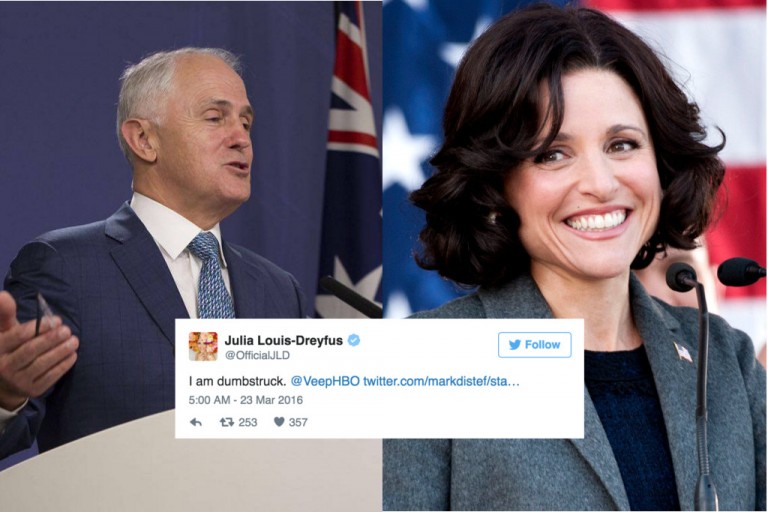
Over the past couple of days, Prime Minister Malcolm Turnbull has been channeling his predecessor and whipping out a bit of a three-word slogan. He first broke it in on 7.30 with Leigh Sales on Monday night. Then ABC Radio in the morning, before heading to 3AW and dropping it four times in less than two minutes. The phrase: “continuity and change”. 
In Turnbull’s eyes, this is an eloquent way of commenting on the ongoing drama between his current government and that of Tony Abbott. “The bottom line is there is continuity [many elements of old policy] and there is change [leadership, number of raw onions eaten, et al]” he said in that first radio interview. But, to the rest of the world it looks a bit like this:

“Continuity and change” is the official slogan of Veep‘s main character Selina Meyer (played by Julia Louis Dreyfus) as she runs for the US presidency in the show’s fourth season. It appears on her campaign bus, on her logo, and (as BuzzFeed‘s Mark DiStefano pointed out) is regularly whipped out in the same kind of interviews Turnbull has been facing this week.
And there in the nutshell is what is so out-of-touch about this Coalition Government - even with Malcolm Turnbull taking over from even-more-out-of-touch Tony Abbott - it is still hopelessly out of touch with popular culture. All of a sudden they are laughing at the Australian Prime Minister who adopted the most meaningless slogan screenwriters could think up, as his campaign slogan. It's like the Australian Prime Minister went and sucker punched his own face for absolutely no gainful purpose whatsoever. It's fucking hopeless, really.


2015/06/24

'The Killing Season' - Episode 3

To The End, The Chaos

Aye Carumba, as Bart Simpson would say. Episode 3 puts us into the tumultuous 3 years of Julia Gillard's turn at the Prime Minister's chair and finishes with the election defeat. As with the previous episodes, it feels like too close to be called history as the heat from it being news is all too familiar.

Perhaps this is part of the Big Now where everything is in some way significant, but it leaves you feeling numb to realise that the ALP coughed up a big lead over personality issues. It is on the whole, unreal and unbelievable. Our disbelief marks us out as neophytes, the unwashed, and outsiders in the arena of parliamentary politics. Clearly we knew so little and have little to do or to say or give.

What's Interesting About This Episode

This was simply devastating to watch right down to the end. People have said some rather extreme things about Kevin Rudd but I don't find him that hard to understand. He's logical and principled and what you see is what you get. He's not perfect, he's not the saviour, but he's there for the greater good. When he was Prime Minister he was there for all Australians. Over the years I have been told how warm and friendly Julia Gillard is, but I actually find her mentation a lot harder to understand. I have to commit to political expediency as the guiding ruler understand why she would do or say the things she would. And yet it's not like she didn't have principles and she had much discipline.

Still, watching this episode was even more traumatic than the previous 2 episodes. Kevin Rudd is essentially self-conscious to a fault while Julia Gillard seems to be unaware of the extent she kids herself when she prevaricates. When she chooses to characterise things, she is far less convincing than Kevin Rudd, and Rudd to his demerit, does not characterise things enough. They may be two of the least insightful leaders from the ALP in a long time. It's funny because they're both clearly intelligent and educated, but insight into themselves seem somehow faulty. Mark Latham seems to possess more insight into his own character than these two, and we thought he was nuts and unworthy.

As long time readers know, I never warmed to the Julia Gillard Prime Ministership. What happened with the 2010 Rudd removal was too drastic and shocking for me to ever get over and then embrace the new Prime Minister. What it did was highlight how little control we had over the political process, and just how much the parties run on the cult personality and take our votes hostage. When Julia Gillard tells us her time in office started with a shadow over it and it only got darker, it highlights the fact that she's trying to ignore the deed that got her into office having any currency as a problem. You really shouldn't try to talk about accidents you caused in the third person.

Lessons In Power

In watching it, one thing becomes very clear. Julia Gillard should have been ruthless and forced Rudd right out of Parliament. As long as he remained, everything that happened was inevitable. The problem of courses was that she couldn't buy out his career, and there was not enough political capital anywhere to buy out Kevin Rudd's career. And so he stayed. Which is like one of those Bond movie bits where the villain's got James Bond strapped to a death machine, spills his beans on the dastardly plot to take over the world and walks away without killing James Bond. She really didn't finish the job she started. And as long as Kevin Rudd was politically alive, he was always going to come back.

The fact that Julia Gillard didn't have this simple insight alone tells you a few things. She didn't really think through what would happen in the event she knifed a Prime Minister in his first term, and a very popular one at that, and she didn't seem to have the insight that if the shoes were reversed, she would be the one doing the come back. In fact if there's one thing that could be said about Julia Gillard's time as Prime Minister, it would be that she didn't seem to have a hell of a lot of insight into the minds people who voted for the ALP in the Kevin '07 campaign. Maybe it was deliberate, maybe it was a blind spot, it's really hard to tell and we may never know. But it translated as being tone-deaf to the electorate.

Then again, former Senator Mark Bishop observes that she was miscast as the leader.

Albo Made Me Cry

There was a moment in March 2011 when there was the first spill to try and bring back Kevin Rudd, and Anthony Albanese pleaded for unity. It was busting him up that the ALP had come to such straits.  Holding back tears he fronted the microphones and pled. Seeing that footage again just broke me. It was pure grief.

But then it made me think, "who are these people making Albo cry? Who are these people in Parliament moving these machinations?"

They're the first beneficiaries of Whitlam's free tertiary education. They are that generation who got the free tertiary education and did with it whatever they could - and they made it parliament. It wasn't a birthright, it was serendipitous that it fell on their laps; and now they're milking it for what it's worth, damn the country, the future generations, the budget bottom line or any kind of integrity. They're grubs.

You Missed The Bit That Pissed Me Off, Sarah Ferguson

It's a very simple thing if you are not a union member but support the broad Left. In this country, if you can't go with the radical idealism of the Greens, then you have to find your place with the ALP. If the ALP tells you, we're putting union concerns ahead of your concerns - your 'social democrat' ones - then you are deprived of a political platform that represents you. Now, I might not agree with Kevin Rudd's do-gooder Christianity-tinged ethos on a personal level, but in all his time as leader and PM, I never felt like the ALP somehow didn't represent my broadly Left-y position. Julia Gillard set about narrowing what the ALP stood for, to the point she was telling us proudly she is not a leader of a 'social democratic' Party.

Gillard sold us out. She told me and my friends who are educated and progressive, and who broadly support her cause, to fuck off. And while I'd never vote for the Tories, she wonders why the middle ground never came back.

Alan Jones & Tony Abbott

Years ago I met a producer who was worried what would happen to an Australia where right wing shock jocks ruled the airwaves with their extraordinary rants. At the time it seemed a little too sensitive to the carping of people who were exercising their right to freedom of expression. Nonetheless it is abundantly clear that years of this kind of hateful bilge from the likes of Alan Jones has infected our democracy to the point where sensible dialogue does not find traction, and instead we get slogans and obtuse rhetoric.

The destruction of nuance and meaning in our polity by the likes of Alan Jones directly led to the rise of Tony Abbott, who can only be described as an utter disaster as Prime Minister. Now, Alan Jones might console himself by saying that he was a kingmaker, but what is the point of installing a functional imbecile as the Prime Minister of this land?

The poisonous slogans and rhetoric that emanated from Alan Jones and his kind has for worse and worser and worst-est, destroyed the political discourse in this country. It is shameful that Alan Jones still has a job and keeps doing it. It is shameful that the Prime Minister of this land takes his cues from the likes of Alan Jones.

Shameful and vile, is what all this is.

It's All Over Now

It's all a little quaint now that we've adjusted to the daily horrors of an Abbott Government. Right up to the last minute of Kevin Rudd's first Prime Ministership, there was a semblance of intelligent discussion about policy and where our nation was going to go. Julia Gillard did try to keep it going, but in the face o the monolithic negativity and feigned-stupidity that marked Tony Abbott's time as Opposition Leader, it never really survived.

Today, I have been reduced to just laughing every time somebody tells me the latest study thing Tony Abbott has said or done. The short answer is, on some level we have no control over any aspect of this stuff. Our democracy only offers us a delusion that our votes count, our opinions matter, facts trump opinions, that our democratic ideals are somehow intact. The fact is, Tony Abbott's government goes to show everyday how venal and menial our existence is, how much our political classes disrespect us, how little integrity there is going in Canberra, how close we are to an authoritarian state where things get decided by decree and not proper discussion.

There are days where I blame Rudd and Gillard for what transpired that brought us to this place. Then again, it might just be a reflection of just how dumb the population has become, and was inevitable that we would come to this point in time. We may marvel yet at Rudd and Gillard in future years - it becomes more likely the longer we are forced to live under the rule of these tories.

2015/06/18

'The Killing Season - Episode 2'

We Really Lived Through That?

If there's one thing tougher than living through the tumult of the Rudd to Gillard change over and seeing it happen (and having no control over it, as with most things in politics), is having to relive the emotions of it all in this documentary series. I think it's a very valuable account by those who were there as participants and witnesses and perhaps it will serve as a lesson to the future.

The agony of watching the CPRS put on hold, watching Rudd's support fail and having Julia Gillard suddenly emerge as the Prime Minister was one of the greatest horror sequences of the ALP's time in government. It's hard to believe these people managed to forget what got them into government and pissed both the climate change issue and their Prime Minister down the toilet.

I'm sorry Ms. Gillard, but you don't come up smelling of roses when you swim in that toilet. As for Kevin Rudd himself, he hasn't really changed my mind about him. He was a populist PM, but he did have the big picture right. We were incredibly lucky to have had him at that time.

What's Interesting About This Episode

The number of people who contradict Julia Gillard's account is mounting. Sarah Ferguson has said she believes both Rudd and Gillard lied to her in the interviews, but as far as the headcount goes, quite a number of people are disputing her version of events. And she looks quite shifty in the interviewee's chair. Maybe Kevin Rudd was always a better media performer, but nobody except Julia Gillard is seriously contradicting his account. If indeed both Kevin Rudd and Julia Gillard are lying, that's one thing; what we're seeing is that Kevin Rudd might tell little lies to smooth over difficulties and problems whereas Julia Gillard tells big lies to coverup her tracks.

Worse still, Wayne Swan was hardly the honest broker as Gillard went and white-ant-ed Rudd's Prime Ministership from her position as his deputy. The Removal was fomented on the backbench by first-timer rookie MPs, and the cabinet ministers were either on-lookers or unaware until it happened. It's quite insane when you think about that. A bunch of rookie MPs scuttled the very Prime Minister whose popularity brought them to power and at the first sign of trouble, they panicked. Nobody seems to have thought ahead to what that would look like and how it would play out in the electorate.  The colossal stupidity of it is breathtaking.

Which brings us to Tony Burke who comes across as this big doofus who let the whole thing roll into action. Whatever his reasons and his latter-day rationalisations, it is clear he totally ignored the contra-indicators and fairly historic reasons why you should not roll a Prime Minister in his first term. As such, he deserves his place in ALP history as one of its villains. Not that anybody's saying out loud, but yes, he did a damnable thing in fomenting the challenge. He should never be allowed to live that down.

We're Hostage To The Cult Of Personality

There's no other explanation for the rise and fall of Kevin Rudd in the eyes of the public as well as the Caucus. The ALP needed a man who could get its message out to the public. Once they put him in as Prime Minister they were constrained by the fact that he exercised power. As idiotic sit seems, the ALP clearly couldn't handle the conditions of victory any more than they could handle the condition of defeat in Opposition. Mark Bishop offers up a picture of how the various Senators started panicking at the polls while Tony Burke started spreading the word that Gillard should replace Rudd.

For all the high-minded talk about policy from Kevin Rudd, it's unbelievable that all these other politicians went about the business of replacing Rudd out of a sense of grievance against the persona. i.e., it wasn't a policy thing at all. At one point Julia Gillard starts psycho-analysing Kevin Rudd to justify her sabotage efforts and well... it drove me to drink I tell you.

Both Gillard and Swan let all the talk fester and pretended it wasn't going on and kept it from Rudd. The only person who conveyed to Kevin Rudd there was trouble brewing was Albanese. Justifiably, Rudd has not forgiven either Swan or Gillard. Seeing that the both of them presided over the election that brought about a hung Parliament and the subsequent government followed by the Abbot government, they have a lot to answer for. It makes it worse to think that Gillard wanted to ride through it with the 'First Female Prime Minister' branding as if this was going to negate the issues of how she came to power. As it turned out, the electorate was not interested in her gender, they were interested in the fact that she just rolled a popular PM, and in a most negative way.

Bitar, Arbib, Howes

Paul Keating referred to the Senate as unrepresentative swill. In the case Karl Bitar and Mark Arbib, he was right. What Paul Howes - who is not an MP, not an elected official in any government - had to do with any of this and why they needed his consent remains a kind of nudge-nudge-wink-wink mystery.

The most objectionable of the lot remains Mark Arbib who brought his NSW Right faction bullshit to Canberra and promptly applied the machinations (addition, it's called Mark Arbib, addition. Not 'calculus') he used to usher in the likes of Iemma, Reece, Keneally in quick succession in NSW with the help of the likes of Eddie Obeid and Joe Tripodi. Yes, the stench of foul Morbid Obeidity stretches all the way into the Rudd Removal as it does to so many other things.

It goes to show that there is a great problem with the nature of party politics and the upper houses, and how people are chosen to preside there. If you had a normal street view of things and life, there's no way you give that kind power to the likes of Bitar and Arbib. Somehow, they happened to have it, and exercised it against the will of the people.

Careerist Politicians

It used to be the case that people had careers in other things before they went into politics. Now, they seem to go straight into the business of politics as soon as they are able to, after finishing school or university. Being in office is kind a bonanza - a winning lottery ticket - that attracts all kinds of ambitious people, but it can also be seen from this series that they might be the wrong people.

It's hard to like the Nationals and Liberal Party in this country. The Nationals are old school fascists while the Liberal Party at this point in time seems like a Neo-Fascist party. The Greens at the other end of the spectrum appear to be just as mercenary and self-serving as the Nats and Libs. The worst thing about all this is that the whole lot of hem are careerists trying to look after their butts. It's despicable. And that includes the ALP in the ostensible 'middle'.

The light at the top of the hill is clearly only there to attract the worst moths in our society.

The Limits Of Holding Power

I might have pointed out this before but the modern ALP Prime Minister has a short time in power with the exception of Bob Hawke. For all this talk about the glory of the Hawke-Keating years, the second part where Paul Keating was PM only went four and a bit years. He won the incredible 'This is the Sweetest of Victories' '93 election, but from there, he only had 1 term. Whitlam was really only in power for 3 years. The same goes to Kevin Rudd and now Julia Gillard.

So if there is a pattern emerging, it is that the ALP has structural issues where it can't keep its Prime Ministers in power for long. This lay dormant through the Hawke years exactly because Hawke was an expert peacemaker and the ALP was still shocked from the events of 1975, nobody dare rock the boat. Perhaps the events of the late 2000s and early 2010's will be remembered as so shocking that the next ALP Prime Minister will be able to stitch together a long consensus based stay.

If this doco is anything to go by, it shows that there are simply too many factions and people who can destabilise even the most popular of Prime Ministers, and that they are none too wise about the consequences of doing so. The fact that the Removal was organised from the backbench and the cabinet were last to know indicates that a bunch of novices got way ahead of themselves simply because they could; but when they got what they thought they wanted in Gillard, they spent the next 3 years wondering why the electorate was in a punishing mood.

The worst aspect in all of this is that there are echoes of Bill Hayden's time as Opposition Leader in Bill Shorten already.

Hate Tony Abbott Coming To Power? Blame The Greens

I forgot how in the fray the Greens scuttled the CPRS because wasn't sufficiently pure for their liking. Given the opportunity to do something for the environment and nothing but grandstand, they clearly chose the latter. Then they held the Gillard government hostage and put in the carbon pricing which was more pure to their liking but saddled Gillard with a broken election promise.

In a roundabout way and then a direct way, all of that combined led to the Tony Abbott Government of today - and we know how environmentally un-friendly they are. Way to go stupid Greens, way to go! I'd forgotten just how odious the Greens were in this time. If you want proof that the Greens are just as careerist and self-righteous hypocrites, their actions during the Rudd and Gillard governments tells you plenty.

*ugh*.

2015/06/11

'The Killing Season - Episode 1'

The 'Phantom Menace' Of Australian Politics

Earlier in the week it was reported that all the TV stations rejected a TV drama series based on Julia Gillard's Prime Ministership, a project that had Rachel Griffith attached. The TV stations all rejected it because basically Julia Gillard was still hated. I laughed when I read that because we all know it was low polls hat eventually brought her Prime Ministership to an end. 27% support at the end of 27  straight losing polls would do it to you; so maybe there is some truth there.

In any case, the ABC doing a documentary on the Rudd-Gilard-Rudd years was exactly the kind of thing I didn't want to watch. After all, I don't think I've ever endured as much trauma at the hands of the ALP at another time in my voting life, and I hoped not to be subjected to the same teeth-grindingly-awful sequence of events so soon. All the same, it has been 9 years since Rudd and Gillard took over from Kim Beazley and 8 years from Rudd's victory over the Howard Government. It might just be the right time to reflect on what once was and could have been.

And let's face it, for all the turmoil of those years, it was still a much better government than the daily farce presented to us by Abbott, Hockey & co.

Whats's Good About It

As long time readers know, I was in fact down on the ALP and Kevin Rudd and Julia Gillard when they deposed Kim Beazley. John Howard had been in power for a good part of a decade and stinking up the joint while the ALP in the wilderness of opposition were doing a fine impersonation of the Coalition in their wilderness years. So it's good to be reminded of just what Kevin Rudd did as Prime Minister. He was indeed formidable as he was prescient on the GFC, and he was the right man at the right time.

What's Bad About It

It's in such a rush to tell the story leading up to Julia Gillard's coup, it glosses over some really important details about the unfolding GFC. it also glosses over just who some of these players were beyond their job titles. Some time is spent on the Godwin Grech affair, which was one of those awful things that ultimately had very little to do with Kevin Rudd and Wayne Swan and just about everything to do with showing us why Malcolm Turnbull was a terrible alternative Prime Minister.

What's Interesting About It

It is the battle for posterity and my gut reaction to finding out about this series was "for the love God, please - both of you shut the fuck up and go away and leave us in peace!" That being said, once you start watching it, it does bring back memories of things and events that seem so distant now. The GFC really was terrifying. It still is terrifying; but back in 2007 and 2008, it looked like financial Armageddon was going to consume the planet.

The documentary goes some distance in explaining just how out of the ordinary Kevin Rudd was as an ALP politician. He didn't come up through the traditional Union ranks and he was also the right man at the right time even for the ALP to lead them to an election win. The ALP had gone through most of the Howard years recovering from the '96 election loss and reeling from the leadership failures of Simon Crean and Mark Latham; and without any meaningful direction or policy ideas worth spit, had fallen back on the caretaker Kim Beazley, and were going to lose again.

They really needed new policies, a fresh face, they needed a new direction, and had they been brave enough they might have settled on Julia Gillard right there and then. The reasons they didn't probably highlight the sign of the times more than anything else. The ALP of that era probably didn't want to go to the polls with a female leader against John Howard and taken extra punishment for gender politics, and they didn't really believe they were in any kind of winning shape in 2006. they sure didn't look like it.

I went back and did a quick scan of my own blog here and I can attest to the fact that all ALP supporters were deep in a funk, so picking the seeming populist in Rudd and pairing him up with the party apparatchik in Gllard made some kind of weird sense. What the doco goes on to show is that Julia Gillard saw herself as the person of destiny - Kevin Rudd turning up was a spanner in the works for her. And so the seed of the eventual destruction was sown right there at the beginning in the unholy alliance of expediency and need.

Still, all this machination and party-politicking seems quaint next to the monstrous stupidity of the Abbott Government. In trying to escape the horror circus of the ALP this decade, our electorate voted in the greater horror that is the Abbott Government. Just don't ask me how subsequent governments are going to repair this damage.

Horrible Bosses

Kevin Rudd's reputation as a boss was in tatters. It may still well be the case, and it comes down to this business of the kitchen cabinet "gang of four" and the urgencies and demands that the events made on the government. Ken Henry who was Treasury Secretary says in this doco that the cabinet process would not have been able to deal with the GFC. These were indeed extraordinary times. If Climate change was the moral challenge of a generation, the GFC was a once a century financial challenge that had to be dealt with and put to rest.

What's struck me as odd through out the latter part of Rudd's year as Prime Minister was just who was spreading this notion that Rudd was too chaotic, and how they were making a comparison.
Who was leaking? You can eliminate Rudd from the 4, and Lindsay Tanner who retired shortly after the period could not have a motive to be doing it. Wayne Swan was the Treasurer and neck deep in the GFC questions and by Julia Gillard's own reckoning she was going down to Swan's office to bitch about Rudd's style. By her own words she was destabilising Rudd in the same language that was used to bury him.

Even as events were unfolding it was hard to believe that the ALP would roll their own PM in the first term - especially one who was so popular for so long - and then run out an argument that he was a horrible boss. Naturally, the argument never really stuck with the electorate and Julia Gillard deservingly was hung by that rope.

Just A Side Note On Conservatives And Moral Fortitude

It was pretty galling to be reminded of the whole Godwin Grech saga. Like some evil Gollum from the dungeon caverns underneath Treasury came upon this land a blighted man of much negative charisma and visibly distorted persona with a fake email to bring about the complete humiliation of Malcolm Turnbull as Opposition leader. It was bad because it was stupid; and yet Malcolm Turnbull was willing to be that stupid because he believed so strongly that Gordon Grech had some kind of moral fibre as a whistleblower when there has been no such bone in the conservatives of this nation, all the way back to mother Britain.

The really strange thing is that after the Grech-fake-email-debacle, Malcolm Turnbull hung on as Opposition Leader despite an 18% support rating in the polls. The Liberal Party really didn't think they could do better than Malcolm Turnbull who basically humiliated himself with the chasm that was his "lack of judgment" (as described by Paul Keating). But when the topic got to carbon pricing and introducing the ETS, that was different, the Liberal Party and its climate change deniers erupted into an open rebellion and managed to put Tony Abbott in as their leader.

And Australian politics has been in a state of lobotomised moron-ry ever since. It's like our political leaders cannot talk about anything in sensible ways because Tony Abbott single-handedly destroyed all nuanced discussion of anything and everything by turning all topics into into three word slogans.  We've been dragged down to the abyss of unfathomable, intolerable, execrable stupidity by our very own political leaders.

Which just goes to show that for all this talk of morality and moral fortitude that conservatives love to bandy about, they're just as likely to excuse themselves and their friends of any unconscionable acts and keep pretending they have some kind of high ground in the morality stakes. If you could ever build a moral argument out of economics, then surely Kevin Rudd saving Australia from the GFC-induced recession was a much more high-minded act than the subsequent carping about deficits that the Liberals and Nationals have done. The brazen hypocrisy of the conservatives in this country - who undoubtedly benefited greatly from Kevin Rudd saving their bacons as well, for they had more to lose - essentially captures the intellectual bankruptcy of the government that today exults in winding back renewable energy in this country.

2015/03/28

They Keep Warning Us About This Bubble Now

Rich People Problems

The one consolation for not being in the property market and thus not sitting on skyrocketing valuations or skyrocketing debt commitments, is that when it busts, you won't be hurt as badly as those in debt up to their eyeballs. When the downturn comes and the banks come knocking to foreclose and businesses are forced to close as much as private residences are sold out en masse - the sort of scenario you dread because unemployment will be up, economic growth will be negligible and banks too big to fail will be living up for government largesse at the public purse, - the non-owning, non-mortgaged will be the relatively lucky ones to escape the downside of all this risk building up.

Even so, it's kind of scary just how much private debt has been racked up in Australia. A lot of that is in mortgages, rather than credit cards. The build up is so epic, the RBA was in denial about it for the last decade until the last 12months or so where they've started to bleat about the private sector debt, and more recently, specifically the "overheated property market".

And so we come to this entry today:
While our society lacks a meaningful and open debate on the toxic and rising levels of household debt, new home buyers in Sydney and Melbourne are entering the market and taking upon the most illogical sums of debt, courtesy of our over-leveraged banking system. 
Based on median multiples, new home buyers in Sydney will spend the better part of 6.54 years savings (using 30 per cent of their income) for a 20 per cent deposit to buy a median-priced home. 
When it comes to servicing the first 12 months of a 25-year/80 per cent LVR mortgage, it will cost roughly 65 per cent to 70 per cent of household income to service that debt at current record-low mortgage rates. Melbourne is not too far behind. 
So what have our leading economists, regulators, public executives and politicians done to stop this debt-induced folly? Nothing. In fact, they have bent over backwards to inflate prices via stimulants such as housing grants and allowing retirees to tap into their life savings. 
These powerful stimulants have been implemented, not to improve home ownership rates, but to boost prices for the benefit of existing owners, bankers' profits and government balance sheets.
Now, just on the point of 'existing owners', the SMH also had this entry right here about politicians who own investment properties, and there fore are beneficiaries of negative gearing
Mr Daley said if the government was unwilling to remove the capital gains tax discount it should get rid of negative gearing altogether. 
"The most important argument against negative gearing is that it drives up house pricesbecause it increases the after-tax returns to housing investors, and so prices are higher than they would be otherwise," Mr Daley argued last week
Mr David, Mr Egan and Mr Soos last year warned that, with such high rates of property ownership among Australia's senators and ministers, it was "difficult to believe that politicians will address the real causes of housing unaffordability, despite the recommendations from government reports".
It's hard to see the vested interest, collectively acting against itself.
All of this is not new, there are no new wrinkles. The property market has been artificially inflated to pay for the retirement of the Baby Boomers. They're in power, they are invested, but at this point in history, they're not selling up and so the price stays up. They then go and get loans against their assets and invest in property even more, using favourable tax concessions. Given the shortage in relevant housing being built, you can see prices spiral ever upwards. Worse still, there's money coming in from China - some of which used to go to Canada until they shut the doors - and they're bidding up prices just to get in because the very point for them, is to get in.
Thus the ground is laid for one-way bets. 

With all these complicating factors loading the system so it only goes one way, we can only ask when it will pop, and how bad would it be when it pops. The latter demands that we know more about the circumstance of the former's condition. If you had to guess it would be 'soon', but this 'soon' has been going on for a few years now and not even the GFC killed it, thanks in part to Kevin Rudd's big spend and China's amazing 7+% p.a. GDP growth (scepticism of that figure aside).

If China tanks overnight, one can't be surprised if these prices fall back down to global norms. So until things head back down towards normal, people are going to keep asking, "will it pop? when will it pop?"

Miscalculating Inflation

For quite some time we've seen the debate about how CPI is calculated. The most glaring problem with CPI is that whinnied up against Cost of Living, it under-reports inflation. This is because the CPI system changes the basket of goods and substitutes things based on the assumption that if you can't afford something, you'll substitute it with something else similar. The strange discrepancy can in part be explained by the fact that cost of living has been following the same goods for the twenty-odd years it has been diverging with CPI.

If you looked at cost of living, it is clear that there is a significant amount of inflation going on with staple foods and accommodation. There is of course severe deflation as well, as the global glut for manufactured goods has commodified just about every possible manufactured item. If you parse through the changes, you can make out this horrifying fact that the less elastic a good or service is, the more it has inflated, while the more elastic it is, the more it has deflated. Or put more simply, the stuff that's undergoing steep inflation are things we need like food and shelter. The things that are deflating are things like mp3 players and tennis racquets and electric guitars. CPI says you've never hd it soggy with your mp3 players, tennis racquets and electric guitars being cheap, so you should be happy. Cost of living says inflation is killing you.

And so you wonder how far out this trend can last before something simply breaks. Indeed, the Arab spring that brought down North African military juntas can be sheeted home to the point at which the staple foods trebled, rents doubled and those regimes tried to buy out the difference and failed. The fact that the AK-47 became so cheap was ironically part of that equation.

But let's get back to the first world. The RBA has set interest rates according to the CPI, and has done so ever since it became independent. Back in the 1980s when stagflation was the big enemy, the US Federal Reserve Bank  chief Paul Volcker opted to fight the rampant inflation by raising rates; And so interest rates went up quite high in the mid to late 1980s in America as well as over here. Yet since those days, if they have been under-reporting inflation through CPI, then it means the successive FRB and RBA regimes have been setting the interest rates too low. If the private debt we've racked up in the last 20years is anything to go by, we've simply bought the economic growth we've had on the back of mounting debts.

When you think about it, the people who benefit the most from all this under-reporting of inflation are bankers themselves. They stand to make a mint, the more people borrow money. Going back to that article before:
So what have our leading economists, regulators, public executives and politicians done to stop this debt-induced folly? Nothing. In fact, they have bent over backwards to inflate prices via stimulants such as housing grants and allowing retirees to tap into their life savings. 
These powerful stimulants have been implemented, not to improve home ownership rates, but to boost prices for the benefit of existing owners, bankers' profits and government balance sheets.
Which just about sums it up. The point is, the bubble is built not on one thing, but many things, including miscounting things that ought to be counted consistently and properly.

No Land Tax, He Says

There's a party contesting the NSW election on one platform - no Land Tax. It's one of those rearguard actions by people with vested interests. Ken Henry's tax review under Kevin Rudd pointed out that Stamp Duty should be thrown out in favour of a Land Tax. The logic of this is quite simple - if you owned a house and never moved or sold it, you'd never pay the Stamp duty and this is the only tax that goes to he State Government coffers based on Land. It would be more efficient and representative of the demographic if they put in a Land Tax instead uncollected something from everybody who owns land instead.

It would go some way towards fair valuations of property, and it would encourage the Baby Boomers to cash out. Given the percentage of people who who own outright and are in mortgages outnumber the renters two to one, you can see there would be a great appeal in putting in a Land Tax, and therefore a great incentive in the electorate to resist it. If you count the fact that the political class is overly landed, there probably is no chance it happens anyway. 

It may even be redundant having a single issue party around not introducing a Land Tax, when you consider that it would paint all the other politicians as those who might be in favour. The numbers simply belie the sense of crisis that this bunch of elected officials would be interested in doing anything so fair or rational as implementing a Land Tax. 

2015/03/26

Renewing Australia

Malcolm Fraser's Common Sense Manifesto

It's bewildering to see just exactly where Malcolm Fraser's political vision ended up. We guessed that he stayed essentially where he was in his mind while the polity collectively drifted to the right, and yet we also get the feeling he moved substantially to the left in the wake of his own experience as Prime Minister, following on from Gough Whitlam's time as Prime Minister.

Just reading the titles of sections is quite fascinating. He wants to talk about a 'modern progressive democracy'; social justice; renewal and independence; democratic reform; ethical politics; status of women (Presumably towards gender equality); sustainable economy; and probably most un-Howardian and un-Abbottian of them all, a secular Australian Republic.There's more and it goes into some detail, but perhaps the most notable thing might be that this document is being described as a 'manifesto'.

Manifestos of course belong to a long tradition on the left side of politics, the most famous one being the communist manifesto; but of course there was a Surrealist manifesto penned by Andres Breton in the early part of the 20th century and there was the Situationalist International Manifesto going around Paris in the 1968 student movement. When you think back, Malcolm Fraser would have been on the side of politics where they would have viewed any kind of political tract labeled as a 'manifesto' with a great deal of suspicion. It is deeply moving to find that Malcolm Fraser found himself working on this project in the latter part of his life, and without self-reflexiveness, was sending it out to canvas support.

Of course, Malcolm Fraser didn't table the document as a manifesto, but as "a Statement of Values and Purposes", but everybody with half a brain knows what this is, even the Sydney Morning Herald, - a manifesto.
"We do not take this step lightly or impulsively," the statement reads. "Our party has been created in the belief that the major political parties ... have repeatedly failed Australians on the big issues". 
"When over long duration the foundations of political parties become eroded and their purposes fall out of touch with the nation's basic values and beliefs, and when government and opposition join in advocating policies ever more corrosive of our national spirit of fairness and justice, there arises the need for new political groupings to better express the voice of the people," says the statement, which is dated January 20. 
The document says the party accepts "the overwhelming scientific evidence of climate change" and recognises that "nothing short of a profoundly different way of structuring the global economy will avert the catastrophic effects of a warming planet." 
"Despite the un-extracted riches in Australia's coal reserves, the imperative of moving to a post-carbon economy is clear, and the urgency of government intervention to achieve it is compelling," it reads. 
Rejecting arguments that Australia was already fully populated, it argues the nation needed to be prepared to increase its population, arguing a larger population would contribute to the nation's "long term vitality and security" as well as its influence on global affairs.
That sure sounds like a manifesto. Manifestos always start with rejecting the status quo and arguing for a radical progression with prescriptions. Conservatives don't write manifestos because their thinking progresses from the lukewarm enthusiasm that the status quo with all its injustices and failings is pretty jolly good.

A quarter of a century ago in what can only be described as another intellectual epoch, I was with a writers' group and proposed we write a manifesto. The notion was laughed out of the Harold Park Hotel. I look back on it now and I think the Sydney University writing set was a lot more bourgeois, complacent, un-radical and largely un-aspirational than I was. I wanted a manifesto because without one, you can't rally a call to change. To proceed with a method or madness or method in one's madness. The truth is, those people didn't want any kind of change - and that sort of drifts off into consumerism and naive materialism and blind acceptance of stupid political rhetoric which is at the heart of conservatism in this country. In that sense, I find it greatly edifying to know that up until the moment died Malcolm Fraser cared about this country enough to be working on a manifesto.

The most important takeaway might be that the tract represents a comprehensive critique of what is wrong with the two major parties in Australia, and that policy-wise, Malcolm Fraser essentially ended up as a kind of Australian Democrat in the sense of the party made by Don Chip (and made defunct by the lamentable Natasha Stott-Despoja and miserable Meg Lees), long after the said party became defunct. I don't know if there is a future in this project, but it is certainly interesting to see where Malcolm Fraser ended up on the political spectrum and it speaks volumes to the distance traveled to the idiotic right by Australian politics in the 21st Century.

Blog Archive