For People Trying To Talk Down Free Education
Life's weird in the tricks it plays. I got free education at tertiary for a time. I did two and a half years of med school and quit, back in the mid-80s. I realised half way through my first clinical year that I wasn't exactly cut out to help people; I also realised I was ideologically at odds with my colleagues, and refused to change my views. It was enough to drive me out the school. Because med school in those days really crammed their hours, in the two and a half years I was there, I would've spent about as much time as a normal Bachelor of science in those days. I have nothing to show for those days except that which I retained from things I learned. That's the way it goes with most education, I guess.
Still, I don't regret quitting because if you have anything else to do in life, you probably should pick that over being a doctor. Medicine, more than any other profession I've observed, should be practiced by those who cannot - and will not - do anything else. Conversely, if there's a choice to do anything other than being a doctor, you should do it because doctor-ing requires a certain single-mindedness and an understanding of that single-mindedness that allows one to be a good doctor. All of which is to say, if you're not a good doctor, then there's no point being a doctor.
When it came to quitting, I had to go talk to the student officer, who was alarmed and appalled because it took him completely by surprise that somebody would quit half way through the course. Most people who quit, quit early. Nobody waited until third year in the dead middle of the course. What he didn't know was that I had considerable parental pressure to be there. He didn't exactly make it easy. He berated and insulted me, and he resorted to putting a money value on it. He told me my time had cost the government $300,000, and I was pissing that down the drain.
I still remember the look on his face, flushed red, practically yelling at me. He was in his forties, horn-rimmed glasses and white shirt and dark blue tie. He looked like a character straight out of the early seasons of 'Mad Men'. I remember thinking, "What has that $300,000 to do with with me now?"
It was the faculty's 'opportunity cost' in investing in me instead of another candidate who might have wanted to really be there. For me, it was an expensive bill I ran up on some tab for having to figure out what I wasn't cut out to do. He was trying to pin it on to me as a reason for guilt and the need to stay. I wonder if he'd thought through the ramification - that even if I'd stayed, I wouldn't practice medicine, so the next $300,000 the faculty would spend on me would be good money after bad, one huge sunk cost. I didn't exactly think about things in those terms then, but I recall thinking, "how's it going to help anybody - me, him or the faculty - if I stayed on?"
I imagine that he didn't get free education under Whitlam's reforms. So he was appalled that I would walk out. I didn't get it at the time, because I was an entitled little shit; but it was a lot more complicated than that. I was failing. I was failing because I missed time from an ankle injury; I then had a bad bout of flu and missed exams, and then got penalised. The faculty seemed to delight in telling me I had blown it. I had just had a bad breakup and was totally messed up. I was not interested in the career let alone in helping sick people, I had discovered in the hospital wards. If I had to repeat the year, I was going to drop into the year that was doing a 6 year Medical course, which would mean I would be at the faculty for 7 years. That was 7 years for a degree that I knew I wasn't going to use. If I were going to get out, then I just had to get out right then and not 5 years further down the track, just for the piece of paper. (and I look back and shudder because in the end I'd finished my 3year AFTRS degree roughly around the time I would have graduated, with a 1year stint at the ABC as well).
To this day it remains one of the most important decisions of my life. Because of that decision, I got the most important life education in the things that followed. It is unfortunate that it took the faculty $300,000 to find out I wasn't going to be any kind of doctor. It reminds me of 'Moneyball' when they signed Billy Beane as a top draft pick and it didn't work out, although the faculty would be a bit too dense in understanding that analogy (and I would be praising myself too much in likening myself to Billy Beane). A good mark in the HSC is not 'due diligence' enough in selecting candidates for Med School. If the system is deluded in thinking this is sufficient, it gets everything it deserves.
The faculty did very badly out of it, if indeed the cost was $300,000. But they did do me over. Instead of putting me down as "withdrawn without fail" as agreed, they put me down as 'fail' - which removed any chance I would have returning to study anything else at the tertiary level under the UCAC system at the time. So the life lesson there is, "don't piss off the powerful". Since then I have been very suspicious of universities in this country as a result. I sure as hell don't buy into the self-allocated esteem these institutions hand themselves. I am still largely hostile in sentiment towards the University of Sydney and its Faculty of Medicine (may they all rot in hell). If the place was on fire, I wouldn't cross Missenden Rd to piss on it.
And even then, and even after my terrible experience at the University of Sydney, I stand for free education. Think on that for a moment!
Studying at Med School for me, was a big mistake. The mooted sum of $300,000 for that bad decision was a costly mistake, but I don't think that sum rests entirely with me. And in that sense I would posit that saddling enormous student debts is a very bad thing for society. I didn't arrive at my $300,000 decision lightly. I suffered and agonised greatly and it was in the final count that I had to push forward with it. And if the faculty punished me for it, well, that's life too. But if students are shouldered with this debt on the front end, they won't be able to make the decision I made; and I would contend it is important that people make ethical decisions when it comes to important things like this.
I have no doubt that I would have made critical errors as an uncaring, unmotivated, lousy doctor; I have no doubt I might have let somebody die on my watch by mistake or incompetence. I have no doubt that the craptacular efforts of my endeavours in medicine would have cost somebody much more than $300,000. People ought to be able to make decisions about their lives - important decisions - without getting penalised with money or encumbered with ridiculous debt. Those are the decisions that are going to contribute positively to society. No matter what the man in the horn-rimmed glasses says, you can't put a price on that. In turn, one should be very frightened of the doctor who is only there because he couldn't get out because the money was too much. I can tell you from first hand experience that most doctors are social idiots, but they are well-motivated social idiots. You wouldn't want to put your lives in the hands of anybody worse than a well-motivated social idiot.

A Gen-X View of the Universe.
"The Issue Isn't Pussy, It's Monkey" - from The Right Stuff
Film, Cinema, Movies, TV, Music, Rock
Showing posts with label Moneyball. Show all posts
Showing posts with label Moneyball. Show all posts
2014/10/27
2011/11/22
'Moneyball'
Instant Nostalgia
Somewhere as a kid I used to sit there and figure out the on-base percentage of my fave players. This is way before I was introduced to Bill James. It came about because I made the observation that a guy who walked with 2 outs and then came home on a homerun was more valuable than the non-credit in the Batting Average that would represent.
Fast forward many years, and I was handed the Baseball Abstracts by Bill James, from a guy who was totally delighted to find I was interested in drawing walks and hitting for power on a team of weekend warriors. I've been a lurker over at Baseball Think Factory since the days it was called the Primer, and I've absorbed as much of the advanced metrics as I can find. Sabermetrics is a wonderful area of scholarship if one can understand the simple premise that the traditional baseball stats don't capture the whole story.
Michael Lewis' 'Moneyball' came out at exactly the moment when sabermetrics and its advanced stats were being picked up by the mainstream media and caused a furor; it was more or less a book that was pitched like a high, inside fastball. Nobody thought it could make a good movie - but amazingly Brad Pitt has staked his clout and persisted with it. In some ways it's amazing that it got made, but then it took a superstar like Brad Pitt to want to do it. Sometimes that's all it takes, and in some ways, it is everything you need to get a big movie up.
What's Good About It
The film is interestingly prosaic and discursive for a subject that is given to romanticism. In that sense, the film is just as dispassionate in its narrative as Michael Lewis was in his explications in the book. The cinematography has a rough and ready look which brings to life beautiful renderings of real locations; and if anything is reminiscent of the starkness of 'Bang the Drum Slowly'. The shooting style is also understated with nary a moment of glossy, over worked establishing shots. It's a very sharp film that tells a very sharp story.
Brad Pitt as Billy Beane is amusing as well as compassionate. It's passable enough that the performance can evoke the real Billy Beane in every one of these scenes, real and created for this movie. The biggest challenge was actually on the shoulders of Jonah Hill (Mr. Superbad) to tone down his usual bumbling fat guy schtick and play a fictional foil to Beane's largely intellectual concerns. He's certainly no Paul Depodesta, but the difference allows us to watch the film as fiction-loosely-based-on-fact than as a docudrama.
The casting is great, although Philip Seymour Hoffman (as much as I love his stuff) was probably just not right for Art Howe. The point of Art Howe in the book was that he looked like a skipper more than he contributed anything. Art Howe has since gone on the record saying the portrayal was more betrayal and unfair and you can see his point. Art Howe didn't resist Beane's moves out of resistance to the new ideas; he simply didn't get that they were new ideas or where they were coming from. So he wasn't Joe Morgan; he was more a buffoon. And you would get upset if you got likened to a Joe Morgan-like anti-intellectual loud mouth.
Plus, Royce Clayton plays Miguel Tejada, which is just awesome. Royce Clayton of course didn't played himself in 'The Rookie' about when he got struck out by Jim Morris as played by Dennis Quaid.
What's Bad About it
It was going to be impossible to do the whole book, but some of the things are out of balance. The 20 game winning streak was awesome, but it hardly proved that Beane was right any more than the post-season failure that year proved he was wrong. (It's called small sample size - any team could do anything in a month, just as a player could do anything in 60 plate appearances) The whole scouting for the draft got dropped in favour of telling the Major league club stories, but in some ways the most interesting lessons are in the 2003 draft.
I have quibbles but they are minor. I can understand the choices they made, and in telescoping the book into a movie, they've had to skip the more abstruse aspects of sabermetric analysis. It's not a major bad, but it's not a good thing for me.
What's Interesting About it
O where does one start?!
This might be the first baseball movie that doesn't end with a winning moment. The end credits trail out with a song about Beane being a loser and a postscript that his A's are yet to win the World Series. Its closest meme might be revenge of the nerds but I don't think that that is the point of the narrative - that the thinking types beat out the sports jock traditionalists. What the film does is in its own way illustrate the distance traveled by the public consciousness about baseball in the 10years between the 2001 playoffs and the 2011 release of the film.
Back in 2001, OBP was such a stand out stat that it necessitated the elevation of Scott Hatteburg as much as it over-emphasised the value of Jason Giambi. Because defensive stats were still in their early phase, nobody put real stock in them, while OBP was as tangible a benefit as they came. Yes, Jason Giambi's bat was great, but he gave back a lot of runs in the field. In the 10years since, we've come to appreciate such notions as the marginal win and what that costs. We understand the strengths of various projection systems as well as the limitations; we now know more about batting averages on balls in play and to what extent that belongs to the batter who has hit line-drives and speed than the defense behind the pitcher.
And they're just the baseball things. Since the book came out, the Moneyball concept has been taken up by Hollywood itself as they try to wrestle with the idea of which stars are worth the millions being paid and which ones are not.
Brad Pitt's 'Blind Side'?
There's a popular opinion out there that this could be Brad Pitt's answer to Sandra Bullock's 'The Blind Side'. Both are sports movies about nurturing talent, but also both are based on excellent books by Michael Lewis. They're like book-matched movies where one covers Football, this one covers Baseball; the other features Sandra Bullock as a foster mother, this one features Brad Pitt playing a divorcee father trying to stay in his daughter's life.
The problem - if such a thing is a problem (it sure isn't for me) - is that this film isn't so much heart-warming as 'The Blind Side' was, but more Brain-warming. The feverish intellectual excitement of the book is what is at the heart of this film, so I don't know if it's going to be enough to move the voting Academy members, who are in my humble opinion, always decidedly un-cerebral when it comes to movies.
I don't know if Brad Pitt deserves an Oscar for this. I don't know how such things come to be. Plenty of undeserving people have won them over the years. Should Brad Pitt get one, one of these years? Possibly. Should he get it for this film? That one's stronger than just a maybe. It's just so hard to tell with these things. The problem with stars being cast is you just can't get around the fact that you're always aware that you're watching the star. It's an interesting film that way, in that you're made to wonder what kind of performance a star should put in to win an Oscar. No wonder they hand them out to stars who wear the ugly makeup.
Billy Beane As Unbeliever In Baseball
The character of Billy Beane is fascinating exactly because he is looking at baseball as both a business and a game from the inside, but with the eyes of an outsider. His failures as a player earmark the reasons for his decisions on many a player. In the book, it is stated that he picks players who are unlike himself in temperament because he believes his temperament contributed greatly to his frustrating non-career as a player.
In the film, this gives rise to a beautiful irony when Peter Brand shows Billy the footage of Jeremy Brown, a fat catcher who stumbles and slips having rounded first, only to discover he's hit a homerun. The deep romanticism of baseball manifests itself for Billy, but Billy himself is largely a victim of that projected romanticism. His own cross, his suffering comes mostly in part from his experiences of other people projecting expectations on to him. It crippled him as a player, and he is unable to watch his own team play. The pent-up frustration of a man with a mission is palpable and fascinating.
The central myth of baseball is how important it is in the wider culture. Billy Beane in both the book and the film portrayed by Brad Pitt casts a great big stone at the myth, but at the same time affirms the myth by having such an interesting part in it. For every traditionalist baseball fan that hates sabermetrics, there's a sabermetrically inclined fan who reveres Billy Beane's A's. That kind of irony is delicious to watch in a film.
Does 'Moneyball' Really Work?
There are in fact many ways to approach any kind of market. The way that Billy Beane and the A's take in the book and movie is to quantitatively analyze players and find who is being under-valued by the market. The fundamental assumption implicit in this is that the market misjudges the value of players all the time, and this is made very explicit in the movie. To tell you the truth, I'm not so convinced that valuing players diverge as greatly as implied in the film. For instance, we all know that Albert Pujols is likely one of the top3 best hitters in baseball, and we knew that the likes of Barry Bonds and A-Rod were the ones keeping him company. It's actually the players that you try to decipher values for from rank 100 down that people's perception and opinions begin to diverge.
You can test this out in any fantasy draft. Nobody drafts a surprise player in the first 3-5rounds in a draft. It's after the 5th round or so that people start surprising you with the dark horse choices. So on the one hand, there probably is a better way to collect the players on your team to fill out the roster but you actually need to have your superstars in place. If anything, I think the benefits of shrewd analysis in finding unloved gems in any market is overstated.
Historically speaking, the other 30 teams have incorporated quantitative analysis as part of their arsenal of tools so clearly Billy Beane has lost that advantage already in the years since the release of 'Moneyball'. It's hard to say if he's been able to find a new inefficiency in the market.
Other Lessons From 'Moneyball'
The more subtle lesson to be drawn from 'Moneyball' is in how to assemble a group of people for a team. One of the choices taken away from Billy Beane is that of paying big money for a free agent star player. In fact, his is a position to lose his star players more than getting any. This situation actually applies to many small companies in various fields, and the best lesson I can relate is that the equivalent of the draft - recruiting junior staff - becomes extremely crucial. You want your young staff to grow up and grow into their roles within the company. It feels a bit risky, but it's not. It's more risky to get the equivalent of that 'star player signing', and have some veteran screw up your roster.
From my own experience, I can say this: it's more rewarding for the organisation to build teams from the ground up than to build them around stars you inherit.
Somewhere as a kid I used to sit there and figure out the on-base percentage of my fave players. This is way before I was introduced to Bill James. It came about because I made the observation that a guy who walked with 2 outs and then came home on a homerun was more valuable than the non-credit in the Batting Average that would represent.
Fast forward many years, and I was handed the Baseball Abstracts by Bill James, from a guy who was totally delighted to find I was interested in drawing walks and hitting for power on a team of weekend warriors. I've been a lurker over at Baseball Think Factory since the days it was called the Primer, and I've absorbed as much of the advanced metrics as I can find. Sabermetrics is a wonderful area of scholarship if one can understand the simple premise that the traditional baseball stats don't capture the whole story.
Michael Lewis' 'Moneyball' came out at exactly the moment when sabermetrics and its advanced stats were being picked up by the mainstream media and caused a furor; it was more or less a book that was pitched like a high, inside fastball. Nobody thought it could make a good movie - but amazingly Brad Pitt has staked his clout and persisted with it. In some ways it's amazing that it got made, but then it took a superstar like Brad Pitt to want to do it. Sometimes that's all it takes, and in some ways, it is everything you need to get a big movie up.
What's Good About It
The film is interestingly prosaic and discursive for a subject that is given to romanticism. In that sense, the film is just as dispassionate in its narrative as Michael Lewis was in his explications in the book. The cinematography has a rough and ready look which brings to life beautiful renderings of real locations; and if anything is reminiscent of the starkness of 'Bang the Drum Slowly'. The shooting style is also understated with nary a moment of glossy, over worked establishing shots. It's a very sharp film that tells a very sharp story.
Brad Pitt as Billy Beane is amusing as well as compassionate. It's passable enough that the performance can evoke the real Billy Beane in every one of these scenes, real and created for this movie. The biggest challenge was actually on the shoulders of Jonah Hill (Mr. Superbad) to tone down his usual bumbling fat guy schtick and play a fictional foil to Beane's largely intellectual concerns. He's certainly no Paul Depodesta, but the difference allows us to watch the film as fiction-loosely-based-on-fact than as a docudrama.
The casting is great, although Philip Seymour Hoffman (as much as I love his stuff) was probably just not right for Art Howe. The point of Art Howe in the book was that he looked like a skipper more than he contributed anything. Art Howe has since gone on the record saying the portrayal was more betrayal and unfair and you can see his point. Art Howe didn't resist Beane's moves out of resistance to the new ideas; he simply didn't get that they were new ideas or where they were coming from. So he wasn't Joe Morgan; he was more a buffoon. And you would get upset if you got likened to a Joe Morgan-like anti-intellectual loud mouth.
Plus, Royce Clayton plays Miguel Tejada, which is just awesome. Royce Clayton of course didn't played himself in 'The Rookie' about when he got struck out by Jim Morris as played by Dennis Quaid.
What's Bad About it
It was going to be impossible to do the whole book, but some of the things are out of balance. The 20 game winning streak was awesome, but it hardly proved that Beane was right any more than the post-season failure that year proved he was wrong. (It's called small sample size - any team could do anything in a month, just as a player could do anything in 60 plate appearances) The whole scouting for the draft got dropped in favour of telling the Major league club stories, but in some ways the most interesting lessons are in the 2003 draft.
I have quibbles but they are minor. I can understand the choices they made, and in telescoping the book into a movie, they've had to skip the more abstruse aspects of sabermetric analysis. It's not a major bad, but it's not a good thing for me.
What's Interesting About it
O where does one start?!
This might be the first baseball movie that doesn't end with a winning moment. The end credits trail out with a song about Beane being a loser and a postscript that his A's are yet to win the World Series. Its closest meme might be revenge of the nerds but I don't think that that is the point of the narrative - that the thinking types beat out the sports jock traditionalists. What the film does is in its own way illustrate the distance traveled by the public consciousness about baseball in the 10years between the 2001 playoffs and the 2011 release of the film.
Back in 2001, OBP was such a stand out stat that it necessitated the elevation of Scott Hatteburg as much as it over-emphasised the value of Jason Giambi. Because defensive stats were still in their early phase, nobody put real stock in them, while OBP was as tangible a benefit as they came. Yes, Jason Giambi's bat was great, but he gave back a lot of runs in the field. In the 10years since, we've come to appreciate such notions as the marginal win and what that costs. We understand the strengths of various projection systems as well as the limitations; we now know more about batting averages on balls in play and to what extent that belongs to the batter who has hit line-drives and speed than the defense behind the pitcher.
And they're just the baseball things. Since the book came out, the Moneyball concept has been taken up by Hollywood itself as they try to wrestle with the idea of which stars are worth the millions being paid and which ones are not.
Brad Pitt's 'Blind Side'?
There's a popular opinion out there that this could be Brad Pitt's answer to Sandra Bullock's 'The Blind Side'. Both are sports movies about nurturing talent, but also both are based on excellent books by Michael Lewis. They're like book-matched movies where one covers Football, this one covers Baseball; the other features Sandra Bullock as a foster mother, this one features Brad Pitt playing a divorcee father trying to stay in his daughter's life.
The problem - if such a thing is a problem (it sure isn't for me) - is that this film isn't so much heart-warming as 'The Blind Side' was, but more Brain-warming. The feverish intellectual excitement of the book is what is at the heart of this film, so I don't know if it's going to be enough to move the voting Academy members, who are in my humble opinion, always decidedly un-cerebral when it comes to movies.
I don't know if Brad Pitt deserves an Oscar for this. I don't know how such things come to be. Plenty of undeserving people have won them over the years. Should Brad Pitt get one, one of these years? Possibly. Should he get it for this film? That one's stronger than just a maybe. It's just so hard to tell with these things. The problem with stars being cast is you just can't get around the fact that you're always aware that you're watching the star. It's an interesting film that way, in that you're made to wonder what kind of performance a star should put in to win an Oscar. No wonder they hand them out to stars who wear the ugly makeup.
Billy Beane As Unbeliever In Baseball
The character of Billy Beane is fascinating exactly because he is looking at baseball as both a business and a game from the inside, but with the eyes of an outsider. His failures as a player earmark the reasons for his decisions on many a player. In the book, it is stated that he picks players who are unlike himself in temperament because he believes his temperament contributed greatly to his frustrating non-career as a player.
In the film, this gives rise to a beautiful irony when Peter Brand shows Billy the footage of Jeremy Brown, a fat catcher who stumbles and slips having rounded first, only to discover he's hit a homerun. The deep romanticism of baseball manifests itself for Billy, but Billy himself is largely a victim of that projected romanticism. His own cross, his suffering comes mostly in part from his experiences of other people projecting expectations on to him. It crippled him as a player, and he is unable to watch his own team play. The pent-up frustration of a man with a mission is palpable and fascinating.
The central myth of baseball is how important it is in the wider culture. Billy Beane in both the book and the film portrayed by Brad Pitt casts a great big stone at the myth, but at the same time affirms the myth by having such an interesting part in it. For every traditionalist baseball fan that hates sabermetrics, there's a sabermetrically inclined fan who reveres Billy Beane's A's. That kind of irony is delicious to watch in a film.
Does 'Moneyball' Really Work?
There are in fact many ways to approach any kind of market. The way that Billy Beane and the A's take in the book and movie is to quantitatively analyze players and find who is being under-valued by the market. The fundamental assumption implicit in this is that the market misjudges the value of players all the time, and this is made very explicit in the movie. To tell you the truth, I'm not so convinced that valuing players diverge as greatly as implied in the film. For instance, we all know that Albert Pujols is likely one of the top3 best hitters in baseball, and we knew that the likes of Barry Bonds and A-Rod were the ones keeping him company. It's actually the players that you try to decipher values for from rank 100 down that people's perception and opinions begin to diverge.
You can test this out in any fantasy draft. Nobody drafts a surprise player in the first 3-5rounds in a draft. It's after the 5th round or so that people start surprising you with the dark horse choices. So on the one hand, there probably is a better way to collect the players on your team to fill out the roster but you actually need to have your superstars in place. If anything, I think the benefits of shrewd analysis in finding unloved gems in any market is overstated.
Historically speaking, the other 30 teams have incorporated quantitative analysis as part of their arsenal of tools so clearly Billy Beane has lost that advantage already in the years since the release of 'Moneyball'. It's hard to say if he's been able to find a new inefficiency in the market.
Other Lessons From 'Moneyball'
The more subtle lesson to be drawn from 'Moneyball' is in how to assemble a group of people for a team. One of the choices taken away from Billy Beane is that of paying big money for a free agent star player. In fact, his is a position to lose his star players more than getting any. This situation actually applies to many small companies in various fields, and the best lesson I can relate is that the equivalent of the draft - recruiting junior staff - becomes extremely crucial. You want your young staff to grow up and grow into their roles within the company. It feels a bit risky, but it's not. It's more risky to get the equivalent of that 'star player signing', and have some veteran screw up your roster.
From my own experience, I can say this: it's more rewarding for the organisation to build teams from the ground up than to build them around stars you inherit.
2008/05/12
More Moneyball
Paul DePodesta Starts A Blog
Remember Paul DePodesta? Sure you do. He was Billy Beane's 'boy-genius' sidekick in their amazing adventure chronicled in 'Money Ball'. Since leaving the A's he's been the GM of the Dodgers whereupon he was sacked after only 2 seasons, but has now caught on with the San Diego Padres.
What's more interesting is that he's started a Blog.
Remember Paul DePodesta? Sure you do. He was Billy Beane's 'boy-genius' sidekick in their amazing adventure chronicled in 'Money Ball'. Since leaving the A's he's been the GM of the Dodgers whereupon he was sacked after only 2 seasons, but has now caught on with the San Diego Padres.
What's more interesting is that he's started a Blog.
I began thinking about hosting a blog about a year ago, and back in January I took the first big step by starting an internal blog for employees of the Padres. The idea all along was to someday create an external blog to engage in a direct dialogue with our fans. Well, given the events of the past few weeks, that "someday" is now.Is this a hoax, I wondered, but it seems to be the real deal. So as of now, there's a permanent link to it on the side bar to the right. Yup, I'm interested - more interested than Robert Fripp's daily blog.
There are already some thoughtful and intelligent conversations taking place at other sites, like http://www.ducksnorts.com/, http://www.gaslampball.com/, and of course, http://www.padres.com/ (in addition to many others). Nevertheless, hopefully you'll find it useful to have some unfiltered access to our internal conversations and feelings. We'll have to figure out the rules as we go since I won't be able to share everything, but I think it's important to open this avenue right now.
So, I'm here, and I'd like to be a part of the conversation. I'll do my best to reply to comments/questions, though I can't promise punctual responses or regular posts. After all, just like everyone else out there, I already have a job. :-)
2008/02/22
More Moneyball
Jeremy Brown Retires
 In one of the more sad episodes this off-season, Jeremy Brown of 'Moneyball' fame has decided to call it quits.
 In one of the more sad episodes this off-season, Jeremy Brown of 'Moneyball' fame has decided to call it quits.
Brown was one of seven players the Athletics picked among the first 39 players taken in the 2002 draft, a focal point of the book. Billy Beane, the Athletics’ general manager, found Brown attractive, despite his size, because he was a college player with a high on-base percentage.And so it comes to pass. Mark Teahen made it, but with another club. Nick Swisher made it, but got traded to the White Sox in the current A's rebuild. Joe Blanton too made it, but he too may be traded. McCrudy, Fritz and Obenchian didn't make it. In hat context Jeremy Brown did okay, even if it was to play a handful of games at the MLB level. Was he worth being a first round draft? Not enough players from the first round make it in any given year. He did all right.
Veteran scouts for the A’s scoffed at the pick. Picking amateur players from among thousands was too much of a gamble, as everyone knew, and Beane sought a system that could be more reliable and less wasteful.
Brown’s retirement is a good time to look back at the Athletics’ 2002 draft and see how the system worked. Based on statistics more than on the established method of having scouts identify prospects from seeing them play, the system has become more widely used and has created debate between old-timers and younger executives.
The change in thinking made its biggest impact on the former Cardinals general manager Walt Jocketty, who was let go last fall despite a World Series championship in 2006, because of a difference in scouting philosophy.
“There are whole Web sites and companies dedicated to providing statistics on college players,” Beane said in a telephone interview. “I think clubs are utilizing them more now than they have in the past. Some companies have solicited clubs and some have accepted.”
Beane unveiled his method to his scouts before the 2002 draft. That was to be a potentially fruitful draft for the A’s because they had so many early picks as a result of the Oakland free agents signed by other teams. With their first seven picks, the A’s selected Nick Swisher, Joe Blanton, John McCurdy, Ben Fritz, Brown, Stephen Obenchain and Mark Teahen. Swisher, Blanton and Teahen have played in the majors for three years, although Blanton is the only one remaining with the Athletics. Swisher was traded to the Chicago White Sox this winter, and Teahen was traded to Kansas City in June 2004 for Octavio Dotel.
Fritz, a pitcher, is preparing for his seventh minor league season, but infielder McCurdy and pitcher Obenchain were released after last season. Beane said hitting on three of seven early picks was a good result.
“You’d like to be 50 for 50, but that’s the imperfection of the draft,” he said. “That was the point of the process for us. The complete randomness is why we did what we did. I think the draft up to this point has been pretty random. The average number of players teams get to the big leagues is two. The idea was to try to do something objectively to compare decisions down the road.”
Four of the seven players picked by Oakland (57 percent) among the first 39 picks in that draft have played in the majors, including Brown. Of the other 32 picks, 20 have played in the majors (62.5 percent).
2005/10/31
Leadership Failure - Or, Getting Fooled, Again
The Partying On The Left Are Now Partying On The Right
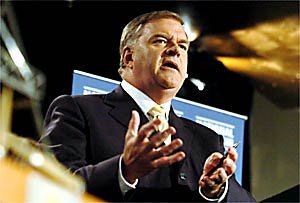 Kim Beazley says he wants to be even tougher on terror than John Howard.
Is this man Kim Beazley congenitally stupid or what?
I guess he's saying, "Fair crack of the whip, mate," with undue emphasis on the word 'whip'. Somebody ought to whip the daylights out of him, right out of Parliament. It's pathetic.
UPDATE:
This came in from Walk-Off HBP:
I read today's entry by David Brin in his blog who argues, why we must liberals label themselves 'anti-war' in order to combat the war in Iraq? Why can't they simply say they are 'anti-stupidwar'?
In he same spirit, I'd like to ask, why Kim Beazley fears being labelled 'soft on terror' when clearly it's just as stupid a piece of rhetoric as the 'anti-war' label? Why can't he simply say, "No, I'm anti-knee-jerk response"?
Instead he says he's more doubleplusgood on anti-terror than John Howard.
Also, as my friend PJ pointed out today, "What happened to this stuff about not letting terror change our lives? In reality we're turning our lives into little cages of fear which is exactly what the terrorists wanted."
Damn straight.
So yes, John Howard and Kim Beazley are gormless little prats undeserving of their labels as 'leaders', who are giving into the terrorists by knee-jerking all the way to fascism. Nauseating.
The ALP? It's Hopeless, Really

The ALP left faction is allgedly bringing the heat on to Kim Beazley over his response to the anti-terror legislation. The thing is, it's sounding really un-convincing. After all, the ALP haven't exactly been very vocal about this issue in the last 10 days when most of what counts for the Australian intelligentzia has been howling to deaf ears.
Moneyball Update
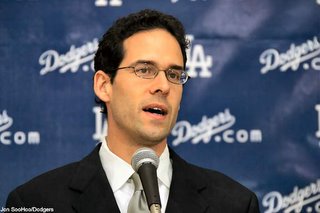
While we're on the issue of leadership, here's an interesting one today.
One of the characters featured strongly in 'Moneybaall was Paul DePodesta who was assistant GM under Billy Beane in the Oakland Athletics' ball club, who then went on to be the GM of the LA Dodgers 2 years ago. After 2 extreme seasons, one in which the LA Dodgers made the play-offs and one in which they fell out of contention due to injuries, he has been sacked.
Rich Lederer has this article questioning the Dodger move to dump Paul DePodesta
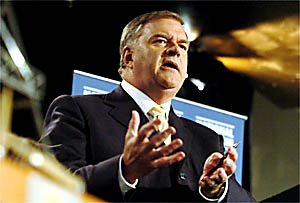 Kim Beazley says he wants to be even tougher on terror than John Howard.
Is this man Kim Beazley congenitally stupid or what?
IN a dramatic reversal in the debate over anti-terror laws, Opposition Leader Kim Beazley (pictured) will move to amend the measures in Parliament – to make them even tougher.
In a bid to make Prime Minister John Howard appear weak and incompetent on protecting Australians from terrorist attack, Mr Beazley intends to strengthen provisions against incitement to violence.
But Mr Beazley is likely to face a fight inside his own party, where it is estimated a third of the caucus has serious concerns about the draft laws.
Following a week of intense debate between Mr Howard and state leaders, the PM has sent revised legislation to the premiers and chief ministers, whose consent is needed to pass the laws.
ACT Chief Minister Jon Stanhope, who created a furore by posting the Government's secret proposals on his website, yesterday revealed there had been changes, notably in relation to so-called "control orders" governing terrorist suspects.
Under the changes, a control order granted to security forces would have to be subsequently confirmed by a court.
Mr Howard has already agreed to amend controversial "shoot to kill" powers in the Bill but Mr Stanhope said there was still not enough judicial oversight.
The issue will be debated by the Labor caucus on Tuesday but Mr Beazley has already decided the legislation is too lenient on those inciting terrorist violence.
Under the proposed laws, people urging violence will be targeted only if the subsequent violence "threatens the peace, order and good government of the Commonwealth".
Mr Beazley argues that under this provision it would be difficult, if not impossible, to convict anybody for incitement.
I guess he's saying, "Fair crack of the whip, mate," with undue emphasis on the word 'whip'. Somebody ought to whip the daylights out of him, right out of Parliament. It's pathetic.
UPDATE:
This came in from Walk-Off HBP:
The Prime Minister has defended proposed shoot-to-kill laws, saying that in the heightened security environment the shoot-to-kill policy would only be used in situations where police freak out. “The world changed on September 11,” Howard said. “Before then I would have needed a good reason to pass draconian legislation like this.”As spoofs go, it's pretty funny.
Mr Howard said that the laws are essential for making Australia safer. “The power to kill civilians is vital in the fight against those who threaten civilian safety,” he said. “We simply can’t afford to be soft on things that have an outside chance of being Terror.”
However, the laws have proven unpopular with the public – registering low approval amongst women, the young, and an incredible 0% approval from Brazilians who enjoy walking along the street in parkas, minding their own business and not being shot in the head.
State Premiers have also cast doubts upon the laws’ effectiveness, pointing to the continued presence of terror in Victoria, despite the Victorian Police’s use of unofficial shoot-to-kill laws for years.
Opposition Leader Kim Beazley initially opposed the new laws, instead advocating for a “shoot-yourself-in-the-foot-to-kill” policy. But when internal polling revealed that voters perceive him as soft on terror, Mr Beazley immediately caved in to the government’s wishes, and is now advocating for police to be given the power to shoot-to-kill terror suspects twice.
I read today's entry by David Brin in his blog who argues, why we must liberals label themselves 'anti-war' in order to combat the war in Iraq? Why can't they simply say they are 'anti-stupidwar'?
In he same spirit, I'd like to ask, why Kim Beazley fears being labelled 'soft on terror' when clearly it's just as stupid a piece of rhetoric as the 'anti-war' label? Why can't he simply say, "No, I'm anti-knee-jerk response"?
Instead he says he's more doubleplusgood on anti-terror than John Howard.
Also, as my friend PJ pointed out today, "What happened to this stuff about not letting terror change our lives? In reality we're turning our lives into little cages of fear which is exactly what the terrorists wanted."
Damn straight.
So yes, John Howard and Kim Beazley are gormless little prats undeserving of their labels as 'leaders', who are giving into the terrorists by knee-jerking all the way to fascism. Nauseating.
The ALP? It's Hopeless, Really

The ALP left faction is allgedly bringing the heat on to Kim Beazley over his response to the anti-terror legislation. The thing is, it's sounding really un-convincing. After all, the ALP haven't exactly been very vocal about this issue in the last 10 days when most of what counts for the Australian intelligentzia has been howling to deaf ears.
So somehow Kim Beazley is trying to have anti-terror laws tied up with racial vilification laws. To think this man is the alternative to John Howard sort of makes one cringe. The Leadership of our nation has sunk to a low level not seen in the last 30 years. Maybe, it's worse than that. Maybe , the worst ever.
KIM Beazley faces an internal Labor Party revolt on two fronts today over failing to argue against "draconian" anti-terrorism legislation and unveiling his own proposal to ban books that promote hate and violence.
A meeting of the ALP's national Left faction passed a motion yesterday warning state premiers and Mr Beazley that proposed anti-terrorism laws could breach the ALP's platform.
The meeting, attended by numerous state and federal MPs, including Julia Gillard, Kim Carr and deputy leader Jenny Macklin, demanded that "all ALP state premiers, chief ministers and members of the federal parliamentary Labor Party act consistently with the ALP's platform and Australia's international law obligations".
Senior ALP figures were also exasperated by Mr Beazley's decision to announce his own vilification laws yesterday, saying he was "mangling the message".
The proposal to link the terrorism laws with his separate reforms to ban racial and religious vilification also angered colleagues because the confusing laws had not been discussed with the front bench.
"Getting up and suggesting the Jewish community of Australia should be wiped off the face of the earth would be illegal, absolutely," Mr Beazley said in Canberra yesterday. "There would be appropriate fines and, if severe enough, appropriate incarceration."
Prominent Labor frontbencher Peter Garrett also raised concerns that the "dog's breakfast" of laws could be used to target writers and artists.If that didn't give you a profound sense of confusion in the ALP ranks, I don't know what would.
"Our bedrock rights to free speech, to due process under law, to confidence that the separation of the judiciary from the executive will stand against the arbitrary exercise of power are all in danger of being swept away by this Government," he said.
However, Victorian Labor MP Michael Danby said support for tougher terror laws was widespread in the community, including in his own inner-city electorate. "Melbourne Ports has lost three people to suicide bombers," he said.
"Even in small-l liberal, inner-city Melbourne, people want to be secure from terrorism. But the federal opposition and the Labor premiers will only agree if there are appropriate safeguards on police use of lethal force and control orders."
Opposition homeland security spokesman Arch Bevis said that the ALP had already agreed to a statement of principles that would include strong legal safeguards.
"There has to be a genuine judicial review, not rubber stamping by courts," he said.
"It's the prospect that Martin Luther King and Mahatma Gandhi could be found guilty of sedition under these laws."
Tasmanian Labor MP Duncan Kerr said he had sent a submission to all state attorneys-general and senior Labor frontbenchers over his concerns.
Mr Howard said he wasn't wedded to introducing the bill on Melbourne Cup day, but he did want to get the bill through parliament before the end of year and certainly effective by the March Games in Melbourne.
He was backed by NSW Attorney-General Bob Debus, who said the laws should be in place for the Games, but not so quickly as to get it wrong.
Moneyball Update
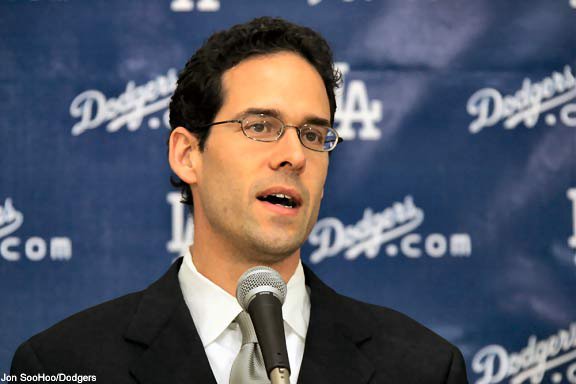
While we're on the issue of leadership, here's an interesting one today.
One of the characters featured strongly in 'Moneybaall was Paul DePodesta who was assistant GM under Billy Beane in the Oakland Athletics' ball club, who then went on to be the GM of the LA Dodgers 2 years ago. After 2 extreme seasons, one in which the LA Dodgers made the play-offs and one in which they fell out of contention due to injuries, he has been sacked.
“Our high expectations were not met,” McCourt said at an afternoon news conference at Dodger Stadium. “I like Paul. He has many positive attributes. It was difficult, but at the end of the day, that’s my job, to make difficult decisions.”The general consensus over at the Baseball Think Factory is that he did a middling job but 2 years really isn't long enough to assess the long term impact of his stewardship. It does however seem very apparent that he was hounded out of town by a hostile press and that perhaps he was not a very good people-skills manager.
Saying the team needs a strong foundation, McCourt listed among his criteria for a new G.M. the ability to evaluate player talent, communication skills, and experience.
---
McCourt hired DePodesta after buying the team in January 2004 from News Corp. The Dodgers won the NL West title in his first season, but DePodesta riled fans by trading popular catcher Lo Duca and two other players at midseason.
“I met with Paul DePodesta this morning and let him know that the Los Angeles Dodgers were moving on,” McCourt said. “I thanked him for his contributions.”
DePodesta shook up the team last winter following the division championship season, and their 71-91 record this year was the Dodgers’ worst since 1992 and second-poorest since moving to Los Angeles in 1958.
“I truly believe that this franchise is poised to begin the next great era of Dodger baseball,” DePodesta said in a statement released by the Dodgers. “I have a tremendous amount of affection for the players, staff and front office, and I wish everyone the best of luck.”
Rich Lederer has this article questioning the Dodger move to dump Paul DePodesta
Here are 32 questions -- 32 seems like a good number when discussing the Dodgers -- that are on my mind:So much for that experiment. We'll never know the results now.
1. Why did McCourt hire DePodesta in the first place?
2. Why did he give him a five-year deal and then fire him in less than two years?
3. Did he hire him because Moneyball was in?
4. With the White Sox the new World Series champs, is Moneyball now out and Smartball--or whatever the hell you call the newest, latest, and greatest way to win--in? Did that influence the McCourts?
5. Why wasn't leadership, now a "very important characteristic" in the search for the new GM, not valued 20 months ago when DePo was hired?
6. Ditto for being a "good communicator" and finding "someone with the experience to do the job?"
7. Why do executives go a complete 180 when they hire a replacement for the guy who failed previously?
8. If experience is so important, why do the McCourts think they know how to run a baseball team?
9. Why don't the standards they hold to others apply to themselves?
10. Just why is Jamie McCourt Vice Chairman and President?
11. Other than being married to Frank, what are her qualifications?
12. Who else interviewed for that job?
13. Was Drew McCourt really 23 years old when he was appointed Director of Marketing last April?
14. When did the Dodgers become Sly and the Family Stone?
15. If leadership, being a good communicator, someone with experience, and having a "keen eye for baseball talent" are so important, why didn't McCourt hire Pat Gillick rather than DePodesta?
16. What would Gillick bring to the table today that he didn't back when he interviewed for the same position in 2004?
17. If McCourt "wants Dodgers here," then how does Gillick fit into that goal?
18. What makes Bobby Valentine such a great choice?
19. Would Gillick or whoever becomes the new GM truly pick the next manager or will there be an understanding that Valentine is the manager in waiting?
20. Has anyone pointed out that it took Valentine more games (1,704) to reach the playoffs (in 1999 with the Mets) than any other manager since divisional play began in 1969?
21. If Tommy Lasorda is so fond of Valentine, why didn't he hire him as one of his coaches after Bobby retired in 1979 and before he became the manager of the Texas Rangers in 1985?
22. If Lasorda's comment that Orel Hershiser's "not qualified" for the GM position is correct "because he has never done it," then would any of us have ever gotten a promotion to a new position? Based on that logic, wouldn't we all still be cavemen?
23. Why would a "special advisor" be so widely quoted in the press? Aren't such confidantes supposed to be more behind the scenes types?
24. Has Lasorda ever done anything behind the scenes, other than snipe about guys like DePodesta, Fred Claire, and Bill Russell?
25. How did the Dodgers perform the year Lasorda was named special advisor?
26. Is he not to blame for the Dodgers' problems this year or is that Al Campanis' fault, too?
27. Has there ever been anyone who clamored the spotlight more than Tommy?
28. As long as Lasorda is in a position of power, why would anyone other than one of his cronies or a McCourt family member want to become the next GM or manager?
29. If McCourt is so fond of staying the course, why did he let DePodesta go?
30. When did that course begin? In 1955 when the Dodgers won their first championship? In 1958 when they moved to Los Angeles? In 1977 when Lasorda became manager? In 2004 when McCourt bought the team? Or a few weeks later when DePodesta was hired?
31. Is baseball the only business in the world in which a degree from Harvard is a negative?
32. Wasn't the late and great Branch Rickey the forefather of the use of baseball statistics in player evaluation?
Please help. I need to know the answers to all of the above questions.
Subscribe to:
Posts (Atom)