2011/05/11

Interest Rate Watch

Something Curious About Interest Rates

I caught sight of this article in the SMH a few days ago and wanted to link to it, so here it is.
It's easy to talk about "tighter monetary policy" restraining inflation, but few pause to think how it actually works.
There's the usual euphemism about higher interest rates taking money out of consumers' pockets and thereby reducing the demand their spending creates, which results in prices not rising as much as they otherwise might.

The reality is harsher.
It doesn't just mean the minority of Australians with mortgages have less to spend. Higher interest rates reduce demand by sending marginal businesses broke and making others marginal.

"Freeing up resources" when we start running close to capacity means creating unemployment in those industries that aren't riding high commodities prices or servicing those that are.

"Freeing up resources" means people going bankrupt, losing their homes and therefore forced to look further afield for work.
An immediate example that comes to mind would be higher rates sending a struggling new car dealer broke, "freeing up the resource" of the yard's mechanics who could then be expected to become available for work in the mines. It's more than a little absurd that Treasurer Wayne Swan tomorrow night will work directly against that aim with a dopey $5000 subsidy for successful small businesses to buy a new car. The offer is of no use to any business "doing it tough" as they must first have the spare capital to blow on a new vehicle which will depreciate by nearly as much as the subsidy as soon as it leaves the showroom. Tell me again how this was meant to be a tough budget.

There's a kernel of something in there about how the RBA might want to raise interest rates but in reality can't bring itself to do so. One gets the feeling that the RBA is putting off the decision for as long as possible before the mining boom kicks in and we have the two speed economy in full dysfunctional totality.

I've suspected for a while that the RBA can't go higher on rates because it would blow up the property bubble. Even if the mining sector does go gangbusters, there might not be much more headroom to go for the rest of the economy. The rate we are at now, might just be the limit of what our non-mining part of the economy can take.

It can't really split up the interest rate to apply differently to the economy, and yet what is going to happen is that the mining sector is going to go gangbusters while everybody else will get left in the doldrums. Spltting the difference and putting up an average isn't going to cut it, but neither is following the mining boom and taking the interest rates up, because surely that will bring down the house of cards that is the property bubble.

When you think about how low interest rates are in places such as the USA, Japan and the Euro-zone, then Australia's interest rate sticks out like a sore thumb. Worse still, those same economies are printing money, then no wonder money is flooding in to Australia, pushing up the AUD. All the same, if the property bubble should pop, then there would be a deflationary spiral, so there's a weird dilemma going on in there. Raise it and be damned or not raise it and be damned. The RBA is clearly trying to stave off the possibility of the inflation to come, but if it raises it too high and the bubble pops, it will have to chase the other nations' interest rates, all the way down to combat the deflationary spiral. Interest rates may not go up at all until the last quarter of this year. Just saying.

2011/05/10

Fiat Money Blues

The Latest From Peter Hartcher

Here's something interesting.
The economies that account for 96 per cent of the world economy are today running loose money policies. Most are happily handing out free money. Some are supplying money at rates so low that it's actually cheaper than free.

It's done for good cause. When money is cheap, people are more inclined to invest or spend. So it aids economic recovery. The former chief of the US Federal Reserve, Alan Greenspan, was named as Time magazine's person of the year in 1999 for his ready resort to loose money.

But if there is too much for too long, it ends badly. Exactly a decade later, Time named Greenspan as No. 3 on its list of "25 People to Blame for the Financial Crisis". And I think they let him off lightly.

The evidence of the past three decades should be enough, but you can go back further. In fact, every major financial crisis in the four centuries of capitalism has had its origins in loose money.

How does it work? It's simple commonsense. The basis for value is scarcity. If scarcity is destroyed, so is value. And when money loses its value, it is abused.

The problem is deleveraging out of extreme debt positions that stem from easy money, when the bubbles pop. So far what we have learned from Japan post 1989 and the US in the 2000s is that nobody who is stretched out wants to take their medicine when the debts are called in. Consequently, the assets that should be written down don't get written down. In a sense, all the asset bubbles that form are deemed to be too large to fail.

It's not as if Australia has more moral fibre in the moral hazard stakes. It's just that it is in a lucky position where the debt collector hasn't come knocking, thanks to Peter Costello's balancing the books.

What history is showing is that the only two ways of paying your way out of debt is to tighten belts or inflate away the money. In a democracy, no administration or government seems able to survive the tightening of belts unless they rise to power with that specific mandate - and even then it remains to be seen if the Tories in the UK can keep it up and retain government. So that leaves the Weimar Republic option of inflating away the debt, which hurts everybody's savings (and explains why everybody rants about gold and decries fiat money).

There is another way of course  and this is simply not to pay what you owe. The fancy version of this is Chapter 11 in the USA, but in Australia we're seeing companies like the Swish Group get away without paying creditors and re-forming themselves as essentially the same outfit that racked up the debts. Not paying your creditors is an option - which Iceland is embracing.

If we had still had the Gold Standard and the value of money was locked into Gold, then we would not have had the option to print the money, which means the fallout from the 2008 GFC would have crippled whole economies instead and the majority of us would be wandering the streets jobless wondering what the hell happened.

You can see why we keep repeating the soft option of inflating away our debts and hurting the entire population over all rather than sheet home the blame to the rich. I just don't see Lloyd Blankfein or Donald Trump hurting too much.

2011/05/08

Sydenham Price Surge

There's A Reason Those Houses Got Demolished

The weird thing to read today is that houses in Sydenham are rising in price.
Several kilometres down Unwins Bridge Road from St Peters is this small suburb that was made smaller in the 1990s when the federal government bought up and demolished a swathe of houses under the flight path.

In their place is a park, Sydenham Green, one of several in the suburb. Like St Peters, Sydenham is on the train line, several bus routes and is close to the shopping strips of Marrickville and Newtown.

And while much of it also suffers from aircraft noise, Rowley says this only seems to be putting off prospective buyers who have never lived in the inner city.

In his experience, that's about one in five people at an open house.

I work next to the park where the houses were demolished with the advent of the Third Runway. The planes come in overhead to land and I can see the innards of the undercarriages as the wheels hang off the bottoms of the planes. It stops conversations dead. The rumble is an ungodly 110dB SPL just outside the building when a 747 comes in. You get used to it, but you wouldn't want to live there. Desiring to live there is a questionable factor if but for the price, so it is the devil's choice. Even if the median prices were 644k, it's nuts. There's a reason those other houses got demolished.

You only need to stand in the park for half an hour to understand.

Cultural Policy In Development

Let The Wookie Win

There is that scene in the original Star Wars where R2D2 beats Chewbacca in some kind of holographic monster chess. The Wookie complains about the loss. Han Solo points out to C3PO that Wookies are known to rip the arms out of their enemies, which prompts C3PO to instructs R2D2, "R2, let the Wookie win."

Such is life in the sphere of media policy in Australia. Here's something from Pleiades that shows just how it works.
Given the importance of the Convergence Review to the eventual shape of the content industries in Australia, it’s pleasing to see that a debate about the policy and regulatory frameworks surrounding them has finally emerged. Yesterday saw the release of a high-quality research paper on convergence by the University of New South Wales’ Catharine Lumby and Kate Crawford, who are senior academics at the Journalism and Media Research Centre there.

Entitled The Adaptive Moment: A Fresh Approach to Convergent Media in Australia, the paper does a much better job than the Convergence Review Committee of setting out the patchwork quilt of competing state and Commonwealth regulations that supposedly govern Australian communications, media, broadcasting and the internet.

It’s not a pretty picture. As they point out, because the internet is “a multifaceted, distributed network with no centralised gatekeeper”, the “vast range of communication options it contains were once governed by distinct policy areas”. As a result, “policy responses to convergence end up being ramshackle and jerry-built”.

The bottom line is that they're likely to roll into one a regulatory body that oversees the whole range of media as a 'one stop shop' with community standards. The best thing about this idea is that it probably gets rid of more jobs of regulators. But can you imagine how powerful this body would become? That is possibly a recipe for various kinds of expression to be oppressed and suppressed by a central body with an axe to grind. Should we see a prolonged period of conservative rule, it won't be long before people would be lining up with pitchforks looking to flay Bill Henson again.

The other nugget in the article is this bit:
It’s also worth thinking about how convergence will shape Australia’s future arts and cultural policies. Historically, there has been almost no understanding among arts policy makers that the internet or broadcast media are even relevant to cultural policy — as the Australia Council’s laughably late and ill-considered attempts to create an arts strategy “for a digital era” attest.

Lumby’s and Crawford’s paper shows what might be achieved if cultural policy was reconsidered in light of the rapid change sweeping the communications and media sector. But the very fact that the Convergence Review  and the National Cultural Policy are being pursued in parallel, with apparently little to do with each other, shows how tough it is to get governments to think outside of their existing silos.

All of this makes the notion of cultural policy even laughable.

The perennial problem for Australia is that the government is always the first and last sponsor of cultural projects. Our publishers and exhibitors and galleries are either too small to amass the kind of capital to initiate their own projects, or these projects tend to be extensions of corporate PR more than genuine attempts to enrich our cultural experience. It's pretty obvious that cultural activities are really not valued by the wider community so it is hard for the government to see a utility in it beyond chest-thumping when somebody wins an Oscar or a Booker Prize.

This isn't to say artists should be entitled to hand outs from the public purse, rather, that it is clear that Australia is only interested in its cultural industries as something to point at and say, "see? we've got one. Now let's talk about the cricket."

Other countries don't quite have this kind of government-led policy formation. In America and Europe and Japan, cultural policy is often signing off after the fact as things keep happening. Culture is something that happens regardless of what bureaucrats say or do, or what guidelines for controlling the expression are laid down. Artists will do as their talent dictates. Cultural Producers will produce as their circumstance dictate. It's not really a problem that the greater community has little appreciation of this fact. We've been happy to be a nation of bogans in the past, it's not worth pretending that having a cultural policy is going to help us grow up from being a nation of bogans  in the future. In that sense, discussions about cultural policy is just all window dressing.

2011/05/04

More From Steve Keen

Housing Bubble Is Shot?

Pleiades gave me the heads up on the latest from Steve Keen. Keen thinks we're seeing the early stages of the decline in house prices. If so sell your banking shares now!
Population dynamics – even immigration dynamics – have nothing to do with house prices. What determines house prices is not the number of babies being born, or immigrants – illegal or otherwise – arriving, but the number of people who have taken out a mortgage, and the dollar value of those mortgages.

For changes in house prices, what matters is the acceleration of mortgage debt, and that’s why the 'first home vendors boost' was instrumental to the turnaround in house prices in 2009: it turned a nascent deceleration in mortgage debt into an acceleration once more. That acceleration has now run out and deceleration has resumed – and house prices have started to tumble as a result.


The fact that the Credit Impulse leads changes in house prices also gives some indication of where future prices are likely to go. The mortgage Credit Impulse shown above is for the acceleration in mortgage debt over a year: the change in mortgage debt compared to the previous year. This brings in an inevitable lag in the series – matched by the lag in the change in house price data, which also shows the change in house prices over the previous year – so that the turning points in each series line up in the graph. Lows in the mortgage credit impulse are associated with lows in house price change, and vice versa. With the mortgage credit impulse still headed south, and leading falls in house prices by three to six months, that implies that there are at least two more quarters of negative house price movements coming up.

All a bit of fun stuff. If you already own your home, then it's probably not the biggest deal. If you've borrowed against equity in the house, this stuff is THE nightmare. I guess there will be an announcement by the government soon that they'll try and prop up house prices with some new helicopter drop of money. If that happens then I think it says a lot about our polity and that in the long run it will be the housing industry and its associated lobby that will be the undoing of Australia - just as the Military Industry Complex in America has racked up the debt, and the construction industry in Japan has soaked up government money putting that government deep into debt. The money spent by the government will simply stave off the inevitable. The problem is that when the reckoning comes down the track, the conundrum will be much bigger then.

2011/05/03

Osama Bin Laden Killed At Last

OMG They Killed Osama!

Like something out of a Tom Clancy novel, President Obama made an address to the world announcing the death of Osama bin Laden. They sent in a small Navy SEALS team to do it - which makes it more like an early 1990s Steven Seagal movie, but I guess that's about the speed of the discourse surrounding Osama bin Laden, even after all these years. I can just hear the synth bass pumping in the soundtrack.

The body of Osama bin Laden was allegedly buried at sea.
The US decided to bury him at sea because it would have been difficult finding a country willing to accept the remains of the world's most wanted terrorist, the official said.

After bin Laden was killed in a raid by US forces in Pakistan early on Monday, senior administration officials said the body would be handled according to Islamic practice and tradition.

That practice calls for the body to be buried within 24 hours, the official said. The official did not immediately say where the body was buried at sea.

Not that it matters to most of us but it makes it impossible to turn it into a shrine. There were fake images of his corpse flying around for a while there but there have been no official releases.

So just like that, the cartoon villain vanishes into thin air. It's almost impossible to ascertain for ourselves if anything about the man was ever true. For my money, he was the most contemporary 'Emmanuel Goldstein' in an Orwellian 21st century we lived in. Sort of an icon governments of the free hour and put up and get their '2 Minutes Hate' happening. And for 10 years the image and myth of Osama bin Laden did his job. It seems today that they had known the whereabouts of Osama bin Laden for some while they probably haggled with Pakistan as to how to deal with it. Maybe it was like a card waiting to be dealt; in which case it is most certain there is a meaning to it happening today. My first guess is that this signals the cue for America and her allies to get out of Afghanistan.

There's a big fiscal problem brewing in America and military spending cuts are inevitable. It seems closing the book on the Osama bin Laden myth complex would allow America to get out of Afghanistan and proceed legitimately with the spending cuts that would include cuts to the military budget.

'2 Minutes Hate' Lasts For 10 Years

It seems like such a long time ago that the Twin Towers fell and ushered in the wars in Afghanistan and Iraq. it seems a world away and half a lifetime ago. The whole nightmare of going to war on terrorism is still hanging over our lives, impinging on our liberties, hampering our movement, blighting our sense of well being. And you could pretty much blame Osama bin Laden for it all, even though various theories swirled as to whole really was working for and why the hell they couldn't "find him and kill him".

Now that Osama bin Laden is officially dead, presumably official business should proceed in the direction of moving back towards the way things they were before the mess - but maybe they won't, because heck, maybe they don't want to.

Just as it was with the wars, I guess we'll get to find out. The next stop is the alien threat terror. It's such a drag.

UPDATE:

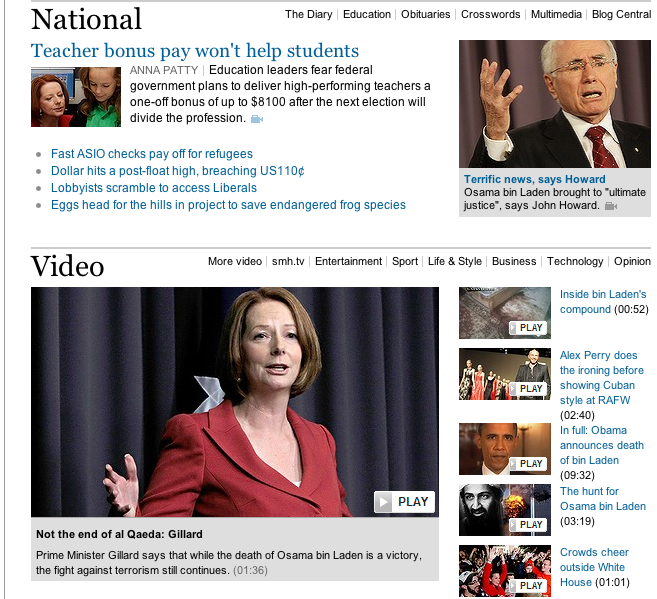
Just a quick snapshot of Prime Ministerial hand gestures in the wake of the news.


John Howard and Julia Gillard agree waving the right hand wipes away the smear of Al Qaeda!

Is anybody amused that Osama was hiding in Abbottadad? Presumably Tony Abbott isn't.

2011/05/02

Sexcalibur Compendium

Customising Is A Way of Consumerist Life

As some of you over on Facebook may know I've been assembling an electric guitar from parts for the last few months. The reason I was quiet in the last few weeks is because the body finally arrived and I was putting it all together rather than spending my nights tapping away at the keyboard. Since then, some people have asked what guided my decisions in picking the parts so I've decided to write it all down. This is sort of an entry to explain my decisions. Others will have different ideas so don't look at this as any kind of best practice - it's more like an extension of where my thoughts were headed.

This guitar project has its origins in my frustration at not being able to find a 'shred axe' - a guitar for playing heavy metal tones that covered all the things I wanted. There are many out there that look like shred axes wielded by the mighty shredders we know, but they don't cover important points. They might have bodies made of bad woods, crappy pickups, horrible replicas of Floyd Rose bridges and so on. Thus the exercise became sourcing all the right components to put into the one guitar to make it kick and scream in a particular way.

Overview

The concept of this guitar has a name and it is, 'super-strat'. This term came about in the 1990s when the original single coil strat design was updated with humbuckers in the bridge. All the shred axes we see today are downstream developments of this idea of marrying a Fender Strat to a Gibson pickup, looking for the best of both worlds.

Historically speaking, the model of this thinking actually goes back to the famous 'Frankenstrat' as constructed from parts by none other than Eddie Van Halen himself. Unashamedly, I have to admit that what I wanted to do was build something that had a Floyd Rose, a Maple neck and a humbucker that had the right out put, which is to say, just another 'super-strat'. but you'd be amazed at how hard it is find one with everything done right these days.

Since the death of Shred as a market force, the guitar manufacturers have beaten a retreat from the once saturated 'super-strat' market to the point where it is actually a lot harder to get the real thing in one piece. Instead there are various low end models for kids that look the part while cutting costs and therefore charm and performance. Presumably the adults get $8,999 Re-Issue Marc Bolan Commemorative 'Pre-Aged' Gibson Les Pauls. Like, yeah.

As for 'super-strats' and shred axes, you can always get a mediocre substitute, but it's worth doing this for real.

The Neck

I got the wooden parts from Warmoth. The neck was bought off their showcase while I specially ordered the body. I picked Warmoth over buying the 'Frankenstrat kit' you can now buy on line because I wasn't really interested in slavishly duplicating the original Frankenstrat. The other reason is that I really wasn't sure of the wood that comes with the kit while Warmoth were all about the best woods they can get their hands on, but more of that in a moment.

The neck is maple, with a maple fretboard because when it gets down to it, that's what I like. I know ebony is nice, Bubinga is interesting as are exotic things like Pau Ferro, wenge, Bloodwood and Purpleheart, but I actually don't know what some of those exotic things sound like, and whether I would like them at all. Maple on Maple? I know I like that.

I was fortunate in that the 'KWS' banana headstock also had the 'Nightswan' inlays which are quirky to look at. Other than that, it was just the clean satin nitro finish and a shelf for the Floyd Rose lock down nut that sold me. Warmoth is particularly cool because if you're adventurous, you could come up with all kinds of wood combinations to satisfy the most inquisitive impulses.

The frets are '6130' so it is like a vintage Gibson. This is possibly the most perverse combination in as much as the neck dimensions are like a Fender stratocaster, but the frets are Gibson-like. This also comes from an old interview in Guitar Player magazine I read years ago where Eddie Van Halen described his early attempts at building a Frankenstrat and how he ruined a strat neck striving to put in Gibson frets. It's nice that you can just order it that way these days.

The Body

Being cautious (or conservative, depending on point of view, I guess) I settled on a combination of a carved Flame Maple top on Mahogany. Again, Warmoth offers a lot of options so you could go crazy looking through their site, but when it comes right down to it, the idea was to marry a Strat to a Gibson. If the maple on maple 25-1/2 scale neck is all Fender, then the body materials had to be something a bit like a Gibson Les Paul Custom.

Just as a side note, the original Frankenstrat was Swamp Ash and many of the kits on offer seem to be made of Alder, so I figured the biggest expenditure should go on getting a combination of woods that justified the whole exercise. To that end, the soloist body also has a carved top, which is in some ways excessive over-design; But you only do this once in a blue moon, why not?

As with the neck, I can think of all sorts of crazy combos from the options available, and it's tempting to just keep building these guitars  with different combinations of woods. You can spend hours playing with the Warmoth site. It's like IKEA for guitar players.

Pickups

The most fun you'll have customising an electric guitar is picking pickups. The plan of attack I had for this one was to go for a set that had about 8.5k ohm resistance and a resonant frequency well below 10kHz. You want a lower resistance because you want the pickups to be responsive. The higher resistance comes from stronger magnets that keep the electrons in place. The lower the resistance, the less power the magnets are exerting on the electrons, the more responsive they become. The bad news is that they have less output, so it's a case of finding the right compromise.

There is a sound you can get from high output pickups but dynamic is not a feature of that sound. Conversely, you can get more dynamic with weaker magnets but you might not get a lot of output to do much with. Both the Humbuckers I picked feature Alnico II magnets as opposed to Alnico V, and the designs are fairly close to the Gibson PAFs.

A more modern metal sound would be to go for the higher output pickups with Alnico V magnets. In my case I was looking for a piece of 1978 (hey, the Yankees won the World Series that year). The bridge pickup is a Seymour Duncan Custom '78. The neck Humbucker is an Alnico II Pro, also from Seymour Duncan and the middle pickup is the Seymour Duncan Cool Rails.

There are some other amazing pickup options out there so this is by no means any kind of ideal. The most important thing I was looking for was that they were roughly the same in resistance so that when I had the switch in between the pickups, I'd get a balanced combined tone. Looking back on the soldering I did, I sort of regret not installing a 5-way super switch to do the fancy coil splitting, but then I didn't know about it until I sat down to wire it up. I naively assumed a normal 5 way switch would get me there.

The Tremolo System


It goes without saying that an axe like this needs a Floyd Rose. What's probably not as well known is that you can easily change the block on the Floyd Rose. Yes, it adds sustain. My advice is "Nike" as in, "Just Do It".  I upgraded mine with a big L-shaped block from Floyd Upgrades. The hope was to have as much Bell Brass sustain to last into the next millennium... except... the problem with the L is that it blocks the forward movement with the L protrusion so I can't pull back. I'll have to get the non-'L' 42mm block now.

Replacing the block is not too hard. Setting up the Floyd Rose system is a little harder. It helps to get one of these trem stoppers. Once it's in place, then it's easier to set the action, the neck relief and then the intonation. Afterwards you can adjust the spring tension. It's a hassle winding the strings on and off, but it's about 2 hours work.

Potentiometers, Capacitors, Switches, Knobs

The most tedious part is ordering these necessary components. You need 3 pots for a Strat configuration; 3 knobs; a 5-way switch; and ouput plug; wire and copper shielding. Copper shielding is something I recommend, now that I've built mine. I encased the entire rear rout with the shielding and it is quiet as a mouse. No RF in the guitar.

The potentiometers in this guitar are 500ohms, as per Gibson specs as opposed to 250 ohms as per Fender specs. The simple reason is that I've loaded up with 3 Humbuckers instead of 3 single coils. It's worth remembering that Humbuckers need 500 ohm pots.

The other note is that on recommendation of the guys at Sydney Guitar Setups, I used this capacitor here. I have no real explanation for this one except that the 0.047 uf I ordered from Warmoth looked strangely 'weak'. I'm no expert but I figured the guys at Sydney Guitar Setup might know something I didn't so I asked them their recommendation and it was the Sprague Big Orange Drop Capacitor.

I don't have a capacitor for my bridge pickup tone control. It's weird, I know, but I wanted to duplicate the 'direct' thing by not putting any capacitor with the Custom 78, as per the original Frankenstrat that had no tone controls. Yes, it's a little hardcore but I can really live without any tone control on the bridge pickup on this guitar. I can't remember ever winding back the tone on the bridge pickups on my Stratocaster or Deusenberg.

The Tools You Need

It's worth listing the tools I needed:

  • drill

  • soldering iron & solder

  • wire-stripper

  • pliers

  • screwdrivers

  • guitar tuner

  • sandpaper in '220' and '100' - and sandpaper block

  • scissors


It's not much if you already own it. I didn't own a drill or a set of drill bits so I had to shell out for that. You don't need a super-powerful drill. In fact it helps to go slow when you screw in to precious bits of wood.

2011/05/01

Peak Oil Is Knocking

Today's Peak Oil Article

Here it is.
Peak oil is forcing its way to the top of the agenda with stark warnings from the International Energy Agency and others repeated on ABC radio and television this week, after an investigation by the Catalyst program.
Following up a similar program she made in 2005, journalist Jonica Newby gained a rare interview with the IEA chief economist, Fatih Birol, who said crude oil production peaked in 2006 and, in veiled terms, added governments should have started working seriously on the problem a decade ago and warned of the threat of more oil wars.

Whereas five years ago the agency expected total production - including oil from deep-sea drilling and unconventional sources such as tar sands - could rise to 120 million barrels a day by 2030, the agency now expects production will reach only 96 million barrels. And Birol reckons there are no guarantees it can be brought out of the ground in a timely fashion.

''Existing fields are declining so sharply that in order to stay where we are in terms of production levels, in the next 25 years we have to find and develop four new Saudi Arabias. That is a huge challenge.''

If you're unsure of the general outline of the argument for Peak Oil, here's the helpful Wikipedia entry with the usual caveats about Wikipedia. Even the mighty Russian fields peaked in 2007 according to Wikipedia. If you want to read in more depth, here's a cool link.

Anyway, back to the article:
Desperately needed, of course, is a policy to tackle both peak oil and climate change at the same time.
Last year the think tank Beyond Zero Emissions, with Melbourne University's Energy Research Institute, published its Zero Carbon Australia Stationary Energy Plan, which shook things up by calling for investment of $37 billion a year to switch the whole country over to 100 per cent renewable energy within a decade. The plan included enough installed energy capacity to power all our transport needs.

Beyond Zero has assembled a team of scientists, engineers and planners working pro bono on a fully costed, national transport plan that will take in three streams: city passenger and public transport, freight, and intercity transport and high-speed rail.

Workshops are under way, drafts are circulating and the report is due out by the end of the year.
The executive director, Matthew Wright, says the opportunity for Australia is there to invest in new, climate-friendly transport infrastructure and avoid spending on high-priced oil imports, which Beyond Zero estimates could exceed $50 billion a year by 2015. ''That's what I call a great big tax,'' says Wright.

That should be the take home message for now. our politicians are barely on the edge of the crux of the problem, and they're whipping up the wrong frenzy. Somewhere in the midterm, our dependence on oil could cripple our economy when it becomes impossible to move things around this country without oil. It's on the cards, it's part of the complex problem that gives rise to the need to prepare infrastructure for alternative energy sources. If one thing could contribute to the popping of the Australian Property Bubble, it would be the rising cost of oil.If people value the investment value of their houses, they might consider moving to alternative energies faster, not slower; and in turn stop whinging about the Carbon pricing because that is the mechanism by which the technology will be funded.

2011/04/30

The Royal Wedding Bash 2011

The Royal Wedding Through A History Prism

It's weird watching the spectacle of a Royal getting married because the main thing it brings to mind is in fact Henry VIII who married six times. Henry so wanted to marry Anne Boleyn, he split off the Church in England from Rome to 'accomplish' this deed. Perhaps the better way to do it is, to do as he pleased.

So, watching the service was rather interesting, what with all the glorious gold robes and the high vault of the cathedral and whatnot; all of it a remnant of the ties to the Catholic Church. I wondered what Pope Benedict XVI would have made of this spectacle. He probably sees it the way the Queen sees America - all that glory used to be ours. And oh, look, there's Sir Elton John - singer, raconteur, and famous gay person - with his partner. In a Church. And the Archbishop of Canterbury Rowan Williams who has no problems with Gay Bishops! This stuff is priceless and writes itself, as does history, it seems.

Royalty is a strange business with all that symbolism. Their main job is to procreate the next generation so that the symbolism can be carried on. It's a little like sport where in essence, you're rooting for the laundry. In this instance, you're rooting for lines of DNA.

I also noted that everybody knew the words to 'God Save The Queen' except Her Majesty. Then again, she wasn't about to sing "God Save Me", though she might have felt like it. God knows how she feels about the whole Diana thing now, now that the son she begot is headed for the throne and fully committed to the family business of trying to push out the next-next-next heir out of Kate Middleton's womb. Oh, joy.

The People Allegedly Not Invited

Notably absent were Fergie, Tony Blair and Gordon Brown. Victoria Beckham and hubbie David were invited. That's got to be an odd invitation list. Oh, and Elton John with partner.

The Royal Wedding Through A Diana Prism

I had no interest whatsoever in the Royal Wedding of Kate & Wills and all the hoopla until this morning when I saw an old reel of when his mother Diana  wed Prince Charles 30years ago. It struck me as tremendously sad and beautiful through the distance of 30 years gone by and how that marriage unraveled spectacularly, publicly and most importantly, in the most humiliating manner for both Diana and Charles. And knowing how Princess Diana died made the footage even more poignant. If that's not quaint enough knowing that Princess Diana dies in an accident at the midway point between the two weddings bridging two generations, then the years since have been tainted with the sadness of watching the two younger princes left behind, grow up in the public glare without their mother.

Weddings are a horrible ritual in my books. I think I mentioned this before but I find them far more uncomfortable than christenings or funerals. But for once, all the symbolism made sense if not but to bring the narrative of the Royal Family back to a positive point. At least all that bad blood that surrounded Diana and her demise can be put to rest. The future of the Throne is secure, her son will ascend to be King one day. If there isn't one day in thirty that the Royal Family could enjoy, this day should have been it.Then again, I doubt they have too many bad days.

I don't know what Princess Catherine's role is going to be in history, but one thing is for certain, her name is writ into the history books as surely as the wives of Henry VIII. People might find the Royal Family an anachronism, but one thing was certain, they still own the process of history in the making.

Did The Media Learn Anything?

That's the big question. The media practically hounded Diana to her death. Of course she was complicit with some of the media, but you couldn't blame her trying to take some control over something that was always threatening to ruin her life.

I wonder if the media is going to go hard at it with Princess Catherine as it did with Princess Diana. I guess they will. Did I hear a starting pistol go off?

The Chaser And That Censorship

I don't like censorship at all, so I'm going to agree with those who say it is medieval of Clarence House to have put the gag on the boys. But then, the Royal Family think things should work around them as when there was a Great British Empire. Clearly they do not think incorrectly. I am no less a Republican, and I am deeply resentful of the gag order. The Chaser boys should do a show in guy Fawkes masks, the next time they do a show.

2011/04/14

Blast From The Past - 13/Apr/2011

Remembering Gagarin

Not that I was around when Yuri Gagarin made his famous flight, but his name has always been the beacon of promise. Anyway, as yesterday marked the 50th anniversary of his big moment in history - and damnit I was going to blog it except I got distracted - it seems a appropriate to pay tribute with Gustav Holst's 'The Planets'.

Holst's 'The Planets' is of course the collective cycle of music that formed the template for John Williams' soundtrack for the original 'Star Wars', which if nothing else means it has much more reach than we ordinarily give it credit. It's probably more meaningful in recent history than say the doodle of Erik Satie or something like the 'Bolero'.

Today I present to you my favourite recording of this cycle of orchestral bombast.


This one is Charles Dutoit conducting the Orchestre Symphonique de Montreal, originally released in 1987. What do I like about this recording? Let's see... It's fully digital from the recording to the mix to the mastering. And it has one of the fastest renditions of 'Mars,  the bringer of War'. The 'Jupiter, bringer of Jollity' is dynamic and rich. The whole album is clear, it's evocative and energetic and actually sounds quite a bit like its idiot bastard son, the sound track to 'Star Wars', which in its own way has an unique sonorous quality.

Because the piece is so popular, there are many performances of this thing in recording. Over the years across LPs and CDs, I have owned 4 versions of this thing by different conductors. Heck I have more of these than Goldberg variations or Bach's Orchestral Suites or sets of Beethoven's symphonies. I can only conclude by this numerical evidence that I must really like this bit of music.

What always amazes me is just how different these same pieces can sound with different conductors and orchestras and rooms. The differences can be quite surprising when listened to and given A/B testing. In many ways this album is an artefact of its time with its crystal clear, bell-like digital tones with somewhat jagged lower mids, but I do like how the dynamic range plays out in the recording as well as the gusto in the performance. It almost sounds reinvigorated as a result of the advent of 'Star Wars' movies and the renewed interest in the source material. Anyway, on the day after the day commemorating the first man into space, I thought this one might be of some interest.

2011/04/13

Steve Keen Says...

Some Sobering Graphs

Pleiades pointed me towards this last week and this week. Having read through the 2 installments I couldn't tell you which one was more frightening. Lets try a taste from the first week first:
While wages have risen, the 2.8 times increase in loan repayments means that mortgage payments on an average first home loan have gone from taking 40 per cent of after-tax income of the average worker in the 1990s to 64 per cent now – after reaching a peak of 74 per cent in late 2008 before the RBA slashed interest rates (the ratio fell to 53 per cent, and it would have fallen further had the first home vendors boost not caused house prices to skyrocket again).

In the early 1990s, a young wage earner could aspire to financing a house purchase using his or her income alone. Now, that’s out of the question.

Faced with this level of potential debt-servicing costs, young would-be house-buyers are giving up on the dream of home ownership – and its attendant nightmare of debt peonage. Recently there have been calls for a first home buyers' strike. A 'buyers’ strike', whether organised or not, is what will end the Ponzi scheme of debt-inflated house prices, because like all Ponzi schemes it only continues to work so long as new entrants outweigh those trying to cash out.

That's it in a nutshell. There are some interesting graphs that follow but the take home point of the first article is that yes, there's a bubble going on, and it's gettng to the point where the bubble can't be supported by the willing participation of the market. Cutting to the chase, the growth in mortgage debt is at once the secret of our banking sector's success. Here's the elaboration in the second article:
Looking back over past data there are several consistent patterns that can be seen.

Firstly, house prices and bank shares are correlated. There was one aberration – the 1970s – but that was marked by peculiar dynamics arising from the historically high inflation at the time. Generally, bank shares go up when house prices rise, and fall when the fall.

Partly, this is the general correlation of asset prices with each other, but partly also it’s the causal relationship between bank lending, house prices, and bank profits: banks make money by creating debt, rising mortgage debt causes house prices to rise, and rising house prices set off the Ponzi scheme that encourages more mortgage borrowing. The bubble bursts when the entry price to the Ponzi scheme becomes prohibitive, or when early entrants try to take their profits and run.

Secondly, the fall in the bank share price is normally very steep, and it occurs shortly after house prices have passed their peaks. Holding bank shares when house prices are falling is a good way to lose money – and conversely, if you get the timing right, betting against them can be profitable. That’s why Jeremy Grantham – and many other hedge fund managers from around the world – is paying close attention to Australian house prices.

Thirdly, house prices and bank shares are driven by rising debt, and when debt starts to fall, not only do house prices and bank shares fall, the economy also normally falls into a very deep recession or depression. This is the crucial role of deleveraging in causing economic downturns, including the serious ones where debt falls not just during a short cycle prior to another upward trend, but in an extended secular decline.

There is also one cautionary note about the current bubble: though history would imply that there is a very large downside to bank shares now, it’s also obvious that bank shares fell a great deal in 2007-09, so that much of the downside may already have been factored in.

It's well worth checking into those pages to have a good look at the graphs because they're very scary. The graphs bear very close inspection. The numbers clearly tell us we're in one big mighty property bubble. The rest of what is said to describe it is window-dressing.

I'm wondering how all this leveraging into mortgages is going to get de-leveraged when we fully switch into the 2speed economy where miners will  boom and drive inflation while the rest of the economy gets taken for a ride. There's some pain up ahead if you aren't somehow hooked into the mining sector, and if your career's all about finance and banking, then you may well be in for a mighty wallop when the bubble bursts. It's going to be the Australian financial crisis. We're going to hate every bit of it, just as people  in the rest of the developed world are hating their post-GFC medicine right now.

2011/04/07

Fail Safe Part II

Aeschylus Was His Name...

I've been arguing a lot about the inferences that can be drawn from the Fukushima plant going into meltdown and a category 6 disaster in the wake of 12m high waves as well as a magnitude 9.0 earthquake. What I find most annoying is the group of anti-nuclear types citing that given the failure of Fukushima, it conclusively proves nuclear power should never be used. I've pointed out that there is an epistemological problem with risk management in my previous post here.

The people saying that Fukushima proves nuclear power plants cannot be safe are ignoring the freakishness of events that befell the plant to send it into its current condition. And this is is what I have for you.

Aeschylus was a playwright. He famously - and apocryphally - died when he was sitting in a forest reading a book when he was hit on the head with a turtle that was dropped by an eagle.

It's exactly that sort of freakishness that led to the events at Fukushima; the off the charts unlikelihood of a series of events overcoming all the fail safes. So if we were going to argue that Fukushima does indeed *prove* nuclear power is an unacceptable risk, then we have to draw the same inference and say that the death of Aeschylus proves sitting in the forest reading a book is an unacceptable risk.

People sit in the forests all the time. They don't get killed by eagles dropping turtles. There are around 2000 reactors around the planet safely supplying power, day in, day out. If we use Fukushima as the yardstick and make all nuclear power generation unacceptable, it would be like making Aeschylus' death the reason why we can't sit and read books in a forest. It's like taking the most outlier statistical abnormality and claiming it should occupy the middle.

Again, I'm not pro-nukes. I find radio-activity and human error and fallibility to be frightening risks. But I can't stand listening to people expressing their fears of nuclear power using the Fukushima disaster as the conclusive reason why we should stop all nuclear power stations. It's the worst kind of opportunism and it is inherently unscientific.

2011/04/06

Vandalising Government

If Society Doesn't Matter, Then It's a Great Social Plan

There's an old joke back at AFTRS that the place would have run much better without students. Or the Royal North Shore Hospital would run much better if it didn't need to deal with patients. There's a certain mindset that says government would be so much better if it simply didn't have to service its citizens. Along those lines comes this little nugget:
Mr Ryan has answered the question today by unveiling a budget plan that, at least superficially, is almost as bold and painful as the  Roadmap for America that he has flogged for years. It claims to slash the federal budget deficit from a little over 9% of GDP this year to just 1.6% by 2021. By contrast, the Congressional Budget Office reckons the deficit would fall to just 4.9% under Barack Obama’s budget. He does this without, on net, raising taxes. By closing loopholes, he would pay for a cut in the top personal and corporate rates. So how does he shrink the deficit? Through an eye-watering assault on entitlement spending, in particular health care. Mr Obama’s health care reform would be ditched, Medicaid would be converted to block grants, and traditional Medicare would be replaced with vouchers.

There are many problems with this strategy but it’s worth keeping in mind how remarkable it still is: a legislative proposal that takes dead aim at the real source of the long-term fiscal imbalance, namely, entitlements.

It's weird how health welfare and education come under 'entitlements' when Paul Ryan's plan doesn't exactly address how these things would become better by cutting these budgets. He even proposes to cut taxes for the rich, and one wonders how this is ever going to help government coffers, when there isn't a federal level sales tax in the USA. The point of cutting the top tax rate is that it theoretically frees up their spending. So without a consumption tax or sales tax or a VAT or a GST in place, there's nothing to replace the lost tax on direct taxation to indirect taxation. But of course, as George Bush the elder once said, "read my lips, no new taxes".

The same applies to cutting the top corporate rate. The cutting of direct taxation is fine provided that there is an equivalent collection of indirect taxation. Otherwise, there's no replacing the lost revenue. Granted that all government is a kind of 'robbing Peter to Paul' sort of affair, it doesn't really make any attempt to explain how these cuts will therefore translate into proper Federal revenue - but then he doesn't seem to be interested in that either because being Republican, a small government is best. In that sense, this is just another ideological whitepaper to tax less spend less screw over the poor and pretend the world's problems will go away, when the previous 8 years of the Bush administration essentially ran with that policy into a brick wall. Which is also the experience in many states in the USA where they keep cutting taxes and eventually they can't pay their employees, but then they can't raise any taxes for ideological reasons.

Doing the same thing over and over and expecting a different result is the working definition of stupidity. In this instance, the intransigence is breathtaking. This is the bright hope for the Republicans. America sounds less enticing by the day.

2011/04/05

The World Is A Con(spiracy)

Try This On For Size

Alan Greenspan was the consummate Reaganomic Federal Reserve bank chief of our time. What if he was secretly an un-reconstructed acolyte of Ayn Rand? That's exactly what Peter Hartcher is postulating in the SMH today.
So why is Greenspan opposed, as a matter of principle, to any attempt at reform? Four possibilities come to mind. First, he is senile. But although he is 85, his statements were not the product of a wandering mind. Second, he is in the thrall of the big banks that oppose change. But while he has been taking handsome speaking fees from them in recent years, he has never been interested in money, selling his profitable Wall Street business to work at the Fed on a relative pittance.

Third, he is a blind ideologue who will not concede that any regulation could be good regulation. This is entirely possible. But he knows full well the terrible damage he inflicted on his country.

Or fourth, he is not a fool but a fox, playing a double game.

Greenspan's view is so absurd that it tempts us to wonder. In 10 days we will see the premiere of a movie of the Ayn Rand novel Atlas Shrugged. This cult 1957 novel is a warning against government intervention, a sermon on the virtues of laissez faire, and a reminder that Alan Greenspan was once a close acolyte of Rand and her Objectivist movement. Her 1966 book Capitalism: the Unknown Ideal included an essay by Greenspan on the virtue of the gold standard.

The young Greenspan advocated a return to a system where a government could only issue currency backed by a physical hard asset - gold. He wrote that "gold and economic freedom are inseparable". He derided the current system of fiat money, where a dollar is backed by nothing more than a government promise to honour its debts, as "paper reserves".

In Atlas Shrugged, the libertarian heroes smoke cigarettes branded with little gold-coloured dollar signs. It's unsubtle. The cigarette represents freedom of choice over government regulation; the dollar sign is a campaign message for economic freedom in the form of a gold standard.

It has often been observed that it was ironic that Greenspan, a leading critic of the paper money system, went on to become its chief, his signature appearing on every dollar bill.

But maybe it wasn't historical irony. What if Greenspan never did change his view, instead covertly dedicating his life to destroying the system he so despised? Could it be that he remained a secret agent of Ayn Rand all these years?

Talk about wild speculation. Long time readers would know that I've had a high opinion of Mr. Hartcher in the time I've been keeping this blog. He's always struck me as astute and level-headed to the point of boring. It's nice to see that he actually has a wildly imaginative side. This is the stuff of conspiracy theories and spy novels. We may never find out for sure, but if it's true Greenspa might have been a mole for the ideological lunar right all these years. If not true, then we have to face the other 3 possibilities - that he is senile, greedy or caught up in his old ways - none of which seem unreasonable in of themselves. That being said, it's a remarkable bit of connecting the dots. Ayn Rand to Alan Greenspan to Gold Standard vs. Fiat Money and the Fed to Cheap Credit and Low Interest Rates to Global Financial Crisis. The guy in charge was the guy trying to destroy it all. It wasn't the butler, it was the chief banker at the Federal Reserve!

It's all pretty good and makes for a gripping conspiracy theory-in-the-making. I think Mr. Hartcher missed April Fools by 4 days.

2011/04/01

The Social Contract In Australia

Our Very Own Quango

There's some discussion about a buyer's strike being put forward by the Get Up! crowd. I tend to think if you cant afford it, then you're already at the picket line of a buyer's strike. If you can afford it, then you're a scab, but hey, you only have to look after your own interests in a market.

Anyway, in light of the campaign, some articles have popped up, but this one had this interesting passage:
Australian housing doesn't have anything to do with economics. It long since ceased being a “market” at all.

Rather, it is a political complex - a quango - that represents the single largest page in the socio-economic contract between the government, the Australian financial system and an ageing baby-boomer population.

When the baby-boomer generation first took power and reshaped Australia in the 1980s, the promise was for a new kind of meritocracy.

The old “Australian Settlement” described brilliantly by Paul Kelly in The End of Certainty - a protectionist social contract between unions, industry, government and the people – was swept aside in favour of a neoliberal vision.

That bit kicks off an interesting historical analysis of just what happened to the Australian property market, which is now experiencing historically anomalous prices. The rest of it makes for interesting reading so do stick with it. For those who think that the Property prices aren't artificially propped up by the government, the RBA and the banks, then this passage alone might help you understand that it's been propped up very nicely:
The final death knell of the new vision surely came in 2003 when the old national good luck arrived in the nick of time.

As the housing quango lay dying in 2003, along came a commodities boom the likes of which nobody had seen in century. The transformation was complete.

The entrepreneurial vision of those pioneering '80s baby-boomers replaced with happy-jack dirt salesmen and a bloated entitlement state that now had the money to keep its most hideous progeny, the great, quivering housing sack that hung from its belly, alive.

Staying alive

In 2008, when the world woke up and the mutated vision was revealed in all its horrible form, the government deployed every available mechanism to keep the thing alive.

Unheard of guarantees across the financial system, moral hazards like leaves in the wind, wholesale immigration, massive direct subsidies, huge general stimulus.

This might be forgivable if it was at least honest and openly declared. But it wasn't and isn't. Instead, those that had sat outside the system, hoping for a house or sagely planning to swoop when the bubble burst, are insulted with blandishments about how robust the system is, how they missed out on the “market”.

Even though this so-called “market” long since ceased to bear any relation to laws of supply and demand.

Rather than let it be a market, and fall, authorities insult them again and again with “affordability” programs. Just yesterday, a reader sent me a link to a Victorian government program that is running a lottery for first-home buyers to win a new home at 25 per cent off.

I don't really know if the absence of affordability immediately translates into a crisis as such. I am, however, quite suspicious of a 'market' that keeps staying aloft in light of the global financial crisis that has brought property prices crashing in other parts of the world. The absence of corrections, as engineered by the Federal Government clearly is an artificial, distorting force in the market place.

When I think about it, I don't mind property speculators speculating, even, but the fact that the government and the RBA and banks won't let property prices go down according to the market's dictates, means those speculators are all protected. People go on about the moral hazards for banks, but it seems people with mortgages in Australia are being bailed out by the very same moral hazard. That part of it does seem incredibly unfair, given that nobody bails out renters, stock speculators and people with money in dodgy Superannuation schemes who then get told they owe the tax office tons of money.

That's not the only thing going in the SMH today. Here's yet another interesting article on the same topic but on a different tangent, covering Negative Gearing.
By contrast, the Australian income tax system provides substantial incentives for people to borrow money to acquire property, shares or other assets with a value they expect will appreciate over time. Unlike most other countries, it has always been possible in Australia to deduct any excess of interest payments on loans taken out to fund an investment over the income produced by that investment to reduce the tax payable on wage or salary income.

Since the Howard government's decision in 1999 to tax capital gains at half the rate applicable to the same amount of wage and salary income, a decision that was supported by the then opposition, ''negative gearing'' has become a means not only of deferring tax, but also permanently reducing it.

In 1998-99, when capital gains were last taxed at the same rate as other types of income (less an allowance for inflation), Australia had 1.3 million tax-paying landlords who in total made a taxable profit of almost $700 million. By 2007-08, the latest year for which statistics are available, the number of tax-paying landlords had risen to 1.7 million, but they collectively lost more than $8.6 billion, largely because the amount they paid out in interest rose more than fourfold (from about $5 billion to more than $20 billion over this period), while the amount they collected in rent ''only'' slightly more than doubled (from $11 billion to $24 billion), as did other (non-interest) expenses.

If all the 1.2 million landlords who reported net losses in 2007-08 were in the 38 per cent income tax bracket, their ability to offset those losses against their other taxable income would have cost more than $4.8 billion in revenue forgone; if (say) a fifth of them had been in the top tax bracket, then the cost to revenue would have been more than $5 billion.

This is a pretty big subsidy from people who are working and saving to people who are borrowing and speculating (since those landlords who are making ''running losses'' on their property investments expect to more than make up those losses through capital gains when they eventually sell them).

That right there is the Quango the earlier article was talking about. That's our social contract in this country. If the speculators are encouraged to speculate by tax law AND they can't lose, is it really incorrect to say the system is rigged? I guess the answer is that you'd be an idiot not to jump in, and that is exactly what's been going on for years and years.

As David Llewellyn-Smith says in the first article, a buyer's strike isn't the answer. But it's going to be a hell of government that's going to find the will power to break out of the Quango.

Don't Look Away, Deflation Is Here

It's been an interesting week with Colorado going bankrupt thanks to Private Equity Fuck-ups, much like how the Borders/Angus&Robertson chain has gone into administration. Suddenly they're flogging their wares at cut prices. A&R will  close another 12 stores and 102people will lose their jobs.

In amidst of all that is this article saying heavy discounting buoys retail sales.
Retail spending increased 0.5 per cent in February, to a seasonally adjusted $20.535 billion, the Australian Bureau of Statistics (ABS) reported today.

Economists’ forecasts had centred on a 0.3 per cent rise in the month.Unlike the 0.4 per cent rise in January, sales in February were driven higher by spending on discretionary items, such as household goods, and on items excluding food, said JPMorgan economist Helen Kevans.

Advertisement: Story continues below
‘‘That suggests consumers are showing less caution than we thought,’’ Ms Kevans said.

The rise in household goods sales suggested a strong increase in sales volumes, due to heavy discounting, she said.

‘‘In the wake of the rate hike (in November 2010), they weren’t even attracted to discounting, but now they are.’’

That's curious, but then again if Borders and Angus&Robertson and Colorado and JAG and all those stores are hurling goods out at a discount, then there's going to be a discount war; it's not surprising at a certain price point people felt like it was worth spending the money.

I hate to break this to people but this kind of price war is going to lead to the sort of deflationary spiral Japan experienced. This is exactly how it started. You read it here first.

Blog Archive