Showing posts with label Bernie Sanders. Show all posts

2017/01/06

From The Pleiades Mailbag - 06/Jan/2017

Standing Rock

Here's a little essay about Standing Rock. The writer likens the stand off to a moment from an imagined Zombie Apocalypse. You can just see that analogy right? Of course, how could those officers lined up to intimidate the Native Americans be so impervious to their own inhumanity? They must be some kind of cultural zombie, right?
At the head of the gathering army of the dead will be a man who brags about his lack of compassion and is so hollowed out by his punishing narcissism that he must compulsively eat our minds with tweets and outrageous behavior so as to fill his emptiness with our attention. His appetite for selfish self-regard seems immense enough to swallow the planet. It’s the appetite the Native-Americans witnessed as the European invasion crossed the continent. Hoisting the false flag of energy independence, our new zombie-in-chief promises a nationwide effort to extract coal, oil and gas offshore and in every natural environment. More pipelines, more strip mines, more deadly warming, more sacrifice zones. 
With Donald Trump a zombie apocalypse arrives, and the Indians at Standing Rock are on the front lines. 
The true origin of this zombie pandemic is of course us, we and the darker angels of our American culture. We are the culture that inspired the world with the ideal of human equality and self-governance. But we are also a culture motivated by fear. It is at work everywhere: in workplace competition, in our paranoia about immigrants, terrorists, ‘liberals,’ the ‘alt-right,’ even and perhaps especially in the pop up ads and blaring commercials that compel us to buy products by making us afraid that we’re lacking something, missing out, not part of the ‘winners.’ Our culture extols the supreme value of the self and is spellbound by narcissists and celebrities, justifies greed as good. Our consumerism, our sense of entitlement and exceptionalism have become part and parcel of the American dream, which in its grossest but most popular form is the dream of a better life filled with ever more comforts, conveniences, frivolous distractions, ersatz privilege (extra legroom on the airplane) and mountainous material possessions, most of them headed for the nearest landfill, the Great Pacific Garbage Patch, or entangled in a sea bird’s stomach.

Like it or not, American culture in its current form destines our spirits to a disconnection from the Earth. Nature has become something we work to own a piece of in the middle class suburbs, or enjoy on our vacations. Many of us, possibly even most of us, feel helpless pangs when we see evidence of the ecological devastation our ravenous culture is wreaking, but even at our most pained we don’t feel wounds inflicted on the Earth as the Indigenous peoples do. During the three presidential debates no question was asked the candidates about environmental issues, and we Americans accepted that as okay. We have become deadened, zombie-fied. Now, as a country, we have chosen to elect a president pledged to perpetrate a conspiracy theory, a grand delusion reality show denying that any environmental crisis even exists. Whisked from their busy human bodies, more spirits will go missing, “lost.” The zombie apocalypse will spread.
Standing Rock, together with the Adani mine in Australia are the two big fossil fuel projects that need to be stopped.

Venezuela Is About To Blow

Venezuela is a troubling nation. Under Hugo Chavez, it was one part populist bullshit as politics, one part military junta-ism, and one part incoherent cult of personality around Hugo Chavez. And while Hugo Chavez himself was kind funky in some small, personal ways - he played a Stratocaster, - as head of government of Venzuela, he sort of ran the country right at financial ruin, a bit like driving the Titanic right at the ice berg. Now, it's looking like crunch time is upon them.

There are, I might add, shades of Gough Whitlam too in what Chavez was able to join his lifetime:
Chavez was intent on utilizing Venezuela’s oil wealth to transform the lives of the masses of the people, instead of allowing it to remain in the hands of the nation’s oligarchs, who used it to fund exorbitant lifestyles redolent of Miami Beach, Monaco, and Beverly Hills. The Venezuelan president undoubtedly kept his word, as over the next decade a social transformation took place in the country, measured in vast improvements in literacy, healthcare, housing, and the overall share of the nation’s wealth redistributed to the poor. Social spending doubled under Chavez from 11.3 percent of GDP in 1998 to 22.8 percent of GDP in 2011. The Gini coefficient, measuring income inequality, improved from one of the highest to one of the lowest in the region.

These achievements should be considered in the context of a relentless attempt by the forces of the right in Venezuela – the oligarchs in control of the private media, big business, and other economic interests – to block, derail, and even overturn the country’s democracy with an attempted coup in 2002, followed by a politically orchestrated strike within the oil industry in 2002-03.
Of course, this was all well and good when oil was fetching US$100 a barrel. What has made Venezuela come unstuck was how the oil prices plunged in the last 18months - pretty much because the Saudi Arabians wanted to kill off the shale oil industry in America.

And that brings us sort of to today.
For good or bad, oil was the economic foundations of the Bolivarian Revolution inspired and led by Hugo Chavez. It is a commodity whose price is so volatile that it can only leave economies dependent on it vulnerable to global factors outwith their control. But this oil dependency cannot be laid at the door of either Chavez or his successor Nicolas Maduro. The country’s underdevelopment had taken root long before they arrived on the scene, a consequence of generations of Venezuela’s unofficial status as US neo colony controlled by a small clique of oligarchs who benefited from this state of affairs. 
Those oligarchs and vested interests never went away. On the contrary, exploiting Chavez’s determination to uphold the most advanced example of mass participatory democracy Latin America has seen, the right in Venezuela has been hyperactive over many years in its efforts to undermine, oppose, and ultimately end everything to do with Chavez and Chavism. In this they have enjoyed Washington’s unflinching support.

It is capitalism not socialism that has failed the people of Venezuela. However it is socialism that is carrying the can. Consequently, as things now stand, the Bolivarian Revolution is teetering on the brink.
It reminds us of Australia and its economic fortunes being tied so closely to coal. The rest of the world is moving on to renewable energy and here we are peddling our fossil fuels to keep our housing bubble going (and really, that's what it's come down to). We might go on about the integrity of our democracy, but structurally speaking, we're not that different to Venezuela. One of these days we might even vote in a hard left leader akin to Gough and you watch how quickly the vested interests and the 1% will manoeuvre to rid us of such a leader. You really can't discount the dynamics of the people who want to keep our country on a losing wicket.

Still, keep thatVenezuela thing in mind...

The Veil Of Niceties Fails Big

How awful were the 2016 US elections? Here's the explanation of the double-bind by which many sensible voters found themselves trapped:
Bernie Sanders put his 12 million primary voters and other supporters in a double-bind. For Sanders supporters, Hillary Clinton epitomized what they despised. Clinton has been: heavily supported by Wall Street and arms dealers; repeatedly pro-war from Iraq to Libya; a friend and admirer of Henry Kissinger, who for Sanders supporters is one of the greatest war criminals in world history; a former board member of the anti-labor union Wal-Mart Board of Directors; a co-sponsor of the Flag-Protection Act of 2005, which included prison terms for those who destroy the flag; and has had an otherwise despicable and untrustworthy history for progressives. 
Bernie Sanders’ choice was to either support someone that his supporters despise and distrust or don’t support Clinton and Trump wins, and the Democratic Party and its media operatives politically assassinate Sanders as was done with Ralph Nader post-2000 election. Sanders’ public reaction was to choose what he had many reasons to believe was a false reality—that Clinton was not going to betray her new-found progressivism. Given Clinton’s history, Sanders had good reason to believe that Clinton as president would likely betray campaign progressive promises and simply blame failure on the Republicans. But rather than choosing Nader’s path, Sanders suppressed the reality of Clinton, and asked his supporters to do the same. 
Many Sanders supporters could not shed the reality of Hillary Clinton’s anti-progressive history and that the Democratic Party establishment had sabotaged Sanders (who the polls had shown had a much better chance than Clinton of beating Trump); and these supporters lost faith in both Sanders and the electoral process and did not vote—a political-self psychotic break of sorts for people who had ardently believed in voting.

Other Sanders supporters followed Sanders’ direction and voted for Clinton, only to find themselves now assaulted by the reality that Sanders had instructed them to support a corrupt political process that resulted in Trump winning anyway.
If you thought the Sanders supporters got it bad, well, maybe you should spare a thought for the Basket of Deplorables after all.
How about Trump supporters? Millions of Trump supporters, even before his inauguration, began having their political-self psychotic break, recognizing that they had been “played,” that Trump had no intention of keeping his campaign promises, and used them to gain power and attention. 
A major issue for Trump supporters was “crony capitalism,” but even before Trump was inaugurated, he orchestrated the Carrier deal of tax breaks for jobs, which was so obviously a betrayal that even Sara Palin decried it calling it “crony capitalism.”
That has not been Trump’s only pre-inauguration betrayal. 
Trump repeatedly promised to “drain the swamp.” The epitome of the “swamp” is the revolving door between the U.S. government and Goldman Sachs, yet Trump’s nominees for his administration include former Goldman Sachs employees Steve Mnuchin for Treasury Secretary and Gary Cohn for National Economic Council. It’s now become increasingly clear that Trump appears to be well on his way to creating the most putrid swamp ever, as he nominated for cabinet positions six of his top donors, as well as several establishment politicians (for example, Senate Majority Leader Mitch McConnell’s wife Elain Chao as Transportation Secretary; 20-year U.S. Senator Jeff Sessions for Attorney General, and others).

Trump promised his supporters an “anti-politician,” and they received a caricature of a politician who didn’t even wait until he was inaugurated to betray his promises.
It could be worse. It's hard to fathom how, but it well may could be worse. But the important thing is that the message is out for once - "average Americans have no fucking influence on government policy". That's probably true of our own democracy down under in Australia as well. You could easily argue the veil-falling-off moment was when Julia Gillard ousted Kevin Rudd and called an early election to face Tony Abbott who had replaced Malcolm Turnbull as leader of the opposition. Now, it is easily argued that Ms. Gillard was trying to save us from the iniquities of the rule by the Deplorables, after all Tony Abbott represents the absolute naked nadir of intellectual ambition amongst leaders in this country. Even so, she was not successful, and by extension we can see how little control the citizens had over the outcomes.

The Thing That Could Go Wrong Yet

...and there are plenty of things that could go wrong for the Australian economy.

Here's the quick list of the various risks:

  1. Car Industry shutdown.
  2. Mining investment bust continues
  3. Commodity prices snap back down
  4. Property Bubble pops
  5. Construction boom peaks
  6. AAA credit rating is lost
  7. Banking crisis in Australia
  8. China slowdown 
  9. Donald Trump being Donald Trump
  10. European disintegration

Some of it reads like fairly reasonable bets. Try the China one for instance:
An ever-present risk for Australia is the economic health of its dominant trading partner.
China's private debt is up there with Australia's as one of the world's highest, with its loosely regulated "shadow banking" sector seen as a key risk for financial crises. 
Beyond a full-scale financial meltdown, there are indications the Chinese Government is planning to renew its economic shift away from heavy industry and construction towards services. 
Last year, China boosted commodity prices through increasing infrastructure spending and relaxing restrictions on real estate investment, as well as cutting its own coal production. 
Even moderate moves to limit growth in those sectors, plus a return to higher Chinese coal output, could see much of last year's commodity price gains unwind and, along with them, the boost to Australia's national income.
I mean, well, yeah. None of those on their own are likely, but there's an element where some of these risks are stacked like dominos. Plus, who knows what happens to Venezuela, and the fallout that would follow that one.



2016/11/09

Trump Wins! (The World Loses!)

If The Cubs Can Win, Anybody Can Win This Year

And by anybody we mean even the much reviled Donald Trump.

Where do you start? I guess we start by the inordinate amount of uncertainty that went into the election day itself this year. Contrary to the two previous elections, FiveThirtyEight led by Nate Silver was incredibly mealymouthed with his prognostication. He cited just how many people were 'undecided', and that the distribution of Hillary Clinton's votes were too concentrated in urban areas, leaving the rural electorates wide open for speculation. This view stood in stark contrast to the definitive pronouncement he was able to make going into the two Obama elections, and so therein we could see ample ground for the kind of seismic shift we saw.

The way things turned out, all those 'undecided' people were in fact Trump supporters. They were just too embarrassed to tell the pollsters they were actually going to vote for Trump, and therein lies the clue to understanding what the hell just happened. The media collectively created an environment where it was shameful to support Donald Trump by stigmatising him with everything from racism through to sexual assaults (hey, count me in on the guilty side there), and they did such a good job of it, the people who agreed with key planks of his platform felt ashamed to say they supported a man who was allegedly all these terrible things.

Now, let's not get too carried away. There is nothing sensible about most of Trump's policy platform. But it was very direct and very simple; clearly simple enough that the lefthand side of Bell curve could understand. And just as it happened with the Brexit vote in the UK, all it took was enough from the right hand side of the Bell curve to defect to the stupid side for catastrophic electoral consequences to unfold. In that light, it's amazing how the media convinced itself Hillary Clinton was actually a good candidate.

Hillary Rodham Clinton, A Candidate From Hell

I was a Hillary Clinton backer back in 2008. Obama blew her away in June that year and the rest is history. One of the frustrating things about Hillary in that campaign was how she couldn't articulate a position that transcended bits of policy positions cobbled together. She might have been great with details, but she had no way to present the big picture. It stood in stark contrast, not only with Obama who came in with a big picture vision of hope, but also her husband an ex-President Bill who was marvellous at presenting a picture of where he wanted to go.

After that election, I browned off from the idea of Hillary Clinton as presidential candidate. This year's run was always on the cards since that defeat in July, but you never really saw that she became a better candidate in the intervening 8years. The public office record of Hillary Clinton is actually much shorter than her public profile. In 2002 she became a Senator for New York state, and ran for POTUS in 2008, after which she managed to get a seat at the cabinet table for four years. During which time she presided over rather hawkish events in Libya as well as Syria with a dose of shooting Osama bin Laden. So, really she had 10years as a public official, added on to which she was First lady for 8years, but that's really not a political office so much as a ceremonial seat. She was short on experience, on top of being a not very good salesperson for her policy position.

And yet, this is the person the Democratic National Committee chose to line up behind, and to the extent that they gerrymandered their own system so well (i.e. by hobbling Bernie Sanders' legitimate campaign), the DNC in fact set the whole world up for this marvellous bit of political failure we see today.

The DNC has a lot to answer for. Yet, it's clear Hillary was the Regressive Left's candidate from day one, and here we are, watching that project burned down to the ground. I'm just wondering if any of these Regressive Left types are going to take note, let alone understand the significance.

Because Bernie Would've Beaten Trump

This was one of the crucial things about the Bernie Sanders candidacy - as an outsider, he was in position to take a sledgehammer to the machine that made so many voters unhappy and outside. Of course, that would have meant the DNC would lose out on its vested interests as well, so they decided the safer candidate was Hillary Clinton. It overlooked the fact that the electorate was looking for a big change. Theft that the electorate was looking for a big change probably goes to the heart of what's wrong with the DNC. If you ask the DNC, they would tell you that the 8 years of Obama's presidency were an outright success. If Obama's presidency were such a success, why are there so many people unhappy and on the outside?

Obama's presidency was a massive attempt to shore up the status quo in the wake of the GFC. If you lost your life savings the GFC, and then never recovered it during the anaemic growth of the last8 years, then you might not be so positively disposed towards President Obama. Combine that with being called a racist any time you object to any of his policies, and maybe you start getting a picture of how vast swathes of white flyover-land might have decided they wanted a big change. As an encore to the Obama administration, the DNC managed to pick the candidate who promised in no uncertain terms that she was for more of the same.

As for Bernie, he was addressing the grassroots and they were responding. It is not hard to believe that those same people might have voted Trump to punish the DNC, or simply stayed home. The DNC will want to blame them, but they would be wrong. They had a candidate who could make inroads into the real plight of the American people, and they decided they wanted the pre-fab apparatchik. They've only got themselves to blame.

End Of The Clinton Dynastic Politics

I write the subheading, mostly in hope. Just as we don't need more Bushes, we don't need more Clintons running for high office. Age would suggest it would be unlikely that Hillary would run for office again. I guess Bill would want Chelsea to run for President one day, but that's exactly the problem, the dynastic politics begets the kind of corruption that hobbled Bernie Sanders' campaign, which in turn hobbled the Democratic Party. You don't get something for nothing in the world of politics.

The election machine of the Clintons would likely stay in place, and maybe somebody can ride upon it to challenge Trump next time; that's entirely conceivable, for it's hard to imagine the Clintons bowing out of politics completely, or for them to abandon the apparatus that so efficiently delivered Hillary to the doorstop o theWhite House this time. Yet in all honesty, we're sick of the dynastic politics and the American electorate is showing signs it wants to move on.

It's Not One Thing

There's this vein of critique doing the rounds that the Trump victory proves that America is one racist nation, or that it is one sexist nation. I would warn people from trying to compress the entire meaning of the Trump victory into a trite one-liner.

I confess I do find it a little amusing that the women who are shocked by this are saying this like this:
Many women in the empty Javits Center concluded that the country was sexist and rejected Clinton in a large part because she was a woman -- and was now headed backwards when it came to women’s rights.

“If Hillary Clinton were a man, tonight would be a much different night,” said Dana Nicolette, who manages a wellness center on Martha’s Vineyard. “Do people not know what autonomy over our own body means? They haven’t read history books? I have no words. I have no idea. I don’t know how as a woman, you could vote for that person who I don’t even want to say their name right now.”
Maybe the electorate simply don't buy any of your discourse? I know, it's hard to believe, but maybe the brand of academic feminism that places such an importance on Hillary being a woman is exactly the wrong kind of intellectual tool to understand what people didn't vote for her. My two cents would be to suggest that it's not that these people don't value these things, it's that they value other things more - and a vote for one or the other candidate is an incredibly un-nuanced tool to dissect thought.

Not even the KKK are voting Trump on just the race issue alone. They are likely voting on a whole range of issues. Similarly, there are non-racists voting for Trump and for that matter non-sexists, non-misogynists and non-capitalists even. The above kind of academic feminist discourse attempts to label-and-shame these people when it is exactly what foments their resentment towards the 'elite' who push Hillary Clinton their way.

Indeed, the label-them-and shame-them routine that has become the staple of the internet era radical feminism is in essence driving more people away from their candidate than it attracts them. The reductio ad absurdum of such electorate support is 100% of the women vote, but 0% of men vote. You'd still only get to a split result with 50% of the population; and frankly presidential politics has to be much bigger than that.

Equally it can be observed that if Trump's support truly were white, male, and old, he shouldn't have enough of a constituency to get to 25%. The fact that he got over 50% in enough electorates clearly demonstrates he wasn't a candidate that could be boxed into this kind of discourse. It's not like Trump is some Mens' Rights Activist either.

Making Trains Run On Time

Before Mussolini tagged up with Hitler, he had along run presiding over a growing Italian economy. The fascist playbook of state and corporate interests looking for synergies while marching a lot of people around actually did okay. Could have done better? Possibly - but there were real reasons why Fascism found adherents around the globe, as a competing ideology to communism. Of course, Mussolini's better moments have been summarised as "he made the trained run on time," so we should all take it with a grain of salt.

Now, I'm NOT a fan of fascism, but in President Donald Trump, we have to understand that his policies are fascist, and so we have to parse how this might play out. If we're lucky, he won't appoint himself dictator, and when he does leave office, he just might have presided over some economic growth. That wouldn't be something to sniff at; but to get to that point, he's going have to break some eggs in the classic fascist playbook. One imagines Wall Street is in for a surprise.

I'm also not being hopeful; instead I'm offering up the tiny possibility that Trump's time in power is not going to be a total and utter loss.

Having to go through Mussolini's track record to find some hope is a tough call, I admit.

2016/07/29

Midnight In The Garden of Democracy And Failure

Sign O' The Times

It didn't take long...


Hey, it's a new day. 
The obits are coming in for Bernie Sanders' campaign. This one here is worth the read, even though it hails from Rolling Stone.
Democratic voters tried to express these frustrations through the Sanders campaign, but the party leaders have been and probably will continue to be too dense to listen. Instead, they'll convince themselves that, as Hohmann's Post article put it, Hillary's latest victories mean any "pressure" they might have felt to change has now been "ameliorated." 
The maddening thing about the Democrats is that they refuse to see how easy they could have it. If the party threw its weight behind a truly populist platform, if it stood behind unions and prosecuted Wall Street criminals and stopped taking giant gobs of cash from every crooked transnational bank and job-exporting manufacturer in the world, they would win every election season in a landslide. 
This is especially the case now that the Republican Party has collapsed under the weight of its own nativist lunacy. It's exactly the moment when the Democrats should feel free to become a real party of ordinary working people.
But they won't do that, because they don't see what just happened this year as a message rising up from millions of voters. 
Politicians are so used to viewing the electorate as a giant thing to be manipulated that no matter what happens at the ballot, they usually can only focus on the Washington-based characters they perceive to be pulling the strings. Through this lens, the uprising among Democratic voters this year wasn't an organic expression of mass disgust, but wholly the fault of Bernie Sanders, who within the Beltway is viewed as an oddball amateur and radical who jumped the line. 
Nobody saw his campaign as an honest effort to restore power to voters, because nobody in the capital even knows what that is. In the rules of palace intrigue, Sanders only made sense as a kind of self-centered huckster who made a failed play for power. And the narrative will be that with him out of the picture, the crisis is over. No person, no problem.
Yep, it'll go by like it was on skates. The Democrats don't want to deal with this because dealing with it  will turn the party inside out an if you're on the inside, it's always better to stay there. The way it is with most institutions is that the institutional culture is preserved at the expense of the mission statement. The Democratic Party is clearly exhibiting signs of a thoroughly ossified institution. It is going hand in hand with the Republicans who are also ossified to the point of immobility, and so cannot catch out a rogue insurgent candidate like Donald Trump. American democracy is deeply in the poo.

We're not exactly too behind in Australia if this year's Federal election is anything to go by.

Julia, Hillary, And The Things That Maybe Don't Matter Like Legitimacy

I mentioned Hillary's candidacy in relationship to Julia Gillard's prime ministership yesterday and had some more thoughts about all this. I'll be honest, I didn't think Julia Gillard really established her  legitimacy with the electorate as evinced by the hung parliament of 2010- very much like how Malcolm Turnbull has failed to establish legitimacy for his government.

Generally speaking politicians and legitimacy is a funny thing. It's even harder in a democracy where leaders come to power on vote and not by the sword. Consider Machiavelli's take on legitimacy.


So who comes to mind as not having solved the legitimacy problem in a democracy? Kristina Keneally as NSW Premier was a fraught figure because she too always had the problem of legitimacy in the eyes of the public. I've been told by those who worked the Department of the Premier how on top of her brief Keneally was and how sharp she was in negotiations with Kevin Rudd (something which Kevin Rudd himself conceded), and even then I never warmed to the premier who got the nod on the back of failed Premiers and backroom deals. But then again Nathan Rees and Morris Iemma weren't exactly people who sparkled with legitimacy. That entire musical-Premier-chairs phase of the NSW Labor Government was strange and demented, infested as it was with Morbid Obeidity to boot. Yes Eddie Obeid had a marvellous way of subtracting from the sum total of legitimacy right across the board.

In that light, and while we're talking about female politicians  I do want to say I liked Anna Bligh a lot. I wish she'd run for Federal office. I liked Joan Kirner - I think she got a raw deal. And going back a fair way, I liked Janine Haines; I was indifferent to Dr. Carmen Lawrence (I sure didn't dislike her but the Easton Affair was troubling); and well, Cheryl Kernot was great until she jumped ship to the ALP - again legitimacy was an issue there. The Anna Bligh thing was interesting because at the hight of the Brisbane flood waters, Anna Bligh looked so much more the states-person than the visiting PM, Julia Gillard. In fact it made Julia Gillard look so bad, it probably wasn't worth her while standing next to Bligh in the big press conference, which was surprising.

The point is, regardless of gender, it's important to look like you got your office fair and square and in the right way. You could be an utter dickhead like Campbell Newman, but at least you have to hand it to the dickhead that he stormed to office on an agenda that was voted in in a landslide. He was eminently despicable, but while he was in office, legitimacy wasn't an issue. It's deeply ironic, isn't it?

Which brings me back to Hillary Clinton who basically has a legitimacy issue not unlike the one Julia Gillard carried through her tenure as PM. Now that it's out in the open that the DNC manipulated the system to Hillary's advantage and did its best to bury Bernie Sanders, she's never going to escape the lack of legitimacy this 'win' gives her. Now, legitimacy is one of those iffy things where it's hard to pin it to a person or an office, but when the role is head of government, you sort of need that thing to beat over the heads of your opponents both domestic and foreign. Indeed, Barack Obama does an excellent job of wielding his legitimacy to beat up on the GOP.

Things worked out the way they did because clearly the Clintons own the Democratic Party and the party owes the Clintons too much not to give Hillary the nod. To that end it burnt its own constituents as well as the youth vote, condescending and patronising them as they disenfranchised them. Legitimacy is in short supply now. She might be the world's best candidate, but we've seen what happens to a head of government who struggles to establish legitimacy. To that end, it's just like the Rolling Stone article linked above says, the Democrats have poisoned themselves, just to deliver the nomination to Hillary Clinton. We'll see if the poison ends up killing them.

Wall Street And The Dems

Wall Street told Hillary Clinton that she couldn't pick Elizabeth Warren as her running mate.
NEW YORK — Big Wall Street donors have a message for Hillary Clinton: Keep Elizabeth Warren off the ticket or risk losing millions of dollars in contributions.
In a dozen interviews, major Democratic donors in the financial services industry said they saw little chance that Clinton would pick the liberal firebrand as her vice presidential nominee. These donors despise Warren’s attacks on the financial industry. 
But they also think her selection would be damaging to the economy. And they warned that if Clinton surprises them and taps Warren, big donations from the industry could vanish. 
“If Clinton picked Warren, her whole base on Wall Street would leave her,” said one top Democratic donor who has helped raise millions for Clinton. “They would literally just say, ‘We have no qualms with you moving left, we understand all the things you’ve had to do because of Bernie Sanders, but if you are going there with Warren, we just can’t trust you, you’ve killed it.’” 
Most big donors don’t want Warren on the ticket because she is the most accomplished anti-Wall Street populist in the Democratic Party. But many also think her presence would drive a potential Clinton administration too far to the left, poison relations with the private sector from the start and ultimately be damaging to the economy.
And so it came to pass that Elizabeth Warren wasn't the VP nominee and running partner to Hillary Clinton. I'm sure it's some kind of pragmatism but this is the very kind of deal that browns off people  from the Clintons. Then some person tells you it's because you're a misogynist. How can you be a misogynist if you want a woman to be a VP to go with the female POTUS candidate?! 

More importantly, the fact that Hillary couldn't run it past Wall Street tells you just how much Wall Street has it all over the politicians. Wall Street got TARP and the bail out in 2008 because it was Wall Street. Did you get a bail out? No? See what I mean? Jokes aside, all this proves that there's too much money in US politics as well as outline the unlikelihood of Bernie anders getting up as the nominee. If people really want the political revolution, we're all going have to dig in a lot harder to dig out these banksters.


2016/07/27

Democracy Is Deeply Wounded

The Deep Blue Sea

For some days I've been trying to write something sensible about the end of Bernie Sanders' Presidential campaign and how Hillary Clinton is now the last standing hope in stopping Donald Trump from becoming POTUS. The thing is, if Donald Trump is the devil, then Hillary Clinton surely is the deep blue sea, and so one cannot in good conscience say that the latter is a better candidate because they are the lesser of two evils.

This is not to be childish and scream Bernie-or-Bust, but more a long distance sketch of how things stand. In many ways it reminds me of the 2013 Australian Federal Election whereby PM Julia Gillard mired in bad polls would point at Tony Abbott as the terrible threat coming our way. In the end she was ousted by her own party and worse sill, the electorate voted in the dreaded Tony Abbott and Australia has had a basket case government ever since. It has the same quality of a not very popular person pointing at a terrifying opponent saying they are the only person who can stop the unspeakably awful from happening. We in Australia have been here, and continue to live through the horror of government by oligarchical interests with scant attention for good public policy. There's not much advice we can offer Americans in how to survive this horror.

Of course in that likening, I do Julia Gillard an immense disservice, for as unpopular as she was, she was not wrapped up in some strange twilight zone of corruption and coverups that is the hallmark of the Clintons. There was Whitewater, there was Mena Arkansas and the gun-running, the Vince Foster thing, the Monica Lewinsky affair (and the distraction of Operation Desert Fox), and above all else the strange charity that is the Clinton Foundation which takes money from dodgy oligarchs to create access in very strange places while the Foundation itself accepts colossal sums of money in exchange for the influence of the Clintons. It's nuts. It really is. That's not a few skeletons rattling around in the closet, it's like a mass grave after a genocide hiding in their closet. It's so bad that when Wikileaks leaks more and more emails from Clinton's past revealing terrible deeds and judgment, the world greets it with an indifferent shrug because we are so inured to the Clintons being scandal-prone.

It goes without saying hat Donald Trump is a terrible candidate. He is such a bad candidate that people really think it's some kind of elaborate hoax or joke. And yet the opposite number American democracy has managed to throw up against him is Hillary Clinton, the dodgiest nominee since maybe Richard Nixon. Talk about your wildest nightmares. If democracy really was just a popularity contest, it's amazing the two finalists are two of the most disliked candidates out of a field of dregs. They've scraped the bottom of the barrel and found there was shit down there - and they must really love shit because they're waving it around like a trophy.

The End Of Bernie's Run

It all came out in the leaked emails how the DNC were far from impartial and went out of their way to hobble Bernie Sanders' campaign. In the end, Bernie Sanders ended up being the only sane candidate with a decent plan and policy platform that withstood rational scrutiny out of a large field of candidates. He's still more popular than Hillary when polled and more importantly far more popular than Donald Trump. And yet the DNC is hellbent on going with their gal Clinton, so it's anybody's guess what's going to happen to the Democratic Party after this election.

It tok more than a generation since Robert F Kennedy's ill fated campaign in 1968 to Bernie Sanders' campaign in 2016 to bring the properly progressive agenda back to the Democratic Party. 48years is a long time between drinks. Maybe the good news is that the Progressive bas that supported Bernie is young, and so the future belongs to them to push forwards. Things can still change in the future, but for now the progressive push back into the Democratic Party platform is stalled. The flip side of the constituency dialogue is that the Baby Boomers are not yet the minority and with the help of a few dirty tricks can keep the Boomer candidate in Hillary Clinton going.

This may not work out the same way in say 2020. The youngest Boomer will be 55 then. One would imagine it would be harder to wage the kind generational demographic war the Boomers of the DNC waged this time around. They would have fewer numbers and less of an influence. Whatever happens in the next 4 years, Bernie sure won't be back to run again next time, and that is the shame of it.

In the mean time, the sensible people are asked to get behind the corrupt candidate to beat the unthinkably awful candidate. The DNC created this mess by insisting on the corrupt candidate - surely they will rue the turn of events they fomented by trying to manipulate the democratic process.

2016/03/09

Generation Politics

Baby Boomers Versus Millennials

A couple of articles wanted to talk about the generational demographics and their impact on the economy so I think we'll have a look at them today.

The first was in the SMH which characterised the future as a conflict between Baby Boomer interests and Millennials.
Millennials have eclipsed baby boomers in the US, in terms of raw population numbers, but not yet on spending power. At some point this imbalance between these two generations is going to correct itself. 
Yet some investors aren't sitting around waiting for that to happen. Like Denver-based Marsico Capital. On a recent visit to Australia, Marsico portfolio manager Brandon Geisler named the demographic shift that will see millennials rise and baby boomers reach the "backend of their spending curve" as a significant theme underpinning his investing.

"If you think back to the 1990s, what was growth? Growth was technology [stocks], but it was also retail and banking, because you basically followed this demographic and you rode them up. The baby boomers, they levered up, they bought a bigger house, they bought two cars. And now the reality is ... they are downsizing," he told Fairfax Media.

The boomers are still spending of course, but on things like healthcare and travel. That has prompted Marsico, which owns a significant position in ASX-listed Dominos Pizza, to buy into stocks like Norwegian Cruise Line, biotech company Amgen and robotic equipment maker Intuitive Surgical.

"Similarly, we ask ourselves all the time what is that [under-35] demographic really interested in? Because that's going to be the next wave," Geisler says.

It's well documented that millennials prefer to buy experiences rather than things: whether that is reflection of their comparatively paltry spending power or not, they are far less interested in brands and material possessions than their forebears. They spend a lot of time on Facebook (one of Geisler's biggest bets) and love travel (which helps explain a stake in UK budget airline Ryanair).
It's kind of curious that this refrain keeps coming up that Millennials prefer to buy more experiences than things. I know this is anecdotal but the Millennials I know don't seem to be all that more biased towards experiences over things, any more than Baby Boomers I know disavow experiences in favour of things. I've known plenty of Baby Boomers who have disavowed materialism so it's hard to imagine the difference is clear cut. 

I might posit that the apparent preference that comes up in surveys that says Millennials prefer to spend money on experiences than things is a protest at the fact that Millennials have much less money to spend on things, and given the options, they end up with the stated preference of buying experiences. Certainly, if you are making investment choices, you might look at service providers than goods manufacturers in the future, but there are plenty of problems even with that characterisation. 

The second was over at Zero Hedge where there's always a whiff of paranoia. Still, it's probably more pertinent to have the Millennials describe their situation to get a better grip on what motivates them, and what this means.
In sum, millennials’ inflationary basket isn’t as simple as weighting goods within large standard components like food, housing, transportation, and entertainment. Student loans, obviously not directly in the Consumer Price Index, account for one of our largest monthly payments. We therefore can’t afford a house, and a lot of us live with our parents as rental costs continue to climb. Many also can’t afford a car, in which Uber proves especially helpful. That’s why we depend on services that provide access to goods without requiring ownership. This keeps expenses low and convenience high. We care about what our friends think and have serious FOMO (fear of missing out), so we’re less reluctant to save and more inclined to travel or buy new clothes when we can. Fortunately, however, technology and startups continue to bring costs down as we benefit from each other’s contributions online and in the sharing economy. In this sense, we are more privy to the deflationary impact of technology and services, in contrast to our parents’ experience with inflation of physical goods, such as food and gasoline.
The gist of the article at Zero Hedge is that the Millennials are, through restricted choice, embracing deflation. So.... are the demographics really at stark conflict?

The most interesting way this is playing out is in the current democratic campaign. Hillary Clinton is the choice of the establishment and beats Bernie Sanders in the above-50 age category, which happens to be the lower limit of the Baby Boomers. Sanders is dominating the under-50 set, which means he's winning the Gen-X and Gen-Y/Millennial vote, and this trend becomes more pronounced as the age group nears 21. This Democratic preselection is the very generational conflict in close-up.

It's interesting that it is not a Gen-X or Gen-Y politician who is garnering these younger votes. Instead it's a man who is a veteran of the 1960s civil rights movement and other long-forgotten battlefields of political activism. Hillary Clinton is still the poster child of the Baby Boomer generation, just as her husband ushered in the generational change of Baby Boomer impact on politic back in 1992. Their constituents are necessarily who they are. Given that the Millennials outnumber Baby Boomers and if you add in Gen-X, it would seem Hillary Clinton's candidacy is in great trouble. This might be the last US Presidential election where the Baby Boomer voice carries the election, and it might not even work out that well given the numbers.

In that light, Michigan going to Sanders today might be a sign of things to come. Yes, Hillary Clinton is about 200 delegates ahead, but because all the Southern states are done, it also means her big guns have fired. From here on in, the advantage goes further towards Bernie Sanders' support territory as well as demographics. We'll see if that 200 delegate lead really holds up. The coming months may well show it's just not enough. And should Sanders go all the way on the back of his support, it's probably curtains for the Baby Boomer block vote holding massive sway over American politics. 


2016/02/26

View From The Couch - 26/Feb/2016

This Isn't Working

There are days where I think Malcolm Turnbull might be smart, lucky and rich, but maybe - just maybe - he's not very good at this politics thing. It's a weird thing to say about a guy who is immensely popular and managed to become Prime Minister of this country but... there are moments where it looks a lot less certain, a lot less solid. For instance, he now has a coterie of backbenchers who are holding his policy platform to ransom.
It comes as Mr Turnbull and his Finance Minister, Mathias Cormann, continue to discuss the unorthodox move of bringing forward appropriation bills in Parliament to before the May budget in order to keep a double-dissolution election option open without risk of the government running out of money to pay public servants.
Fairfax Media reported earlier that informal discussions had been held about bringing forward budget day, but the latest thinking is believed to favour the early introduction of the appropriations - also called supply bills - which would clear the way for a snap poll to be called either before the budget or immediately after. 
Proponents say there is no legal problem with appropriating funds prior to the budget but admit the move would be tantamount to admitting an early election call was imminent.
The $15 billion figure is a similar amount of money that would have been available to spend after a GST rise to 15 per cent, which would raise about $35 billion, and the payment of compensation to low-income earners. 
The group of Liberal economic dries are, in particular, determined to kill any change by the Coalition - such as a dollar limit on the amount that can be deducted - to negative gearing because in the words of one MP, "why would we attack Mum and Dad investors?"
Which is all very weird. We appear to have a Prime Minister with very little authority over his own party in spite of his high personal polls.

The quick answer to the rhetorical question why the Liberal Party might attack the Mum and Dad investor might be because they're way in over their heads and need to back out before the shit hits the fan. In fact, not doing so is a kind of moral hazard situation that the conservatives and economic dry types hate so much. Making matters worse, negative gearing as it stands is kind of the wrong economic incentive that encourages the very same moral hazard that conservatives hate so much. 

Put more bluntly, the very same Mum and Dad investors are now the most indebted people on the face of this earth. Yes, Australia has the highest per capita private sector debt and the majority of it is locked up in mortgages. The whole point of winding back negative gearing is to take the wrong incentives out of the system, so the same Mum and Dad investors can make a more rational decision, based on a more rational economic policy. 

I'm pretty sure this is not lost on Malcolm Turnbull. It's just that he seems incapable of explaining this to his own side and making them shut the hell up. You'd think a conservative PM could explain traditional conservative economic policy to his own side. Of course, it might be that these backbenchers aren't conservatives at all but simply just "greedy cunts" as Paul Keating would have characterised them. Turnbull is letting these people hold his office to ransom too much. He should be playing hard ball with his side if he wants to get anything serious done. A leader is only good as his willingness to whack his own side to make the deal stick. Even I know that - why doesn't the prime Minister? 

I Hate It When Things Close

Some years ago at the height of the GFC, Starbucks closed a slew of their stores in Australia. They had picked the wrong moment to expand with their stores when all of a sudden, carrying debt became a dirty word. I was walking through Martin Place on the day they announced the mass closures, and I could see they were having a staff meeting about it in their store. It just looked terrible, witnessing all these people losing their jobs in a very public place. I didn't particularly like their offerings, but it was just terrible to see them in that situation. 

Dick Smith's debts total about $400 million including $140 million to its banks, National Australia Bank and HSBC. 
Dick Smith staff will now have to liquidate the remaining stock, which is understood to have a book value of about $200 million. 
It's the second fire sale in three months for the chain, which launched a desperate pre-Christmas clearance in a bid to prop up sagging sales.

One Dick Smith worker said the sale was likely to kick off as early as Friday.
The store manager said it was an anxious time for staff even though they knew the end was nigh. 
"There was a false sense of community for a while with everyone trying to look on the bright side and then there was the news about a potential buyer from China," he said.
"But we have an update this morning, saying no more customer orders and we thought uh oh!" 
"Then when we got told about a national conference call . . . and we knew that this was probably going to be bad news, not good."
It has to be said, Dick Smith stores were terrible. They didn't offer up a big range of stuff, they didn't offer up a good range of stuff, they weren't price competitive and they never really had up to date stuff. It was kind of the electrical doodad shop you went to when you couldn't get to any other electrical doodad shop. You couldn't decipher what the selling proposition was, when compared to its competitors, let alone if it even had a unique selling proposition at all. You just couldn't understand how it was supposed to operate, let alone compete with JB HiFi. As it turns out, neither could they.

A long time ago, this kind of something-nothing shop sort of blundered on in the market place. Grace Brothers which turned into Myers, was for years operating like this where you could get second tier goods for second tier prices guaranteed to leave you somewhat dissatisfied. Not surprisingly, Myers has been on the ropes for the last decade because it simply has no edge whatsoever in the modern retail marketplace (and never really had anyway). In many ways it's not surprising at all that Dick Smith stores hit the wall. 

Nonetheless I really do feel for the employees in the stores. It's terrible watching a long time going concern close down. Working through the process is even worse. Some of these private equity people that brought about the debt-laden IPO need to be investigated. 

The Meaning Of Bernie In The US Presidential Elections


It's 56 years since John F. Kennedy was elected President. There have been equal years with Republicans and Democrats in the White House since 1960: Nixon with 6; Ford with 2; Reagan with 8, George Bush Snr. with 4; and Dubya with 8 making 28. Kennedy with 3; Johnson with 5; Carter with 4; Clinton with 8 and Obama with 8 including this year also makes 28. It's surprising because it feels like there have been more years under Republicans and crazy ones at that: Nixon, Reagan and Dubya make you want to reach for the American Psychiatric Association's DSM. It was also a long time between Kennedy who was a Northern Democrat and Obama who is from Chicago. 

The years since Kennedy's assassination have been quite depressing from a progressive point of view, up until Barack Obama. If we cast our minds back to the 2008 election, Obama's campaign essentially ambushed and derailed Hillary Clinton's campaign, largely on building from the grassroots, and this in turn delivered the first Northern democrat President since JFK. Which goes to show it hasn't been easy for a Northern Democrat to get up. Just think of Walter Mondale and Michael Dukakis and their terrible campaigns in 1984 and 1988 respectively. And while Bill Clinton's two terms gave some respite, he was decidedly a Southern Democrat who wooed back the Southern vote. Thus the rise of Obama in 2008 signals a new direction for American politics. All of a sudden, the Northern Democrats are a big force, thanks to a progressive grassroots. 

It's enough to make one sort of wonder if Hillary Clinton's problem is that next to Bernie Sanders, she's not Northern Democrat enough. She may even not be Southern Democrat enough. Bernie Sanders is of course, espousing a lot more progressive politics. There was at one time great expectation for Elizabeth Warren running, because she too is more progressive than the Clinton camp. There are strong indications that the younger demographic is radically slanted towards the progressive end of the spectrum

The more historic view I take on the Sanders campaign is that it is the first time since Robert F. Kennedy was gunned down in 1968 that a Democrat is running with a very progressive platform. It's the first time in 48 years we're seeing the kind of galvanising force assembling a strong youth vote turn out, in favour of the Progressive cause. Sanders' platform - much more than Obama's platform - inherits the legacy of the1960s activism and builds upon it until it finally reaches the middle of American politics. It's the moment the protest songs and the hippies and the activists and the New Left finally arrive, decades late - but better late than never. 

It's funny because back in 1992, Bill Clinton fooled us all into thinking *he* was that guy. The fact that he wasn't is demonstrated by his presidency, by the things he was not able to achieve in office. It's actually the kind of baggage that really weighs down Hillary Clinton's campaign. 2016 is 24 years beyond 1992. There's a whole generation of kids who grew into adults, not believing in the Clinton name, and they'll be out there not voting for her. Should Sanders get up over Clinton, there are going to be a lot of 'Regressive Left' types who are going to be upset. But then they were upset when Obama got up over Hillary in 2008 and that didn't exactly change anything for them. The Clinton supporters are essentially Baby Boomers who are still fooled by the Clinton name. 

As for Bernie Sanders, in a certain way, the most impressive thing about him is how long he's been fighting for equality. He has been 'on message' since before Generation X was even born. The photos that have emerged from his activism in the early 1960s are heartening. They give us great strength and let us understand that it is possible to fight the power for a lifetime and make it count. If the defining characteristic of leadership is to inspire people into being their best, then certainly Bernie Sanders has that quality in spades.


That's him right there during some sit in in 1962. It could have been you, it could have been me in another time and place; but as it turned out, it was him all along. If people really think the 1960s activism meant something more than just what people did to kill boredom, they really ought to look into Bernie Sanders. 

2016/02/10

Bernie Sanders Wins New Hampshire

The View From Outside America

To an Australian, the American aversion to such terms as 'small-'l'-liberal' and 'socialist', strike us as more of a paranoid American mindset than cogent political analysis. After all, if it is Godwin's Law that it's only a matter of time before somebody eventually trots out Hitler in an internet argument, it seems equally true that in any discussion about socialism, it isn't long before an American trots out Stalin. They both make excellent arguments in a reductio ad absurdum of fascism and communism but it's not necessarily meaningful.

American elections are a difficult thing to watch. So much of the world depends on how America votes, and in many ways the most depressing thing is to see America vote in conservatives who push the discourse so far to the right that it hardly makes any sense to those who are outside America. Now, there is no reason why we should have influence on American politics, after all it a separate sovereign nation - except for the problem that what America does, impacts so much on us. If it were possible, interested parties outside America should be allowed to vote for American governments exactly because of the degree they impact on the world.

As such, a candidate like Bernie Sanders actually gets a lot of support outside of America, where socialism is not a dirty word but a sensible middle-of-the-road policy framework. There are many aspects to this gap, but mostly because both the Republicans and Democrats function as two wings of the same right wing party, it is hard to get any kind of centrist voice heard in American politics without the opprobrium heaped upon such a position. Much to his credit, Bernie Sanders has remained true to the centre of the spectrum of ideas for as long as we can remember.

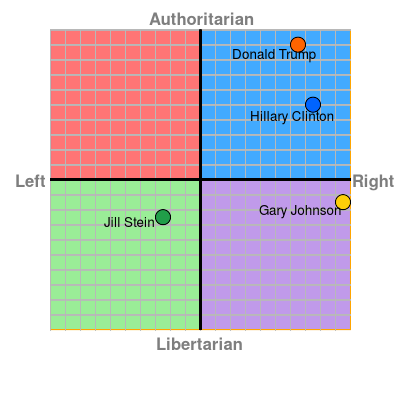
Just so you can understand how skewed American politics is, here is Political Compass' take on the candidates this year:

The cluster up in the right corner is where the Republican candidates dwell. Deep to the right, High on the Authoritarian scale, there's really no distinguishing these positions between Trump, Bush,Cruz and Rubio. It's like fifty shades of the same old fascist dogshit, but there you have it. It's a wonder that Republican voters can tease apart nuanced differences on what amounts to a clusterfuck of fascist ideation. Interestingly, Hillary Clinton is about a third way up on the Authoritarian scale but also two thirds across on the way to the extreme Right. If the endorsement of the Democratic Party establishment is for Hillary Clinton, we can surmise that the Democratic Party establishment is a cloud of opinions and sentiment that centres around Hillary Clinton, and so we can also surmise that the realistic difference between Hillary Clinton and the GOP Clusterfuck Candidates is a degree of Authoritarianism and not policy Left-Right ideology.

Then there's Bernie Sanders, who is no only a little bit left of Centre, but dead bang on the line between Authoritarian and Libertarian impulses. Most importantly, he's the only candidate who is reasonably close to the middle of the board. Yes, by world standards, Bernie Sanders is a reasonable man who is at the middle of the discourse for both Left and Right as well as Authority of the State and Liberty of the Individual Citizen.

And this is why people outside of America pin so much hope on a Bernie Sanders Presidency. For once, just once in living memory, the President of the United States might be somebody who has a very balanced view of the world.
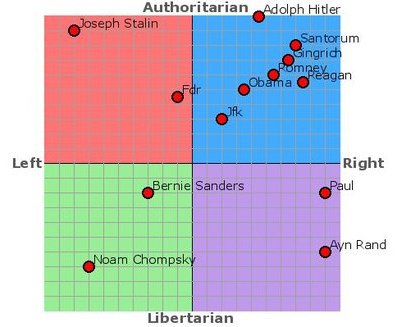
Just so you know, here's a quick comparison of where he might stand in relation to other famous politicians:


In that chart, Bernie has shifted somewhat to the south towards Libertarian-hood, but he's mostly close to the middle.The point remains, he maybe the closest to the middle, even in this historic context. Certainly, the world could do with an American President who better reflected the middle of the world's ideation on politics than the continued parade of rightwing authoritarians. It's worth bearing in mind that no matter how awful the mudslinging gets, politics is the battle for the middle ground. If the middle ground of the American electorate has shifted significantly towards the middle of the Political Compass board, then it is entirely possible Bernie Sanders is going to go all the way.

A Quick Note On The Clinton Candidacy

Back in 2008, Hillary Clinton was the candidate of destiny. Her problem was the she ran into a greater candidate of destiny. Since then Hillary Clinton has been preparing for this very run to win back the ground but there are mitigating factors against her candidacy.

One major problem for Hillary Clinton is that she carries with her the legacy of Bill Clinton's presidency. Now, Bill Clinton's presidency was marked by a huge transition to a Baby Boomer President in 1992. If there ever was a Presidency mired in the lost opportunity for the Baby Boomer
generation to deliver on its promise, then it was the Clinton Presidency. And there is no reason whatsoever to believe that a Hillary Clinton Presidency would in any way be less disappointing than the Bill Clinton presidency; and this picture has not changed since 2008.
And there are many people who resent the dynastic whiff of the Clinton run.

Then there are the demographics. Since Bill Clinton, through George W. Bush and now Barrack Obama, we've seen 24years of Baby Boomer leadership in US politics. Given the field of candidates this year, it is unlikely that there will be a generation change - that is to say, I don't see Marco Rubio or Ted Cruz getting up. If any one of Sanders, Clinton and Trump wins, it will be at least another 4 years of Baby Boomer leadership.

Yet, the problem with this demographic is that its retreat is already beginning to show. If you add Gen-X and Gen-Y voters, they outnumber the Baby Boomers and older set. If a majority of them are turning on to Bernie Sanders, it is going to be awfully difficult for Hillary Clinton to wrest the Democratic nomination from Sanders. In fact, it's going to beard for any of the Republicans to beat a candidate that appeals so strongly to both Gen-X and Gen-Y. If anything, the results in Iowa and New Hampshire signals a major shifting the American electorate itself, and there is a good chance that even more so than with the 2008 election, the 2016 Presidential election is going to smash the old demographic models.

The worst problem of all might be that she doesn't really stand for anything other than a dynastic run at the Presidency, and it's not exactly something she has addressed or can address. Bill Clinton keeps telling us she's a great candidate. She may well be if she had a framework or ideological context to her candidacy that was as vibrantly memorable as Sanders' position. If there is a unique selling proposition to Hillary Clinton, it might be that she's a woman. But I doubt the electorate is going to buy that.


Blog Archive