2006/06/13

How Much Fun Can One Boy Have?

That Used To Be MY Credo In The 90s
Alas the 90s are long gone and while nobody seems to look back with fondness the way babyboomers go on and on and on about the 1960s, truth is, I really miss the 1990s. The Naughties have been a bit of a drag. Still there's no reason to let up with the fun, so here's my sketchy account of a weekend mired in sports.


Working For A Quid
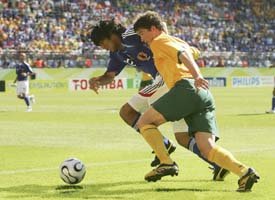

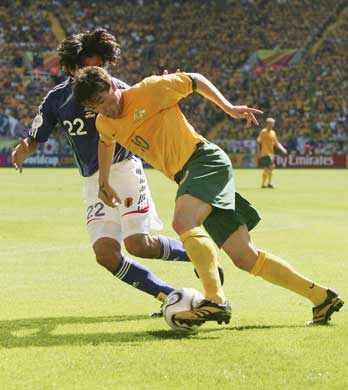
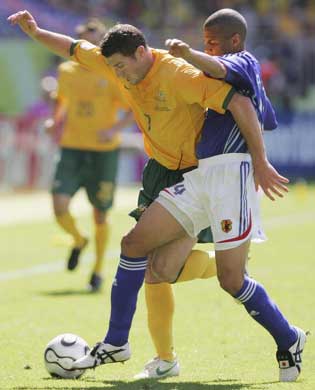
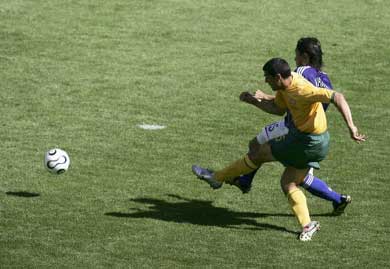
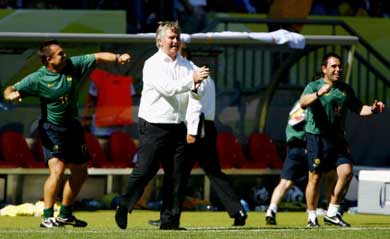
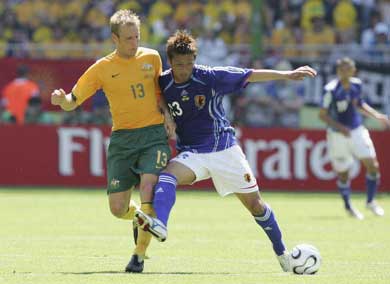
TV Tokyo wanted to a do a story in Sydney about the Japan Australia match; and I was the intrepretter-coordinator guy. It was hilarious. We staked out positions for the match down in Ciruclar Quay and Shelbourne's pub where soccer fans haad reserved a place to go whacko as the game unfolded. Then, we went and covered 'stories' ; one of the stories was how un-energised Sydney was about the match. The other story was the TAB betting chart. All very tongue in cheek takes on Sydney-side attitudes to the impending match.
The guys were such good sports they placed $50 bets or Japan to win, at the TAB as part of the story.

Now, I dunno about you, but I'd rather barrack for a team because I have an emotional investment without the gambling angle. I swear, if I had $50 riding on the Yankees in the World Series, frankly it would diminish my enjoyment as well as put a jinks on *my* team.

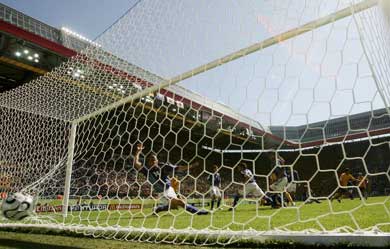
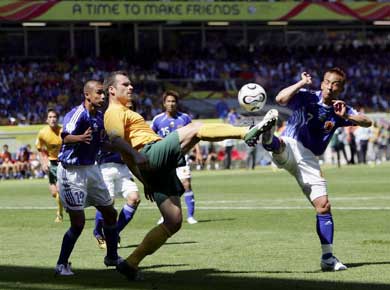
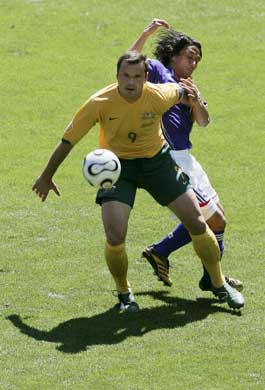
Anyway, eventually we were down in Circular Quay to see the action start in the first half. Then of course Japan went up 1-0 in the 23rd minute and the Japanese half of the crowd went bananas. They held onto that lead right up to half-time which was when we changed locations to Shelbournes.The game continued and Australia really didn't look too good as the score stayed 1-0, up to the 75th minute.

Just about then, the Japanese reporter asks me, "When this game is finished, can you ask these questions for me?: How do you feel about the loss?; how do you feel about the chances of Australia now? & How will Australia respond to this grave loss?"
I said "sure," thinking, "dude, how much can you jinx your own team like that? Firts you place bets, now you're talking about it like they've won it?"
Seriously, that is exactly what I thought.

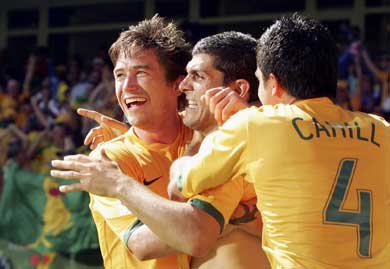
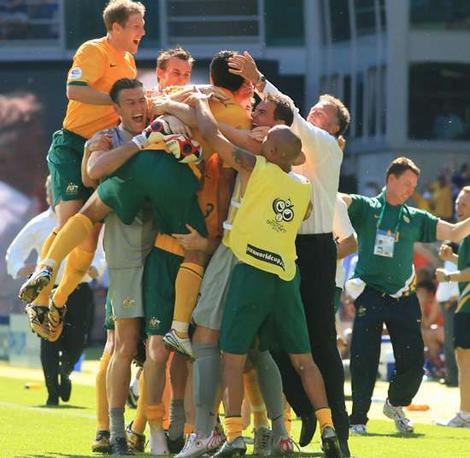
Sure enough, the rest is history: 3 goals in the final 9minutes to Australia. Talk about Shock-And-Awe as Celebrations broke out everywhere. In the car later on, the postmortem on the Japanese side sounded really sad as I sat in the same car with a smirk in the dark.

Some Thoughts On The Socceroos
It's been a bloody long time coming that the powers that be in the Australian Soccer Federation finally:

1) Got their best payers from around the world together in one team.
2) Got a World Class Coach who knows how to conduct aa World Cup Campaign
3) Got a little lucky with the PR.

Truth be known, I can't think of any Socceroo team that met these pre-conditions. it's been a long time coming. During that time, Australia did dominate the Oceania block; it just wasn't good enough to be rated highly so they always came in with a rank of 42 or there abouts or worse.

I don't think anybody in the Australian soccer admin have ever seen a Socceroo team function properly as a proper Test Side should until this incarnation of the Socceroos. In other words, not even Australia knows how good it really is or can be until this World Cup is all said and done. We've simply never witnessed a proper Australian 'Test' team for soccer with the best bits in place and play until this year. Are they good enough to knock over Brazil? Our humility and common sense tells us no, and yet if ever there was an under-rated team in this World Cup, it's the 42nd ranked Socceroos.

BTW...
Even the NYT took notice of the Socceroos.
KAISERSLAUTERN, Germany Australia waited 32 long years and 84 agonizing minutes for its first goal ever in the World Cup finals. Once it started Monday against Japan it could not stop.

Tim Cahill scored twice and John Aloisi added a third as Australia, which had trailed for almost the entire game, scored three times in the last eight minutes to win, 3-1.

Cahill's opening goal after 84 minutes was the first ever for Australia in the finals. It had failed to score in its three games in its only previous appearance in 1974. His second, in the 89th minute, gave Australia its first victory. Cahill, a second-half substitute who received a yellow card for a typically wild tackle, won the man of the match award for only 38 minutes of action. He also drew attention from his goalie, Mark Schwarzer, who had presented the Japanese with their goal after 26 minutes. The Australian players, and their coach, Guus Hiddink, who tussled with officials on the sideline as the replay was being shown, thought Schwarzer was fouled.

The noisy Australian fans made clear what they thought, although perhaps the referee, Abd El Fatah of Egypt, was unfamiliar with English sexual insults.
Well, the last bit's not too edifying.

A Quick Word About South Korea Supporters
After the celebrations broke out in Sydney Streets, we came across a group of Koreans rejoicing at the top of their lungs, chanting for South Korea. Excuse me if this sounds judgemental but that just is the very definition of having no class at all.

A Fantasy Life Is Better Than None
On top of all the above, there's this part of my life exploding this weekend:

Part 1. The AFL Fantasy League
This thing is really a bitch with conical metal tits. Once you have made your 20 alotted 'trades' which are essentially swaps with the free agency pool, you are screwed! Just screwed! Marooned without any real option to change or reshape your roster, and this is simply no fun. Plus getting beat by some guy I never even heard of until I signed on to this league just plain sucks; but there it is, that's a 4-4 record for my AFL Combat Wombats.

Part 2. The Fast Rise And Fall Of The Combat Wombats
For a brief moment, my fantasy baseball team did but linger in first place for 3 days. Then of course the wheels fell off and now they're back to 4th. I still can't tell if they're contending or fluking it from week to week.

Part 3. More World Cup Madness
Through some weird mishaps the likes of which are regular occurence on the net I've signed up for a Yahoo team for the World Cup as well as one for Sportal; and somehow ended up with essentially the same team. they're chugging along okay so far. My Sportal team is actually coming second as of this writing, but that will change again in a day.
2006/06/09

From The Mail Box

China And Banking
This came In From Mr db:
I'm quoting this wholus bolus because this doesn't have a URL. They come and complain, I'll take it down.
By George Friedman

The month of May witnessed an interesting phenomenon: a spate of reports on China's nonperforming-loan problem. What is most intriguing is that these reports did not come from organizations like Stratfor -- minor outfits that have been talking about this for a couple of years. It came from real, solid, serious mainstream organizations that were, and continue to be in some cases, quite positive about China on the whole. What is important here is not that China has a serious problem with bad loans in its banking system. That's old news. What is important is that mainstream analysts in the West now are taking official notice of it. The wide divergence between the Western perception of Chinese economic health and the realities of China's economy is beginning to close. There will be consequences to that.

The first report came from Ernst & Young, which released a study saying that China had a substantial problem with nonperforming loans (NPLs). We have to confess to not having seen that report, because the accounting firm withdrew it a few days later. The Chinese government blasted the report, using words like "ridiculous" and "distorted." Ernst & Young, which has a substantial practice in China, denied having retracted the report because of pressure from the government. Whatever their reasons for doing so, we wish we had been faster in asking for a copy.

No matter, because May also brought studies on the same subject from PricewaterhouseCoopers (PWC), McKinsey Global Institute, and Fitch. Each said the same basic thing: that Chinese banks have enormous NPL numbers on their books. The PWC report was issued by a group within the company that specializes in making markets in NPLs. Their news was that the water in China was fine and everyone should come in. McKinsey focused on inefficiencies in the Chinese banking system that should be cleared up, so that NPLs could decline and the Chinese gross domestic product could surge. Fitch was the harshest of the three, but that firm also argued that the Chinese had the tools in place to handle the problem. The bottom line was that all three acknowledged that NPLs were a big issue for China, but they took different approaches in trying to put the problem in perspective. In other words, they gave a warning without yelling "Fire!" Some of the reports were criticized by the Chinese, but none were blasted. Meanwhile, Moody's Investors Service has told us that they will be releasing a report in a couple of weeks. It will be interesting to see what their take is.

Let's begin this analysis by looking at a couple of quotes from these reports. McKinsey, for example, writes:

"Underlying these reforms, however, is capital misallocation by the system. Nonperforming loans are the most conspicuous outcome of this misallocation, but our research shows that the much larger volume of loans to underperforming ventures that don't go bad but yield only negligible returns are potentially more costly to China's economy."

Fitch's report states:

"Summing all of these figures, we come up with total official nonperforming loans of US$206 bn and other estimated problem loans of over US$270 bn in the banking system. We would reiterate, however, that a large portion of this latter figure is comprised of estimated Special Mention loans or loans that currently are not classified as nonperforming [emphasis Fitch's]. At the same time, there is an additional US$197 bn in NPL carveouts still remaining on the balance sheets of China's asset management companies, which no longer represent direct losses for banks but are a future liability for the government."

Fitch also states:

"Beyond this, estimating a rate of flow of new nonperforming loans is not an easy exercise given Chinese banks' extremely weak historical data and ongoing deficiencies in accounting and disclosure. Few banks report data on NPL flows, and those that do show recent flow rates in the extremely low single digits. We believe these numbers understate the likely level of ultimate credit losses, given what we know to be the slow evolution of a strong credit culture and risk management practices and our suspicion that China's over-reliance on investment-led growth comes at a cost to bank credit quality."

Fitch is estimating China's bad-loan situation (our term, lumping all these categories together) at $673 billion, but it warns that -- given Chinese accounting and reporting, and the fact that what reporting exists is not credible -- $673 billion is a low number. That's important. If $673 billion was the final number, then measures that are put in place could limit the ultimate losses to a level below that figure. If, however, the total number of bad loans is substantially higher than $673 billion -- which is our view of the situation -- then the system would be lucky to have to write off only this amount.

There are numerous ways to measure the magnitude of the problem, but one of the simplest is this. China is said to hold nearly $819 billion in foreign reserves. Fitch's conservative estimate of the bad loan situation comes close to matching that number, and a more liberal calculation would swallow those reserves up and then some. Put very simply, the Chinese banking system is in deep trouble -- and with it, so is the Chinese economy.

It has become an article of faith that China's economy is booming. The economy certainly is growing rapidly. But growth and size alone don't tell you how healthy an economic entity is. During the Great Depression, the U.S. economy was enormous, but it was crippled. Japan's economy was growing at a phenomenal rate in the 1980s, all the while heading for its disaster. Size and growth are but two measures of an economy -- or of a business. They do not tell you how well it is doing.

The basic problem of the Chinese economy, as in many Asian nations, is that the banks have not made loans with business considerations in mind. They made loans for political reasons and to maintain social stability. In many cases, loans were seen as being more like grants. As a result, they were invested in enterprises that did not make enough money to repay (or even attempt to repay) the loans. Frequently, rather than bankrupting the business or writing off the loan, the banks lent more money to the business -- so that it could repay old debts, and there was an appearance that the loans were viable. Loans went into land speculation or to investments in areas that were already overbuilt. (And this does not attempt to take into account ancillary problems, such as corruption and embezzlement, which also have been significant issues for the Chinese government.)

In the first part of 2006, there has been a huge surge in lending in China. With the economy already growing at rates of more than 9 percent, it would seem structurally impossible to grow it any faster. Shortages in skilled workers, management, buildings -- all these limit the rate of growth. The truth is that a substantial portion of the loans that went out were issued to keep bad loans floating, like using one credit card to pay the monthly payment on another. You can do that for a while, but you can't do it forever.

What keeps the Chinese system alive is not domestic consumption, which is not rising in tandem with overall growth. What keeps China afloat is exports -- exports in ever greater numbers, and with ever-smaller profit margins. Surging exports are critical to China, as they were to Japan before it. They generate the cash that allows the financial system to continue operating.

This is also the Achilles' heel of the Chinese economy, as Fitch points out:

"Given the weaknesses already discussed, we believe Chinese banks remain acutely vulnerable to an economic slowdown, although the analysis above recognizes that much work has been done to tackle these weaknesses and at a minimum suggests that Chinese banks and the government are more equipped today than in the past to deal with problems that may arise."

Here is the problem. The official policy of the Chinese government is to cool off the economy. In fact, the Chinese are attempting to cool growth only in certain sectors, where they perceive particularly dangerous bubbles starting to form. For the most part, however, they are doing everything they can to keep the economy hot, in order to try to manage the financial problem. Now, Fitch argues in its report that the Chinese banks are better equipped than in the past to deal with their problems. We agree with that assessment; they were completely unprepared in the past and now are abysmally prepared. You cannot prepare to deal with a loan situation as bad as that in China. You simply keep cycling as fast as possible and hope that something turns up.

In our view, this spate of reports on China's financial situation marks a turning point.

One of the things that has kept the Chinese economy booming was cheap exports. But another was the perception in the West that, underneath it all, China was sound. This perception induced foreign banks to invest in Chinese banks. There have, of course, been studies detailing the Chinese debt problem for some time: Standard & Poor's, for example, estimated the bad debt in 2002 at $600 million. That part isn't new.

However, when "irrational exuberance" (to quote Alan Greenspan) is at its peak, it is hard to break through the noise. Markets continue to rise, even as bad news comes out. Last week, for example, we saw the Bank of China make its initial public offering and shares soar, just as these financial reports were emerging. That doesn't mean these reports are wrong or that the Chinese have things under control. It simply means the market is ignoring news and rising on its own giddiness.

Nevertheless, a turning point has been reached that will be difficult to ignore. Reports from Stratfor are, of course, one thing. Reports from a single credit agency are another. But when a series of reports from highly respected, mainstream analysts all come out within a few days of each other -- with each, in their own way, telling the same basic story, it becomes hard for the system to dismiss that. Western companies moving into China have CEOs and CFOs who must exercise due diligence. There are now too many reports out there to be simply ignored. All of them are caveated. None of them write China off. But a critical mass is forming that will cut through the froth in due course.

Obviously, this does not mean that China will implode, disappear or anything like that. It will remain an enormous economy and an important one. But this does mean that the dynamics of the Chinese economy are shifting. The debt issue represents a deep structural problem that China will either deal with -- as South Korea did -- or not, as Japan did not. (Japan reaped more than a decade of economic stagnation as a consequence. It is significant that China lacks the degree of insulation that Japan built up; the economy has more external exposures and would not weather a similar crisis as well.) The point is that, ultimately, the books have to balance everywhere. That means that the huge structural imbalance of China, which these debts represent, must be rectified. And that process, as in all such matters, will be painful.

It is not clear how much pain Chinese society can withstand before it fractures. This is clearly a concern for Beijing as it tries, simultaneously, to reform the economy and to crack down on dissent. The Chinese, like anyone in this fix, try to put the best possible face on the situation. Which is why they exploded at Ernst & Young. But even the government in Beijing couldn't shout down the ensuing tidal wave of financial reports; instead, they grumbled and pointed to the passages that said it could all be managed.

Perhaps it can. But if it can, it won't be easy -- and we doubt that it is possible. We have been writing about this problem for several years now, and people keep asking when the crisis will come. Our answer is simple: If this isn't a crisis, what would a crisis look like? The Chinese financial system is sinking under nonperforming and underperforming loans. Mainstream Western analysts are all writing about the problem and calling for reforms that the Chinese cannot possibly implement in time to make a difference. At some point, the weight of evidence will shift the behavior of the Western financial community, and that will be that.

In the meantime, let the exports flow -- for they surely will, and in breathtaking quantities.
There's also this thing that got sent in:
By George Friedman

The U.S. Department of Defense released its annual report on China's military last week. The Pentagon reported that China is moving forward rapidly with an offensive capability in the Pacific. The capability would not, according to the report, rely on the construction of a massive fleet to counter U.S. naval power, but rather on development and deployment of anti-ship missiles and maritime strike aircraft, some obtained from Russia. According to the Pentagon report, the Chinese are rapidly developing the ability to strike far into the Pacific -- as far as the Marianas and Guam, which houses a major U.S. naval base.

Whether the Chinese actually are constructing this force is less important than that the United States believes the Chinese are doing this. This analysis is not confined to the Defense Department but has been the view of much of the U.S. intelligence community. There is, therefore, a consensus in Washington that the Chinese are moving far beyond defensive capabilities or deterrence: They are moving toward a strike capability against the U.S. Seventh Fleet.

If this analysis is correct, then the reason for U.S. concern is obvious. Ever since World War II, the United States has dominated all of the world's oceans. Following that war, the Japanese and German navies were gone. The British and French did not have the economic ability or political will to maintain a global naval force. The Soviets had a relatively small navy, concerned primarily with coastal defense. The only power with a global navy was the United States -- and the U.S. Navy's power was so overwhelming that no combination of navies could challenge its maritime hegemony.

In an odd way, this extraordinary geopolitical reality has been taken for granted by many. No naval force in history has been as powerful as the U.S. Navy. The U.S. Navy does not have the ability to be everywhere at all times -- but it does have the ability to be in multiple places at the same time, and to move about without concerns of being challenged. This means, quite simply, that the United States can invade other countries, anywhere in the world, but other countries cannot invade the United States. Whatever the outcome of the invasion once ashore, the United States has conducted the Iraq, Kosovo, Somali, Gulf and Vietnamese wars without ever having to fight to protect lines of supply and communications. It has been able to impose naval blockades at will, without having to fight sea battles to achieve them. It is this single fact that, more than any other, has shaped global history since 1945.

Following the Soviet Strategy?

The Soviets fully understood the implications of U.S. naval power. They recognized that, in the event of a war in Europe, the United States would have to convoy massive reinforcements across the Atlantic. If the Soviets could cut that line of supply, Europe would be isolated. The Soviets had ambitious goals for naval construction, designed to challenge the United States in the Atlantic. But naval construction is fiendishly expensive. The Soviets simply couldn't afford the cost of building a fleet to challenge the U.S. Navy, while also building a ground force to protect their vast periphery from NATO and China.

Instead of trying to challenge the United States in surface warfare, using aircraft carriers, the Soviets settled for a strategy that relied on attack submarines and maritime bombers, like the Backfire. The Soviet view was that they did not have to take control of the Atlantic themselves; rather, if they could deny the United States access to the Atlantic, they would have achieved their goal. The plan was to attack the convoys and their escorts, using attack submarines and missiles launched from Backfire bombers that would come down into the Atlantic through the Greenland-Iceland-United Kingdom (GIUK) gap. The American counter was a strong anti-submarine warfare capability, coupled with the Aegis anti-missile system. Who would have won the confrontation is an interesting question to argue. The war everyone planned for never happened.

Today, it appears to be the Pentagon's view that China is following the Soviet model. The Chinese will not be able to float a significant surface challenge to the U.S. Seventh Fleet for at least a generation -- if then. It is not just a question of money or even technology; it also is a question of training an entirely new navy in extraordinarily complex doctrines. The United States has been operating carrier battle groups since before World War II. The Chinese have never waged carrier warfare or even had a significant surface navy, for that matter -- certainly not since being defeated by Japan in 1895.

The Americans think that the Chinese counter to U.S. capabilities, like the Soviet counter, will not be to force a naval battle. Rather, China would use submarines and, particularly, anti-ship missiles to engage the U.S. Navy. In other words, the Chinese are not interested in seizing control of the Pacific from the Americans. What they want to do is force the U.S. fleet out of the Western Pacific by threatening it with ground- and air-launched missiles that are sufficiently fast and agile to defeat U.S. fleet defenses.

Such a strategy presents a huge problem for the United States. The cost of threatening a fleet is lower than the cost of protecting one. The acquisition of high-speed, maneuverable missiles would cost less than purchasing defense systems. The cost of a carrier battle group makes its loss devastating. Therefore, the United States cannot afford to readily expose the fleet to danger. Thus, given the central role that control of the seas plays in U.S. grand strategy, the United States inevitably must interpret the rapid acquisition of anti-ship technologies as a serious threat to American geopolitical interests.

Planning for the Worst

The question to begin with, then, is why China is pursuing this strategy. The usual answer has to do with Taiwan, but China has far more important issues to deal with than Taiwan. Since 1975, China has become a major trading country. It imports massive amounts of raw materials and exports huge amounts of manufactured goods, particularly to the United States. China certainly wants to continue this trade; in fact, it urgently needs to. At the same time, China is acutely aware that its economy depends on maritime trade -- and that its maritime trade must pass through waters controlled entirely by the U.S. Navy.

China, like all countries, has a nightmare scenario that it guards against. If the United States' dread is being denied access to the Western Pacific and all that implies, the Chinese nightmare is an American blockade. The bulk of China's exports go out through major ports like Hong Kong and Shanghai. From the Chinese point of view, the Americans are nothing if not predictable. The first American response to a serious political problem is usually economic sanctions, and these frequently are enforced by naval interdiction. Given the imbalance of naval power in the South China Sea (and the East China Sea as well), the United States could impose a blockade on China at will.

Now, the Chinese cannot believe that the United States currently is planning such a blockade. At the same time, the consequences of such a blockade would be so devastating that China must plan out the counter to it, under the doctrine of hoping for the best and planning for the worst. Chinese military planners cannot assume that the United States will always pursue accommodating policies toward Beijing. Therefore, China must have some means of deterring an American move in this direction. The U.S. Navy must not be allowed to approach China's shores. Therefore, Chinese war gamers obviously have decided that engagement at great distance will provide forces with sufficient space and time to engage an approaching American fleet.

Simply building this capability does not mean that Taiwan is threatened with invasion. For an invasion to take place, the Chinese would need more than a sea-lane denial strategy. They would need an amphibious capability that could itself cross the Taiwan Strait, withstanding Taiwanese anti-ship systems. The Chinese are far from having that system. They could bombard Taiwan with missiles, nuclear and otherwise. They could attack shipping to and from Taiwan, thereby isolating her. But China does not appear to be building an amphibious force capable of landing and supporting the multiple divisions that would be needed to deal with Taiwan.

In our view, the Chinese are constructing the force that the Pentagon report describes. But we are in a classic situation: The steps that China is taking for what it sees as a defensive contingency must -- again, under the worst-case doctrine -- be seen by the United States as a threat to a fundamental national interest, control of the sea. The steps the United States already has taken in maintaining its control must, under the same doctrine, be viewed by China as holding Chinese maritime movements hostage. This is not a matter of the need for closer understanding. Both sides understand the situation perfectly: Regardless of current intent, intentions change. It is the capability, not the intention, that must be focused on in the long run.

Therefore, China's actions and America's interpretation of those actions must be taken extremely seriously over the long run. The United States is capable of threatening fundamental Chinese interests, and China is developing the capability to threaten fundamental American interests. Whatever the subjective intention of either side at this moment is immaterial. The intentions ten years from now are unpredictable.

As the Pentagon report also notes, China is turning to the Russians for technology. The Russian military might have decayed, but its weapons systems remain top-notch. The Chinese are acquiring Russian missile and aircraft technology, and they want more. The Russians, looking for every opportunity to challenge the United States, are supplying it. Now, the Chinese do not want to take this arrangement to the point that China's trade relations with the United States would be threatened, but at the same time, trade is trade and national security is national security. China is walking a fine line in challenging the United States, but it feels it will be able to pull it off -- and so far it has been right.

U.S. Defense Policy: Full Circle

The United States is now back to where it was before the 9/11 attacks. Defense Secretary Donald Rumsfeld came into office with two views. The first was that China was the major challenge to the United States. The second was that the development of high-tech weaponry was essential to the United States. With this report, the opening views of the administration are turning into the closing views. China is again emerging as the primary challenge; the only solution to the Chinese challenge is in technology.

It should be added that the key to this competition will be space. For the Chinese, the challenge will not be solely in hitting targets at long range, but in seeing them. For that, space-based systems are essential. For the United States, the ability to see Chinese launch facilities is essential to suppressing fire, and space-based systems provide that ability. The control of the sea will involve agile missiles and space-based systems. China's moves into space follow logically from their strategic position. The protection of space-based systems from attack will be essential to both sides.

It is interesting to note that all of this renders the U.S.-jihadist dynamic moot. If the Pentagon believes what it has written, then the question of Afghanistan, Iraq and the rest is now passé. Al Qaeda has failed to topple any Muslim regimes, and there is no threat of the caliphate being reborn. The only interesting question in the region is whether Iran will move into an alignment with Russia, China or both.

There is an old saw that generals prepare for the last war. The old saw is frequently true. There is a belief that the future of war is asymmetric warfare, terrorism and counterinsurgency. These will always be there, but it is hard to see, from its report on China, that the Pentagon believes this is the future of war. The Chinese challenge in the Pacific dwarfs the remote odds that an Islamic, land-based empire could pose a threat to U.S. interests. China cannot be dealt with through asymmetric warfare. The Pentagon is saying that the emerging threat is from a peer -- a nuclear power challenging U.S. command of the sea.

Each side is defensive at the moment. Each side sees a long-term possibility of a threat. Each side is moving to deflect that threat. This is the moment at which conflicts are incubated.
All very interesting stuff.

2006/06/08

Is He Dead?

So Much For The Terror Boss In Iraq


The Iraqi Prime Minister is claiming the al Qaeda leader in Iraq abu Mussab al-Zarqawi is dead. Even the NYT is running with it, so it must be fact.
At a joint news conference with Iraq's prime minister, Nuri Kamal al-Maliki, the top American military commander in Iraq, Gen. George W. Casey Jr., said Zarqawi's body had been positively identified by fingerprints, "facial recognition" and known scars. He said seven of Zarqawi's associates had also been killed in the strike.

The announcement of Zarqawi's death, shortly before noon today in Baghdad, appeared to mark a major watershed in the war. With a $25 million U.S. bounty on his head, the Jordan-born Zarqawi has been the most wanted man in Iraq for his leadership of Islamic terrorist groups that have carried out many of the most brutal attacks of the war, including scores of suicide bombings, kidnappings and beheadings.

"Today, we have managed to put an end to Zarqawi," said a beaming Mr. Maliki, who took office three weeks ago at the head of Iraq's first full-term government since the overthrow of Saddam Hussein. He said the death should be a warning to other insurgent leaders. "They should stop now," he said. "They should review their situation and resort to logic while there is still time."

The announcement came on the same day that Mr. Maliki's new government took a crucial step forwarde by winning Parliamentary approval of nominees for interior and defense minister, which had been blocked by disagreements between political parties.

American and Iraqi officials all muted their high spirits today with a recognition that violence is bound to continue, a point underscored by a midday blast in eastern Baghdad that killed at least a dozen people, news services reported.

"Unfortunately, this kind of violence has become routine," Foreign Minister Hoshyar Zebari said in a televised interview.
I guess if they're wrong the onus is now back on al-Zarqawi to claim otherwise; he can always pop up and claim "I'm not dead yet!"

Asking For It, And More Of It
Iran, meanwhile keeps sedning mixed signals to the world. Here's an article saying they're ready for nuclear talks.
Iran's President Mahmoud Ahmadinejad said Thursday Iran is ready to discuss “mutual concerns” over its nuclear program and claimed the West had given in to the will of the Iranian nation.

Mr. Ahmadinejad did not say whether Iran accepted a Western proposal for resuming negotiations that demands Tehran suspend uranium enrichment in return for a package of incentives .

“On behalf of the Iranian nation, I'm announcing that the Iranian nation will never hold negotiations about its definite rights with anybody, but we are for talks about mutual concerns to resolve misunderstandings in the international arena,” Mr. Ahmadinejad told thousands of people in Qazvin, west of the capital Tehran.
Here's one saying they're not going to negotiate on iota.
“We will never ever make any concessions or negotiations on our legitimate right and will not allow the West to tell us what to do and what to decide,” the president said in a speech in Qazvin, central Iran, which was broadcast live on the news network Khabar.

“The West would make a grave mistake in believing that the Iranian nation would negotiate about its destiny because Iran would not retreat one iota from its undeniable rights to pursue peaceful nuclear technology,” Ahmadinejad added.
Now, go figure whether they sound like they want to talk or not on the basis of that noise. The funny thing is, Washington's willing to talk. It's a great time to come in from the cold. Muamar Gaddaffi did it; it's not inconceivable for Iran.

Meanwhile there's this gem.
Everyone knows where Iran’s nuclear weapons will be aimed. Everyone knows they will be put on Shahab rockets, which have been modified so that they can reach Israel. And everyone knows that if the button is ever pushed, it will be the end of Israel.

But it gets worse. The president of a country about to go nuclear is a confirmed believer in the coming apocalypse. Like Judaism and Christianity, Shiite Islam has its own version of the messianic return—the reappearance of the Twelfth Imam. The more devout believers in Iran pray at the Jamkaran mosque, which houses a well from which, some believe, he will emerge.

When Ahmadinejad unexpectedly won the presidential elections, he immediately gave $17 million of government funds to the shrine. Last month Ahmadinejad said publicly that the main mission of the Islamic Revolution is to pave the way for the reappearance of the Twelfth Imam.

And as in some versions of fundamentalist Christianity, the second coming will be accompanied by the usual trials and tribulations, death and destruction. Iranian journalist Hossein Bastani reported Ahmadinejad saying in official meetings that the hidden imam will reappear in two years.

So a Holocaust-denying, virulently anti-Semitic, aspiring genocidist, on the verge of acquiring weapons of the apocalypse, believes that the end is not only near but nearer than the next American presidential election. ... This kind of man would have, to put it gently, less inhibition about starting Armageddon than a normal person. Indeed, with millennial bliss pending, he would have positive incentive to, as they say in Jewish eschatology, hasten the end.
That would be our friend in Tehran, Ahmadinejad, would it not?

Dachshund of Victory
That's right. The Japanese soccer team have brought in the big guns; they have brought to Germany a mascot dachshund 'Rommel' (hah!) that has never seen the Japanese team defetaed.
【ボン8日共同】ジーコジャパンに強力な援軍が登場—。日本チームに同行すると負け知らずという“不敗神話”を持つ雄のダックスフント、ロンメル君(10歳)が8日、ワールドカップ(W杯)日本代表のキャンプ地ボンに到着した。

 日本サッカー協会の手嶋秀人広報部長の愛犬。2002年日韓大会の際、日本代表が合宿していた静岡県の取材拠点に「癒やしになれば」と連れて来ると、日本は1次リーグを突破するなど、試合会場や記者会見場に姿を見せた18試合は軒並み無敗。ドイツ大会のアジア最終予選バーレーン戦にも、ジーコ監督が写真を持って行ったほどだ。

 高齢のため“海外遠征”は最初で最後になるが、手嶋部長は「ロンメルの力も借り、まずは1次リーグを確実に突破したい」と話している。 (19:57)
If they're doing this, they must be either clutching at straws or they are unbelievably superstitious. It's a dog. With short legs. Called 'Rommel'. I guess the World Cup is in Germany.

Wallabies Pick Four Rookies
Just as a side note, I noticed this article.
Four players will make their debut for the Wallabies against England on Sunday, with prop Rodney Blake, hooker Tai McIsaac, and reserve backs Cameron Shepherd and Josh Valentine all named in a 22-man squad on Thursday.

Wallabies coach John Connolly has opted for a totally new front row to the one that was demoralised by the European teams during Australia's northern hemisphere tour last year.

Greg Holmes, McIsaac and Blake will start up front with veteran hooker Jeremy Paul and 31-Test prop Al Baxter on the reserves bench.

For McIsaac, who started the year as the reserve hooker at the Western Force behind Wallabies stalwart Brendan Cannon, making his debut in the national team was a big surprise.

"My main goal at the start of the year was to just play some games for the Western Force and the try to cement a place in the starting team," McIsaac said.

"You always think about the Wallabies team, but it was not something I thought would happen. But the way things have gone, with the injury to 'Canns' (Brendan Cannon) I took my opportunity and here I am."

The ex-Australian representative water-polo player didn't take up the sport of rugby until he was 24-years-old and then quickly progressed through the ranks, playing Super 12 rugby with the Queensland Reds before accepting an offer with the Western Force.

During his time with the Queensland As, McIsaac packed down in many scrums with prop Blake, so lining up alongside his old teammate will be a kind of homecoming for the wily rake.

"Yeah we played a few games together in Queenslands A, and I am not sure but we might have played at least one game with Holmesy as well."
Changing of the guard going on in th Wallabies too. It was about time.

2006/06/07

The 2006 Draft


Yankees Pick... Ian Kennedy?
Yes, it's that time of year again where hope springs eternal. Projections and wishcasting and all that take form in picking names one by one for the future.

This year, the Yanks picked at the 21 slot thanks to Tom Gordon going to the Phillies in the off-season. The yankees lost their No 28 pick to the Red Sox for signing Johnny Damon, but having a pick in the first round is quite okay if you spend it wisely. Last year it was C.J. Henry. this year it's Ian Kennedy.

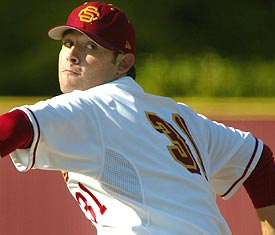
Who is Ian Kennedy? A RHP from South California. MLB.com's description has him at 6'-0" 195lbs. University of So Cal. Was drafted in 14th round in 2003. Lost some speed(!) "has an aggressive style and a hard curveball."
There's more here.
Kennedy was the Pac-10 Pitcher of the Year in 2005, though his numbers dipped a bit as a junior in 2006. He went 24-12 in three seasons with USC and also pitched for Team USA in 2004-05.

"He's a quality college pitcher, he's had a lot of success in college and for Team USA," Oppenheimer said. "We scouted every game this guy pitched this year. In terms of his stuff, we're very happy with it."
He wasn't even on the 30-man top draft picks from Baseball America so already I'm wondering "what's going on there?"
Round 1 Comp pick - Joba Chamberlain RHP 6'-2" 230lbs. University of Nebraska Lincoln. Fastball in low-90s; Changeup & slider.
Round 2- nil
Round 2 Comp Pick - nil
Round 3 - Zachary MacAllister. RHP 6'5" High School pitcher.
Round 4 - Colin Curtis L/L 6'-1" 200lbs. RF Arizona State University "Cancer survivor. Can hit for average, draw walks, steal some bases but not much power."
Round 5 - George Kontos 6'-3" 215lbs. RHP Northwestern University, no report.
Round 6 - Mitchell Hilligoss 6'-1" 200lbs SS Purdue University
Round 7 - Timothy Norton 6'-5" 230lbs RHP University of Connecticut. Fastball and splitter pitcher, with FB at low-90s.
Round 8 - Dellin Betances 6'-8" 215lbs. RHP High School pitcher. FB in the mid-90s.
Round 9 - Mark Melancon 6'-2" 215lbs RHP University of Arizona
Round 10 - Casey Erickson 6'-2" 200lbs. RHP Springfield college. No description.
Round 11 - Jeffrey Fortenberry 6'-2" L/L LF 175lbs Baylor University
Round 12 - Nicholas Patterson 6'-3" RHP 210lbs U Tampa.
Round 13 - Daniel McCutchen 6'-2" 195lbs RHP U Oklahoma
Round 14 - Donald Hollingsworth 5'-7" 170lbs L/L LF U Riverside
Round 15 - Gabriel Medina 6'-5" 235lbs RHP Emporia State University
Round 16 - Paul Patterson 6'-8" 215lbs RHP Northern Kentucky University
Round 17 - David Robertson RHP 5'-11" 180lbs RHP University of Alabama Tuscalona
Round 18 - Paul Howell 6'-3" 185lbs LHP High School pitcher.

So after 18 rounds, 4 position players, 1 LHP and a platoon of assorted RHPs. None of the position players inspire much confidence. It seems the Yankees are hell-bent on stocking up on Pitchers. Amongst this crowd, the really intersting one is Dellin Betances, who is this years' Anthony-Jackson-Pick: the high-risk-high-reward player who falls through the rounds for whatever reason.
Betances is a rare specimen: He is an 18-year-old right-handed pitching prospect with a fastball in the mid-90's, a well-developed breaking ball and the intimidating stature of a basketball power forward.

That explains the steady parade of scouts who have made their way to Brooklyn this spring, including the dozen or so who stood behind the backstop and watched him pitch a one-hitter, striking out 16 bewildered New Utrecht hitters over seven innings in a first-round Public Schools Athletic League playoff victory in late May.

It also explains why, a few months ago, Betances seemed destined to become the first high school player from New York City to be chosen in the first round of baseball's amateur draft since Manny Ramírez in 1991.

"Down the road, this kid's going to be throwing 100 miles per hour," said Mel Zitter, who coached Betances and Ramírez in his Youth Service League Inc. baseball program. "People understand with Dellin, that down the road, he's going to be a No. 1 or No. 2 major league starter."

But scouting is a fickle science, and in an era in which seasoned college talent tends to trump pure speculative possibility, scouts are reluctant to overvalue a gangly teenager in the days before the draft. Betances could go anywhere from the first to the fifth round, according to several experts.
Betances is exactly the kind of player they should be looking for.
Here is a piece on Hilligoss:
Hilligoss played youth league ball in Mattoon all the way through American Legion when he was a three-time Most Valuable Player for Post 88, which won the 2003 state championship and was runner-up in 2002.

Now he is waiting to hear where his first professional summer season is to be played.

“There were no contract talks,” Hilligoss said. “They said they would be in touch later. That all will start a day or so later. They said ‘congratulations on being a Yankee and we’ll talk to you soon.’ ”

Hilligoss still has the option of playing in the Cape Cod summer collegiate league this summer and returning to Purdue for his senior season.

But Purdue assistant coach Todd Murphy is not counting on having back the shortstop who led the Boilermakers with a .386 batting average, .576 slugging percentage and .453 on-base percentage after winning the Big Ten Conference batting title as a sophomore at .403.
He's certainly interesting.
Here's a piece on Mark Melancon:
Arizona relief pitcher Mark Melancon became a draft-day risk because he missed the last seven weeks of the season with an elbow injury.

The closer who at one time was regarded as a potential first-rounder slipped to the ninth round on Tuesday before the New York Yankees took him with the 284th pick. Melancon said he'll use the slight as motivation.

Melancon was one of three Arizona players drafted, along with junior shortstop Jason Donald, who went to the Phillies in the third round (97th overall), and senior second baseman Brad Boyer, picked in the 13th round (386th overall) by San Francisco.

Donald said the Yankees got a steal, if they can sign Melancon. "Once he gets healthy, he's going to prove he should have been taken earlier," Donald said.

Melancon said he will sign with the Yankees if they offer appropriate compensation, but otherwise will consider returning for his senior season.
So yet another interesting high-risk-high-reward player.

UPDATE:
Here's the list of the rest of the names. Right now, that'ss all they are:

Round 19 - Christopher Kunda R/R 2B 6'-0" 175lbs Oregon State U
Round 20 - Kevin Russo 5'-11" 190 lbs R/R 2B Baylor U
Round 21 - Russell Raley R/R 2B 5'-10" 185 lbs U Oklahoma
Round 22 - Brian Aragon L/L LF 6'-1" 210lbs North Carolina
Round 23 - Brandon Thompson L/L LHP 5'-11" 175lbs Chandler Gilbert CC
Round 24 - Brian Baistey R/R C 6'-3" 215lbs U South Florida
Round 25 - Kevin Carby S/R SS 5'-11" Texarhana CC
Round 26 - Tomothy Dennehy L/L LHP 6'-1" 195lbs Lubbock Christian U
Round 27 - Michael Lee R/R RHP 6'-6" 190lbs Bellevue CC
Round 28 - Barrett Bruce R/R RHP 6'-3" 195 Highschool
Round 29 - Orlando Torres 6'-0" 184lbs High School
Round 30 - Brock Ungricht R/R C 5'-10" 190lbs San Diego State U
Round 31 - Zachary Prestly L/R CF 6'-1" 185 lbs High School
Round 32 - Thomas Palica L/L LHP 6'-3" 215lbs Golden West CC
Round 33 - Luke Trubee R/R RHP 6'-3" 210 lbs U Dayton
Round 34 - Tiger Ladendorf R/R SS 5'11" 185lbs High School
Round 35 - David Van Ostrand L/R 3B 6'-6" 215lbs Allan Hancock Col
Round 36 - Jared Rogers R/R RHP 6'-6" 170lbs High School
Round 37 - Timothy O'Brien R/R 3B 6'-1" 210lbs San Diego State U
Round 38 - Michael Diyorio L/L LF Florida Southern Col
Round 39 - Kevin Smith L/R 1B 6'-1" 210lbs U Oklahoma
Round 40 - Tanner Chitwood L/L LHP 6'-3" 230lbs High School
Round 41 - Ohmed Danesh L/L LF 6'-0" 185lbs High School
Round 42 - Dan Duffy R/R SS 5'-10" 175 lbs High School
Round 43 - Erick Erickson R/L LHP 5'-10" 174lbs High School
Round 44 - James Lasala R/R C 6'-1" 205lbs Iona Col
Round 45 - Nathan Albert R/R RHP 6'-3" 215lbs Bakersfield Col
Round 46 - Jeff Ludlow R/R RHP 6'-2" 190lbs High School
Round 47 - Charles Smith R/R C 5'-10" High School
Round 48 - Jeffrey Loveys R/R RHP 6'-8" 245lbs Ball State U
Round 49 - Chase Odenreider R/R RF 6'-0" 210lbs Creighton U
Round 50 - Sam Honeck L/L 1B 6'-2" 210lbs Grayson County Col

Notably, no Jeff Maier. :)
Lots of 6-foot-something tall, RHPs. It's like they're buying slabs of meat. Ian Kennedy's upside is sounding like a possible analogue of Moose. That'd be a nice pitcher to complement Phillip Hughes in the next dynasty.

2006/06/06

Investing In The Power Of Media

Iran Nuke Talks


They're talking to Iran about their nuclear programme. It's about productive as a meeting of smack addicts talking to a dealer who wants to try out coaine dealing, trying to tak him out of it.
Javier Solana, the European Union's most senior diplomat, has formally offered Iran a list of incentives that the major powers hope will be enough to persuade it to stop enriching uranium.

The deal was presented today in a two-hour meeting with Ali Larjani, Iran's chief nuclear negotiator, at the Supreme National Security Council headquarters in central Tehran. An official close to the talks said afterwards: "Larijani said Iran will study the package, clause by clause, and respond."

Mr Solana arrived in Tehran last night last night as the messenger to convey a deal agreed in talks among the five permanent members of the UN Security Council, plus Germany, in Vienna last Friday. The former Nato chief told reporters at Tehran airport that the West wanted "a new relationship" with Iran and that the package would "allow us to engage in negotiations based on trust, respect and confidence".

Details of the proposals, drawn up by Britain, France and Germany and backed by the United States, Russia and China, have been kept secret, but an early draft suggests that if Iran agrees to stop enriching uranium, the major powers would offer it help in building nuclear reactors and guarantee a supply of nuclear fuel.

The offer contains the implicit threat of UN Security Council sanctions if Iran continues to insist on enriching uranium - a process that can produce fuel for generating electricity or material for making nuclear bombs.

But with both China and Russia keen to avoid any more explicit threats against Tehran, the major powers have focused on incentives to draw Iran back into the fold. The package is thought to include the offer of European Airbus aircraft. The United States, which offered last week to enter direct talks with Iran for the first time since the Islamic revolution of 1979, has reportedly sweetened the offer by saying that it would lift some bilateral sanctions, including a ban on the sale of Boeing passenger aircraft and spare parts.

Iran has so far insisted that as a signatory to the Nuclear Non-Proliferation Treaty it is entitled to enrich uranium for peaceful purposes. But the world is suspicious of its nuclear plans because it concealed significant aspects of its programme for many years.
The Iranians of course had this to say:
"The proposals contain a number of positive aspects, but some issues need clarification," an Iranian television channel quoted Ali Larijani as saying.

The European Union's foreign policy chief, Javier Solana, Tuesday handed over to Iran a package of incentives drafted by the Iran-6 negotiators aimed at persuading the Islamic Republic to halt its controversial uranium-enrichment program.

Larijani said Iran would return to the negotiating table after studying the proposals.

"We need to study the propositions carefully, and after that we will resume negotiations to achieve a reasonable result," he said, adding that Tuesday's meeting with Solana had been positive.
This is going to drag on.

Hey, You're Still Arabs, Though...
Some folks who have had enough of stereotypes have decided to everse them in order to help self-esteem of their kids. It's as dicey an issue as they come.
Set to be released in September, "Al-Quraysh" is a strategy game that tells the story of the first 100 years of Islam's history from the viewpoint of four different nations - Bedouins, Arabs, Persians, and Romans.

One can choose to command any of the armies of the four nations or lead the army of the main character, Khaled Ibn Waleed, a Muslim warrior who defeated the Roman and Persian empires and never lost a battle. Or one can play the role of the Bedouin sheikh, who must earn the respect of his tribe. The player has the task of building and protecting trade routes and water sources, building armies, conducting battles, and freeing slaves.

It's just one of several new games produced in the Middle East with the idea that video games, like other media, play a role in shaping young minds and impacting self-esteem. The makers hope "Al-Quraysh," named after the prophet Muhammad's tribe, will help to correct the image of Islam, alleviate tensions with the West, and stoke pride among young Muslims.

"Al-Quraysh is going to help people in the West better understand the people who are living in the East," says Radwan Kasmiya, an avid gamer and the executive manager of Afkar Media. "We want to show that this civilization was a sort of practical and almost heavenly civilization."

The game also holds lessons for Muslims, says Mr. Kasmiya.

"I get very embarrassed by the way we are showing our civilization," says Kasmiya. "There were rational laws that were governing Muslims at that time. This allowed this civilization to last for a long time and to accept the other civilizations that they came in touch with. It was not a conservative or sectarian civilization. But people have stopped taking the ideas behind the laws, and are taking the laws themselves. They do not understand the essence of the laws."

Afkar Media has already produced two games, both dealing with the plight of the Palestinian people. One game released last year, "Under Siege," was born out of frustration with the prevalance of Arabs and Muslims portrayed as terrorists in Western video games. The creators of the game say the story line counteracts the biases in some Western games by showing the Palestinian struggle from an Arab vantage point and creating Arab and Muslim characters who are fighting in self-defense.

In the first scene of "Under Siege," Baruch Goldstein, the Israeli settler who killed 27 worshipers in a Hebron mosque in 1994, snickers as he sneaks up to the mosque where two boys, Maen and Ahmed, are among those praying inside. Goldstein enters the mosque and starts shooting into the prostrated crowd.

As chaos ensues, Ahmed must disarm Goldstein and turn to fight Israeli soldiers. Killing civilians - Israeli or Arab - will make him lose his stamina. Maen is armed with a slingshot and must help the ambulance, which is being blocked by Israeli forces, reach the mosque.

Critics say the game merely inverts stereotypes - replacing extremist caricatures of Muslims with extremist caricatures of Jews, like that of Baruch Goldstein, and using the violent "shooter" format common to many video games.

But by giving young Muslims and Arabs the chance to see themselves in "the good guy" roles, Kasmiya hopes the games will bolster self-esteem among the region's children.

"Most video games on the market are anti-Arab and anti-Islam," says Kasmiya. "Arab gamers are playing games that attack their culture, their beliefs, and their way of life. The youth who are playing the foreign games are feeling guilt. On the outside they look like they don't care, but inside they do care. But we also don't want to do something about Arabs killing Westerners."

Both "Al-Quraysh" and "Under Siege," which cost roughly $100,000 to make, have been funded and released by Dar al-Fiqr, a publishing house that distributes a wide range of conservative to liberal voices on topics related to Islam. An estimated 100,000 copies of "Under Siege" have been distributed around the Arab world.

Hasan Salem, a director at Dar al-Fiqr, hopes "Al-Quraysh" will promote a more "modern" Islam.

"People believe that only their heritage will help this nation," says Mr. Salem. "We believe that this nation needs a new vision, new people, new blood to study, read, and then think about Islam. We believe in this line, not the old line that only reads old books and believes in the past."

But Dar al-Fiqr and Afkar Media's toughest challenge may be getting serious gamers to play.

Weak copyright laws in the region limit a company's ability to profit from such games, which sell for about $10 a copy.

And games like "Al-Quraysh" must compete with the sophisticated graphics and game plots of a multibillion-dollar gaming industry.

Mohamad Hamzeh, a 26-year-old gamer, says he bought "Under Siege," but that he would not play it instead of other popular games like "World of Warcraft" or "Counterstrike" because he says the plot lines are not convincing.

"We do want to put Arabs in games and show that we have a civilization, we respect other people, and that we are not aggressors," says Mr. Hamzeh, who develops video games himself. "But it's hard to really get into a game like 'Under Siege.' When you are in 2005 and you find a game that was released in 1995 that was much more advanced, it is not good. You must feel the challenge in the game. They are paying so much attention to the political and religious part, they are not concentrating on the technical parts of the game."
I can understand the kind of angst that comes out of copping Western prejudices about the Arab world. It's just one of those things where the Arab World is function as 'the other' in a post-modern First World struggling to get a fix on any reference they can hang a hat on.

However, I'm really not convinced making computer games to suit your own crappy prejudices is the best way to go about making a more enlightened world. True, it might feel better to have their kids blasting Europeans and Jewish badguys as Arabs instead of playing Europeans and Jews killing Arab bad guys; but maybe those kids should just be reading books instead of playing computer games. Nobody has ever convincingly shown that computer games have increased cultural acceptance or awareness to any great depth.

Besides, at the end of the day, you'd still be just a sad little Arab complaining about their lot in the world's great kicking order. I'm orry too; it's just the way it is and no computer game is going to change that fact.

2006/06/05

Weekend World Watch

'Asking For It' Part 3


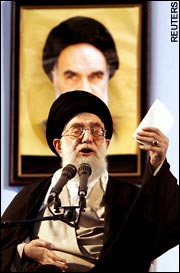
Ayatollah Khameini, that man whose surname has only 1 vowel difference with the late Theocratic Dictator-Imam issued a warning against the USA, basically threatening oil supplies.
WASHINGTON, June 4 — Iran's supreme religious leader warned Sunday that oil shipments from the Persian Gulf would be disrupted if the United States made a "wrong move" toward his country over its nuclear program. But Secretary of State Condoleezza Rice dismissed the threat, saying the United States was awaiting a more formal response to last week's diplomatic initiatives in the matter.

"We're going to give the diplomacy a little time here," Ms. Rice said on the CBS News program "Face the Nation," one of three Sunday talk shows on which she advocated a new package of incentives, and potential Security Council penalties, devised to resolve a crisis over Iran's nuclear ambitions.

"And we're not going to react to everything the Iranian leadership says," Ms. Rice added. "Over the last couple of days, they have said lots of different things."

Earlier Sunday, Iran's supreme leader, Ayatollah Ali Khamenei, said, "If the Americans make a wrong move toward Iran, the shipment of energy will definitely face danger, and the Americans would not be able to protect energy supply in the region."

In a speech on the 17th anniversary of the death of Ayatollah Ruhollah Khomeini, the founder of the Islamic revolution, he said that Iran did not intend to pose a threat to any country but that if it came under attack, it would defend its national security. "If anyone threatens the national interests of the people, it will feel the sharpness of their fury," the official news agency IRNA quoted Ayatollah Khamenei as saying.

The package of incentives to induce Iran to halt its nuclear program and possible penalties if it refuses has not yet been formally delivered to the government in Tehran by a European delegation, and Ms. Rice urged patience. She advocated not responding officially until Iranian leaders had assessed the proposal.

"I don't think we're going to react to everything that's said until they have a chance to see the proposal and until they understand the two paths," she said.

Ms. Rice again acknowledged Iran's right to use nuclear power for civilian needs. She noted that the demand for Iran to freeze enrichment and enrichment-related activities to avert Security Council action had not been dictated by the United States alone, but represented conditions set by the United Nations International Atomic Energy Agency. "No one is questioning that it has a right to civil nuclear power," she said. "But many countries have the right to that that don't enrich and reprocess on their territory. And given Iran's history, it must not have the technologies that could lead to a nuclear weapon." On "Fox News Sunday," she said Iran's own dependence on oil undercut its threat to halt energy supplies to the world. "I think something like 80 percent of Iran's budget comes from oil revenue, and so obviously it would be a very serious problem for Iran if oil were disrupted on the market," she said.

Ms. Rice indicated that Iran had weeks, but not months, to respond to the initiatives, repeating language from negotiations last week in Vienna among Britain, China, France, Germany, Russia and the United States that produced the package of inducements and penalties.

"I don't believe in setting timelines and deadlines, but the only point here is that this can't be endless," she said on the CNN program "Late Edition."

The six-nation proposal, just like the Bush administration's offer on Wednesday to shift longstanding United States policy and sit down at negotiations with Iran as part of multilateral talks, requires Iran to freeze its nuclear enrichment and enrichment-related efforts.

Iran has said it will accept no preconditions.

"The claim that there is international consensus against Iran is a lie," the official IRNA news agency quoted Ayatollah Khamenei as saying on Sunday, adding that members of the Nonaligned Movement "have supported Iran's access to nuclear technology."
Still looking very ugly over there. Speaking of which, those garbs they wear and those grey beards they grow; it's really not a winning look for the 21st Century, is it? All part of the thing that robs Iran of any credibility when they trot out a guy who looks like an extra from Kingdom of Heaven who threatens oil shocks. Not good.

When You're On To A Good Thing
The Socceroos had a good outing. Coach Guus Hiddink, - pronounced roughly as 'Who's Hittink?' has a name that is more appropriate for a baseball team. Guus's on First? Watt's on Second. Heh heh heh. Enough of that.
The Socceroos came from a goal down and survived close to half an hour with 10-men when Luke Wilkshire was sent off in the 61s minute to announce to the world they won't simply be making up the numbers in Germany when the 2006 tournament kicks off on Saturday (AEST).

The home side, roared on by an intimidating orange-clad crowd of 50,000 at Feyenoord's De Kuip Stadium, went ahead early when Manchester United striker Ruud van Nistelrooy capitalised on a Mark Schwarzer error in the 10th minute.

The Middlesbrough keeper parried a shot from Dennis Ooijer straight to the deadly feet of van Nistelrooy inside the box, and the big No.9 calmly side-footed the ball into the bottom right corner of the goal.

It would prove the only blot on Schwarzer's report card, though, as he went on to make a string of superb saves to keep Australia in the hunt.

When substitute Tim Cahill equalised early in the second half, pouncing on a rebound from another Mark Viduka missed penalty, it was Schwarzer the Socceroos could thank for being in a position to be on level terms.

Cahill, who has struggled with a knee injury in the lead-up to the World Cup, showed his rehabilitation is as good as complete when he was first to react as the ball bounced back of Edwin van der Saar's crossbar.

Socceroos coach Guus Hiddink, who took the Dutch to the semi-finals of the 1998 World Cup in France, was delighted with the result for his current team.

"What a great match, with a great physical level that proves our players are ready even if they were tiring at the end," he said.

"Tactically we have come up against one of the best teams in the world and we matched them.

"The progress we have made is amazing in several short months compared to the Australia of six months ago."

In the previous match, the socceroos got their favorite son Harry Kewell back and that was good. meanwhile, Japan seems to be scuffling in their leadup games. Team Captian Hidetoshi Nakata is really pissed off with his team and ragged them after a 1-0 win over low-ranked Malta.
≪中田と一問一答≫ Q&A with Nakata

 ——収穫はあったか? What did the team gain from the expeerience?

 「収穫はないですね。課題はどういうプレーをするか以前に、走らないことにはプレーはできない」"Nothing was gained. Before you think about different approaches, if you don't run it's not soccer."

 ——この試合でやりたいと思ったことは?"What did you wwant to accomplish in this game?"

 「高い位置から早めにプレスをかけて、速いボールを回しでゴールすることを狙っていたが、できなかった」"To apply pressure from a higher position wih swift passes and getting goals but we coulddn't do that."

 ——こうしておけば良かったということは?"Is there anything you wanted to do better?"

 「先ほども言った通り、走れない。ほかのことをやろうという段階ではない」"Like I said before, it's not at the point where we can approach things in any particular way."

 ——前線に速いパスを出しても追いつけていない選手がいたが、それは走っていないからか? "There were some passes made to the front line where players couldn't keep up. was that because they weren't running well?"

 「別にそういうことじゃないと思いますけど」 "Not specifically so."

 ——ロッカールームの中でチームで反省はしたか? "Was there a debrief afterwards."

 「いや別に」"Not as such, no."

 ——これから皆さんで話し合う予定は?"Will you be discussing this?'

 「そういう機会があれば」"If there's such an opportunity."
Not sure I approve. My measuring yardstick on this is "what would Jeter do?" I can't see him ripping his teammates in the papers like that.

East Timor Is Still A Mess
Well, it still is.
Part of the East Timorese capital of Dili again was terrorised by the gangs yesterday, with houses torched while Australian and Malaysian troops patrolled nearby.
Mr Downer, who visited East Timor on the weekend, said he believed the Australia-led troops were making a difference.

"On the whole, I think the army have got the situation under control, but there are outbreaks of violence still and these things are being driven by gangs," he told ABC radio.

"These gangs ... are in some instances, not in all instances, reasonably well coordinated. Just nailing all that down is proving quite difficult at this stage, so there's still a way to go."

Mr Downer rejected suggestions the violence appeared to be getting worse, not better, saying it had declined substantially since the Australian-led force arrived.
It's just not looking good there.

Wrong Code Redux
Many thanks to all the people who popped into listen to my song last week.
Here's an article that may amuse you all in the wake of that song...
England coach Andy Robinson says it's not only the Wallabies' rugby skills his side will need to watch out for, apparently it's their AFL skills as well.

Robinson said players like Lote Tuqiri improved their ability under the high-ball through exposure to the home-grown game.

But an Australian team spokesman confirmed that ex-rugby league player Tuqiri had never played Australian Rules.

"One thing that concerns me is their kicking game," Robinson told the England Rugby Football Union website.

"They used it once in the World Cup final and scored and I expect them to kick for the corners and to kick for the wings.

"A lot of their players like Lote Tuqiri are very good in the air because of their roots in AFL."
A lot fo football confusion going on there.

My Fantasy Team Report
My AFL side took a 2 point loss to the Syddney Scorpions. All I can say it hurt and it hurts to be at 3-3 at this point of the season.

My baseball Combat Wombats chargeed up to second place briefly. That was a highlight, but it's hard to say if this is going to contiue.

2006/06/04

Farmland Produce

That's Melky, Kevin Thompson and Damon...


...And that's Andy Phillips.

March of The 'True Yankees'
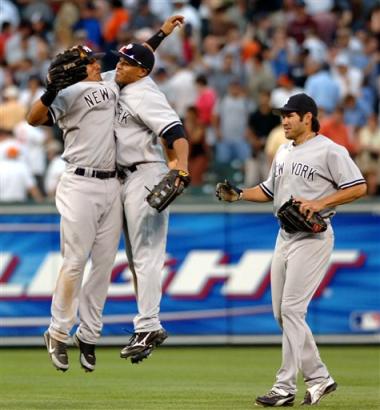
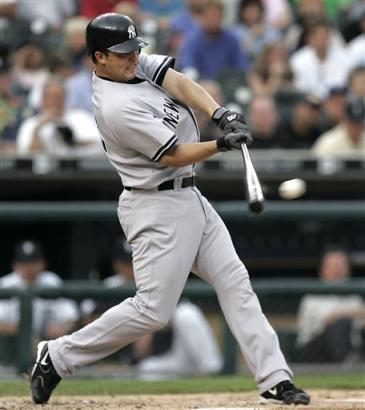
The Yankees edged out the Orioles 6-5 in the 10th with this lineup:

Johnny Damon CF
Melky Cabrera LF
Derek Jeter SS
Jorge Posada C
Bernie Williams DH
Andy Phillips 1B
Robinson Cano 2B
Miguel Cairo 3B
Kevin Thompson RF

That's right. No Juicin G, No A-Rod, No Sheff, No Godzilla. What's even more remarkable isthat apart from Johnny Damon and Miguel Cairo, they are all Yankeee farm produce/graduates. Gets even better when you see who pitched:

Randy Johnson 7.1IP
Scott Proctor 1.2 IP
Mike Myers 0.1 IP
C Wang 0.2 IP

Randy Johnson arrived in a trade that represented a swap of Juan Rivera and Nick Johnson for Javier Vazquez, and then Javier Vazquez and Dionar Navarro for Randy. So even if he's not exactly pitching great, he tenuously represents the outcome of the Yankee farm system (by dint of not being a Free Agency signing). Wang and Proctor are Yankee farm-hands. So it's only the sole out that Mike Myers accounted for that didn't involve the Yankee farm. I don't think I've ever seen a Yankee line-up composed of so many of its farmhands; and it's really cool that they actually won.

It's only due to the long list of injuries that reminds one of Frank Zappa's track "Diseases of the Band":
Hiya folks!

Alright, here’s the deal,
This is our last show here in london
Gee, it’s gonna be tough!
Got a few...a few of the boys are sick tonight
But they’re still gonna...give you their all
I want to introduce you to the members of the rockin’ teen-age
Combo and tell you which ones are sick and what they’ve got

Denny walley on slide and vocals
He has, he has an aluminum finger
And we’re gonna have that removed
A little bit later in this show^lthis is ike willis
Ike has a...now ike, ike is our lead vocalist,
Our dynamic male vocalist
He’s got a soar throat
And all sorts of other things are wrong with him
He’ll never be able to get through this show
The only thing he’s got to take care of is his knitted hat

And of course tommy mars,
Who also has stomach-flu, on keyboards
Do you have any other diseases tommy?
No? he’s available! ok!

Ed mann on percussion
Ed is still healthy
Except, and he told me this backstage,
Except for his mental health
You have to expect these things in this kind of a group

And peter wolf on keyboards
There’s, there...apparently there’s nothing wrong with peter yet

(he’s got stomach-flu too)

You have stomach-flu too?
Ooh, my goodness!
The circle is closing in

Okay, vince colaiuta on drums
Now, as you can see from looking at vince,
There’s absolutely nothing wrong with him

(malnutrition)

Arthur barrow, our bass player has got a ...
He’s having a lotta trouble
He’s been very sick all day
Missed the soundcheck and everything
But he’s gonna try
He’s gonna try really hard

And of course: sophia warren on guitar
Oops. The real list reads like this:

Mariano Rivera Back spasm
Juicin' Giambi: Flu.
A-Rod: Flu.
Hideki Matsui: broken wrist
Gary Sheffield: torn ligament in wrist
Bubba Crosby: strained hamstring
Shawn Chacon: Hematoma, drained surgically to speed up recovery.
Tanyon Strutze: Rotator Cuff injury
Octavio Dotel: Recovering from TJ surgery
Darrell Rasner: Shoulder pain, unidentified
Carl Pavano: inflamed bicep.

Have I missed anybody? Amazingly, with all their injuries, they have won 8 of 10 in the last 10 games. That's right, they've won 8-of-10. and with the Bosox losing to the Tigers, they've stumbled out front to 1st in the AL East with a .611 win %. Smoke and mirrors and farmhands.

Look Who's Back In Town!

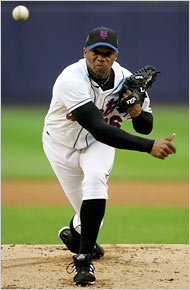
Orlando 'El Duque' Hernandez is back in NYC, but this time with the Mets.
Whatever Hernández's age, yesterday was a throwback enactment of baseball as it was played according to physiological laws that governed the sport in the pre-enhancement years. Before Mark McGwire, Bonds and the other suspects whose performance peaked so fantastically beyond their primes, Father Time could be teased, fooled, never knocked flat.

When the Yankees made Hernández a major leaguer in 1998 after his defection from Cuba, their general manager, Brian Cashman, said: "If he signed with us, he's 28. If he signed with somebody else, he's got wooden teeth." Hernández proceeded to become one of the most entertaining pitchers in the game. He had one of the great postseason runs ever across three championship seasons.

Officially 36, possibly 40, El Duque found himself back in New York yesterday, trying to seize on the opportunity given him by people who in times of need will tend to see what they wish to.

"He still looks the same," Mets Manager Willie Randolph had said before sending Hernández out to face Bonds and his slowing bat for the first time in his career on a rainy afternoon when the wait for baseball seemed as long as it took Bonds to hit his 714th and 715th home runs. "His motion's the same. He's a veteran who knows how to handle himself."

One playoff relief appearance for the White Sox last October was apparently enough to propel the El Duque mystique forward. He escaped a bases-loaded, no-out jam in Game 3 of the American League Division Series in Fenway Park on the night the White Sox put the Red Sox to sleep. Randolph mentioned that yesterday instead of the fact that Hernández hasn't pitched a full season since 2000 and it's anyone's guess when he was in his prime.

All Pedro Martínez could offer on that subject was a remembrance of the El Duque legend spreading from Cuba and reaching the Dominican Republic before there was an Internet to assist in the journey.

"He was one of the most famous Cuban players, him and Omar Linares and Rolando Arrojo, and of course we'd hear a lot about them," Martínez said earlier, as Hernández sat a few feet away, stretching his arms behind his back.
Ah, the wonderful world of International Baseball. El Duque and Pedro are now teammates in Queens.

2006/06/03

10 Years Gone

Then as it was, then again it will be
An' though the course may change sometimes
Rivers always reach the sea
Blind stars of fortune, each have several rays
On the wings of maybe, down in birds of prey
Kind of makes me feel sometimes, didn't have to grow
But as the eagle leaves the nest, it's got so far to go

Changes fill my time, baby, that's alright with me
In the midst I think of you, and how it used to be

Did you ever really need somebody, And really need 'em bad
Did you ever really want somebody, The best love you ever had
Do you ever remember me, baby, did it feel so good
'Cause it was just the first time, And you knew you would

Through the eyes an' I sparkle, Senses growing keen
Taste your love along the way, See your feathers preen
Kind of makes makes me feel sometimes, Didn't have to grow
We are eagles of one nest, The nest is in our soul

Vixen in my dreams, with great surprise to me
Never thought I'd see your face the way it used to be
Oh darlin', oh darlin'

I'm never gonna leave you. I never gonna leave
Holdin' on, ten years gone
Ten years gone, holdin' on, ten years gone
- Led Zeppelin
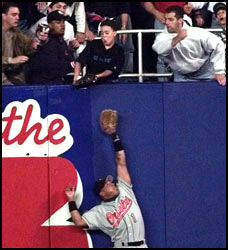
Ten Years Ago, a kid by the name of Jeffrey Maier popped into baseball lore. He flicked Derek Jeter's flyball to the wall, away from the Orioles outfielder Tony Tarsaco. The ball was ruled a homerun and the Yankees went on to win the World Series.


Young Jeffrey is now 22 and is up for the amateur draft, and the Yankees are looking closely.
The Yankees' angel in the outfield has a shot at earning his wings.
In a twist of fate even Hollywood couldn't dream up, the former Little Leaguer who stole a home run for the Bronx Bombers in a 1996 playoff game could be drafted by his heroes.

The Yankees invited Jeffrey Maier to a workout a decade after he reached over the right-field wall and stopped a Baltimore Orioles outfielder from catching a Derek Jeter blast.

"It's been a very exciting week," said Maier, who graduated from Wesleyan University Sunday and was batting, fielding and running bases at the House that Ruth Built on Thursday.

"It was awesome to be there," he said of the invitation-only workout with about 30 other college standouts, observed by Yankee scouts and trainers.

Maier, 22, tried to make it sound like he was just another prospect, although he admitted that when his name was announced, there was a murmur of recognition from the players.

They remembered the infamous moment when Oriole outfielder Tony Tarasco leaped to catch Jeter's long drive in Game 1 of the 1996 American League Championship Series only to have it flicked away by Maier in the bleachers.

The O's squawked about fan interference, but the ump ruled it a home run. The Bronx Bombers went on to win the pennant and the World Series, and Maier became part of Yankee lore.

He played for his high school team in Old Tappan, N.J., and then for Wesleyan, where he broke the hitting record.

Then came the call from the Yankee scout and the trip to the Bronx, where he thought not about his role in Yankee history but about the legends who had been on the field before him.

"You think about the likes of Babe Ruth and Lou Gehrig and Yogi Berra and Reggie Jackson," he said.

Major League Baseball's amateur draft starts Tuesday, and Maier said it would be a dream come true if he were tapped by the franchise.

Yankee officials wouldn't discuss his chances, although one evaluator not affiliated with the team said he's more likely to be an "organizational player" consigned to the minor leagues than a future major leaguer.

But Maier's got at least one big-name fan rooting for him.

"I hope he does get drafted," Jeter said last night.

"It's the least they could do. Pay him back finally. It would seem kind of ironic, wouldn't it?"


As the folks say, you gotta love it. I hope he makes it to the big club. Something tells me he will get there. I don't what that is, but it's the sniff of destiny.

2006/06/02

More Than Two Chances


Listen To What The Man Says
Ronaldhino disagrees with my song.
That's right. He thinks Australia's Socceroos have a shot.
"Even though Australia looks a formidable team and they are our key group rivals, I have to admit that I'm fascinated by them from a purely personal point of view," FIFA's world player of the year told the Herald. "Apart from appointing one of the top four or five coaches in the world, what Australia did when they signed Hiddink was drag world attention onto themselves.

"Anyone with an interest in soccer understands that Hiddink is a magnificent achiever and someone whose names stand for perpetual success. So I think that focused people's attention, all around the world, on how Australia might do in qualifying.

"Then if you take the drama and the romanticism of the win over Uruguay it seems to me that Australia has become an easy team for the neutrals to support. Everyone I speak to seems to have a good word for Australia in a sporting sense and lots of decent judges have identified them as a team which could make a surprising impact in Germany.

"I can't claim to know the first-choice team player by player, yet, but I know about the majority of top players and I'm aware that most of Australia's key men play in leagues scattered all around the world.

"Given the difficulties we in Brazil face with that same problem and travelling to and from qualifying matches or friendlies, I do find it remarkable that a slightly smaller soccer nation like Australia can achieve all that they have done.

"Generally when the players follow their careers in a very wide geographical spread one of the most difficult things to achieve is that 'feeling' between them when they are called together in a squad.

"Yet the evidence is that Hiddink has achieved a unified and winning mentality in his team. That's impressive and it's a little dangerous, too."
Then, he has this to say:
"Literally everywhere he's gone, Valencia, Real Madrid, PSV, Korea, Australia, Hiddink has been a byword for popular, winning football and I respect that," the Brazilian No.10 said.

"Not many coaches get the kind of phone calls he's been getting from FC Barcelona, from Real Madrid, from Roman Abramovich and from the English FA.

"He's in demand because he's a coach who achieves massive success, who has won the Champions League and who took Korea to the brink of the World Cup final four years ago.

"Hiddink is a daring man because he's willing to work all over the world in different circumstances, yet no matter where he goes he applies the same principles.

"His football methods are good, he's a good man-manager and he rarely seems to cause any real rows with his bosses or his players.

"I hope that when we play Australia we can break this habit of his and defeat them but both before and after our game in Munich I'll be watching Hiddink's team with interest to see how they do."
Hard to believe that Brazil's celebrated no.10 thinks Australia are a serious threat.

Michael Moore Sued By Soldier
This came in from the Independent
.
A US military veteran who lost both his arms in the war in Iraq is suing the film-maker Michael Moore for $85m (£46m), claiming that the director incorrectly portrayed him as being against the war in the controversial film Fahrenheit 9/11.

Peter Damon, a National Guardsman from Massachusetts, has filed a lawsuit seeking damages for "loss of reputation, emotional distress, embarrassment, and personal humiliation". The former sergeant says that Moore did not seek his permission to include television footage of him in the 2004 movie.

Mr Damon, 33, lost both his arms when a tyre on a Black Hawk helicopter exploded while he and another reservist were working on it. Another serviceman was killed in the same incident. The National Guardsman was subsequently interviewed for an NBC's Nightline programme about a new painkiller that the military was testing on wounded veterans.
That's kind of what you expect when you editorialise too much to put across your point.
But in even better news today, The Angry Fat Man has been shut down. We rejoice.

2006/06/01

Coming Into His Own

Melky Time Paying Off


Don't look now, but Melky Cabrera's OPS topped .800 as of yesterday. Melky Cabrera went 4-for-5 yesterday with a double and a triple. So the power stroke maybe starting to show. As a result of yesterday's blinder, he is now sitting on .328/.406/.410. in 61 at-bats. He's also drawn 8 walks in the 18 games but is yet to homer.

It's also a good sign that he's starting to hit these doubles. As of May 22 he's had a double every three games and yesterday he slipped in that triple. If he can go the rest of the season hitting like that, I can't think of a manager who wouldn't take him. On top of that, Torre has audaciously started him as lead-off hitter in place of Johnny Damon when Damon has been resting, and that seems to have sparked his hitting.

Still, it's small sample size. We don't know how he'll respond when he hits that inevitable slump. But I think his slump was when he was just hitting singles, adjusting to the league. We'll see. But just I was happy with Cano last year, so far I'm pretty happy with Melky this year.

The other observation to be made based on the recent successes of Cano, Wang and hopefully Cabrera, is that the Yankees systems seem to be getting a lot out of their Latin American and International scouts.

Blog Archive